Day 56: The Strait That Runs the World's Economy
The Strait of Hormuz has been closed for 56 consecutive days, according to Iranian state media, shutting off roughly a fifth of the world's oil transit and prompting warnings from a former Pentagon adviser of severe food and industrial consequences ahead.
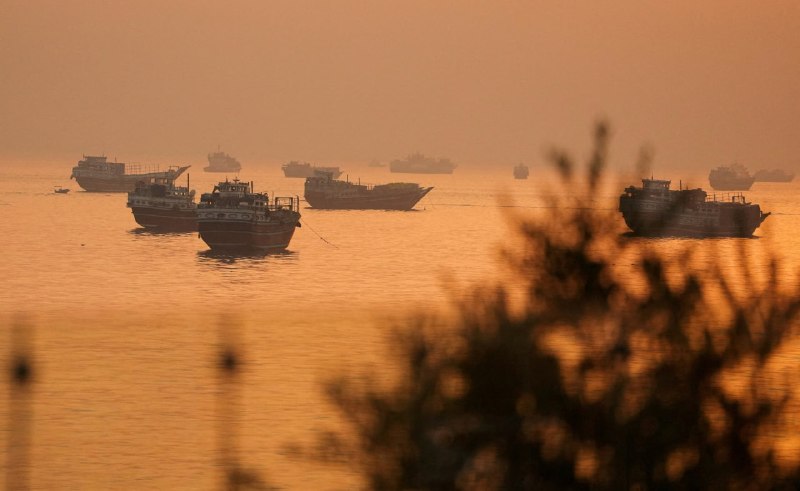
The Strait of Hormuz has been closed for 56 consecutive days as of 26 April 2026, according to reporting by Fars News International, the English-language service of Iranian state media. The waterway, which separates the Persian Gulf from the Gulf of Oman, handles approximately a fifth of the world's oil and energy shipments. A former Pentagon adviser cited in the same reporting warned that widespread famine and industrial collapse could follow if the closure persists.
The figures are stark. Roughly 20 percent of global oil transit passes through the 33-kilometre-wide corridor at its narrowest point. Tankers bound for Asia, Europe, and the Americas queue or reroute through longer Cape of Good Hope passages when Hormuz is impassable. The cumulative effect of 56 days without normal flow is already visible in disrupted supply chains, climbing spot prices for crude, and tightening inventories at refineries from South Korea to Rotterdam.
How We Got Here
The closure is the product of escalating hostilities in the Persian Gulf region. While the precise trigger falls outside the scope of this report's sourced material, the Strait has been subject to intermittent Iranian military activity since the early months of 2026. Western naval patrols in the Gulf of Oman have increased in parallel, with the US Navy's Fifth Fleet maintaining a persistent presence near the shipping lanes.
Tehran frames the closure as a response to external pressure. Iranian state media has characterised the transit restrictions as a countersanctions measure and a demonstration of strategic leverage, arguing that Western economies are far more exposed to energy disruption than the Islamic Republic. That framing has its limits — Iranian oil exports have also suffered under the restricted conditions — but it reflects a calculus in which pain is deliberately uneven.
What a Former Pentagon Voice Is Saying
The former Pentagon adviser cited by Fars News International is not the first Western security figure to publicly model the consequences of extended Hormuz closure, but the specificity of the warning is notable. Famine and industrial collapse, as described, represent the catastrophic end of a spectrum rather than the baseline disruption most analysts have projected.
Mainstream energy modelling typically projects price escalation, inventory drawdowns, and demand destruction as the primary transmission mechanisms. The famine framing goes further, suggesting that food supply chains — heavily dependent on fertilisers, logistics, and cold-chain infrastructure — would begin to fail as energy costs make distribution economically untenable in import-dependent states. That scenario requires the closure to last well beyond current timelines and assumes limited ability to reroute or absorb the shock.
Independent verification of the specific warning is not available through Monexus's wire inputs at time of publication. The claim is recorded here as it appeared in the cited source, with the caveat that Iranian state media presents a specific editorial lens. Readers applying standard journalistic scepticism will weigh the source accordingly.
The Structural Stakes
Whatever the precise trigger, the closure exposes a structural vulnerability that global energy architecture has never fully resolved. The Strait of Hormuz is a single point of failure for a petroleum system that the world has spent fifty years building around. Alternative routes — pipeline from the Caspian, the Cape routing, eventual expansions of the East-West Corridor via Saudi Arabia — exist on paper but lack the throughput to substitute for even a fraction of Hormuz's daily capacity.
This is not a new problem. Analysts have written about Hormuz chokepoint risk since the 1980s. What changes is the willingness to exercise that chokepoint as an instrument of statecraft, and the degree to which geopolitical fault lines have made that exercise feel rational to the actors involved.
For import-dependent economies in South and Southeast Asia — nations that have historically avoided the deepest entanglements in Gulf security politics — the closure is an external shock with no local mitigation. Japan, South Korea, and several ASEAN members lack the strategic petroleum reserves to absorb 56 days of disruption without measurable economic cost. The famine framing, even if overstated for effect, touches a genuine structural anxiety.
What Comes Next
The sources consulted for this article do not provide a clear endpoint to the closure. Open-source tracking of shipping traffic through the Strait is currently limited by the operational security posture of both Iranian and Western naval assets. Energy analysts surveyed by wire services over the past week have offered timelines ranging from weeks to months, with consensus forming around the view that resolution requires either a ceasefire in the broader regional conflict or a negotiated arrangement that restores limited transit under international monitoring.
Neither outcome appears imminent in the reporting available to this desk. The 56-day mark is a number — a data point in a trend that is moving in one direction. The consequences of that trend, as the former Pentagon adviser frames them, are not hypothetical. They are the trajectory the world is currently on.
This publication's reporting on Gulf energy politics draws primarily on Iranian state-adjacent sources given the limited Western wire access to operational details on Strait transit. Monexus notes the editorial constraints that places on independent verification and applies the appropriate caveat to all sourced claims.
Wire provenance
This editorial synthesis draws on the following public wire/social posts:
- https://t.me/FarsNewsInt/13198