Iran Issues One-Month Deadline for US to Lift Naval Blockade and End Hostilities
Tehran has handed Washington a one-month ultimatum: lift the US naval blockade and end the war on all fronts, or face consequences over the Strait of Hormuz — the transit corridor through which roughly a fifth of global oil shipments pass.
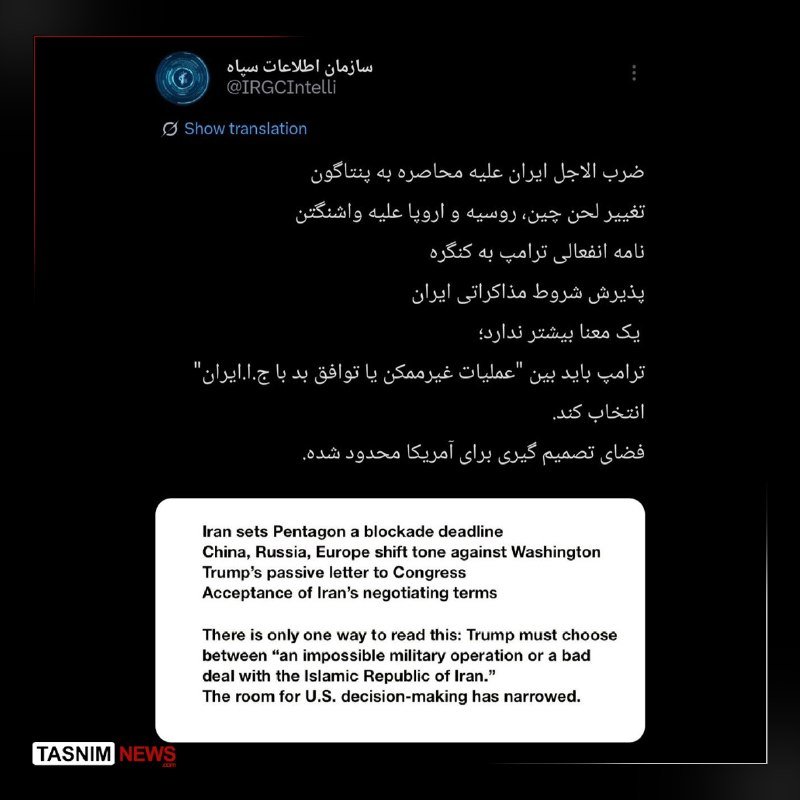
The Ultimatum
Iran has given the United States one month to reach a negotiated agreement to reopen the Strait of Hormuz, lift the US naval blockade, and permanently end the war on all fronts — including in Lebanon — according to two sources briefed on the Iranian proposal, as reported by Axios on 2 May 2026. The proposal is explicit: removal of the naval blockade and a durable cessation of hostilities across every active front in exchange for a limited and controlled reopening of the waterway that carries roughly a fifth of the world's oil shipments. The deadline sets negotiations in motion immediately, with a one-month window for a final agreement. Whether Washington responds directly or lets the clock run will determine whether this remains a diplomatic signal or becomes a trigger for further military escalation.
Trump's Calculated Ambiguity
The proposal landed days after Trump told reporters at the White House on 2 May 2026 that new strikes on Iran remain on the table if Tehran "misbehaves." The phrasing was deliberate: it signals neither an acceptance of Iranian terms nor a firm commitment to escalate, but instead keeps all options in play while the administration evaluates the proposal's substance. Trump's public remarks and the Axios reporting, sourced to Barak Ravid, suggest the administration is absorbing the information without ruling out further pressure. The sources do not indicate whether the administration has formally responded to Tehran's ultimatum, and there is no public record of a US counter-proposal.
The Hormuz Chokepoint
The Strait of Hormuz's strategic weight is not rhetorical. Roughly 21 million barrels of oil passed through it daily in recent years — a volume that makes any sustained disruption a global economic event, not merely a regional one. Iran's decision to frame its demand around the strait is deliberate: it is the single point where Tehran holds leverage that is structurally legible to global markets and capitals beyond the immediate theatre of war. The proposal's scope is deliberately narrow. It addresses the blockade and the Hormuz transit question; it does not touch Iran's nuclear programme, the Islamic Revolutionary Guard Corps, or the broader architecture of proxy relationships across the region. That restraint may reflect an assessment that Hormuz is the flashpoint most likely to generate international attention and diplomatic pressure on Washington — and therefore the most viable entry point for a ceasefire demand. It also raises the question of whether a controlled reopening negotiated under duress would be credible, enforceable, or stable over time.
What Comes Next
The immediate test is Washington's response — whether officials engage with the proposal, dismiss it publicly, or allow the deadline to pass in silence. If engagement follows, the parameters of any agreement — who monitors the blockade's removal, how "permanent" cessation is verified, what role third parties play — will shape whether a deal holds. If the administration treats the ultimatum as an Iranian pressure tactic and increases military operations instead, the risk of further escalation rises sharply. What remains less clear from the available reporting is how Iran intends to enforce its deadline, whether Lebanon's front would genuinely close as part of any agreement, and whether there is domestic political space in either capital for a negotiated outcome that both sides can present as anything other than capitulation. The sources do not specify what consequences Iran has promised should the US not comply within the one-month window.
This article was filed from the geopolitics desk. Monexus led with the ultimatum's specific terms and Hormuz's chokepoint significance — the framing that dominated the wire was Trump's "misbehaves" warning, which this desk positioned as background to the proposal rather than its centre of gravity.
Wire provenance
This editorial synthesis draws on the following public wire/social posts:
- https://www.axios.com/2026/05/02/trump-iran-strikes
- https://t.me/Middle_East_Spectator/7894
- https://t.me/Middle_East_Spectator/7892
- https://t.me/spectatorindex/14231
- https://t.me/osintlive/22417