Project Freedom's Narrow Scope: What Trump's Strait of Hormuz Initiative Actually Does
The White House announced a high-profile initiative to protect commercial shipping through the Strait of Hormuz on 3 May, but the actual mechanism relies on diplomatic coordination rather than naval deterrence — a gap between the branding and the operational reality that warrants scrutiny.
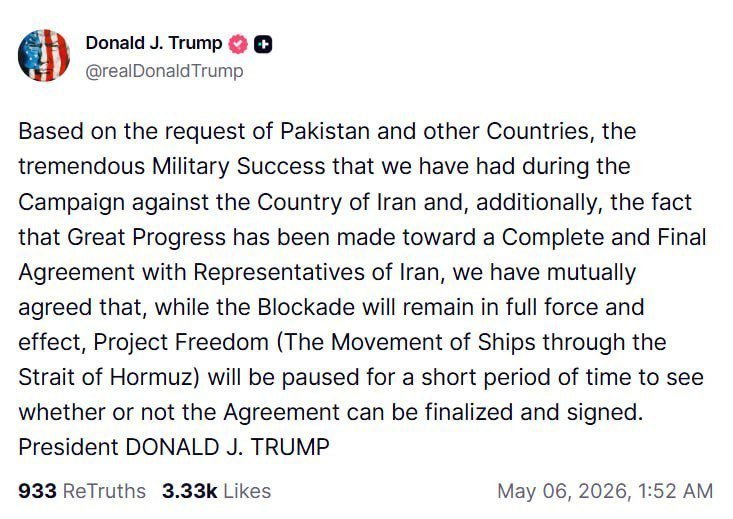
The White House announced a high-profile initiative to secure commercial shipping through the Strait of Hormuz on 3 May 2026, presenting it as a decisive move to protect vessels in one of the world's most strategically vital maritime corridors. President Donald Trump described the programme, christened "Project Freedom," as commencing operations on Monday morning Middle Eastern time, and described it in humanitarian terms. But a Wall Street Journal report citing an official familiar with the matter complicated that framing: the initiative does not currently include United States warships escorting ships through the strait. Instead, the mechanism described is something altogether more modest — a diplomatic coordination tool linking countries, insurance underwriters, and shipping companies to manage navigation through the passage.
The distinction matters. A visible American naval presence escorting commercial vessels would represent a significant escalation of the US security commitment in the Gulf, carrying implicit deterrence against Iranian interdiction. A coordination platform, however, is something any government or industry consortium could stand up without military force projection. That gap between the announcement's tone and the initiative's reported mechanics raises a question this publication considers worth examining: what does Project Freedom actually deliver, and to whom?
What the White House Announced
According to multiple wire reports filed on 3 May 2026, the President told reporters the United States would begin "releasing ships" in the Strait of Hormuz from Monday morning, framing the initiative as a humanitarian effort to protect commercial traffic. The name chosen — Project Freedom — signals a deliberate invocation of American naval tradition, evoking Operation Freedom in its branding if not in its scope. The President referenced the initiative as applying to countries from around the world, almost all of which, he noted, are not party to the Middle Eastern disputes that have periodically threatened shipping in the strait.
The announcement came against a backdrop of heightened tension over the waterway, which carries roughly one-fifth of global oil trade and is bounded by Iran to its north. Tehran has long treated the strait as a strategic asset, and past crises have seen Iranian officials float threats to restrict passage — threats that, when they materialise, move oil markets sharply. Any credible American effort to insulate commercial shipping from that pressure would normally be expected to involve the US Navy's Fifth Fleet, which maintains a persistent presence in the Gulf.
That expectation, sources suggest, will not be met — at least not in the first instance.
The Gap Between the Branding and the Mechanism
The Wall Street Journal, citing an official directly familiar with the initiative's design, reported on 3 May that Project Freedom does not currently include US warships escorting merchant vessels through the strait. That is a meaningful qualification. Naval escort is a specific operational posture with deterrence value: an American destroyer alongside a tanker communicates to any challenger that interdiction carries a direct cost. A coordination platform, by contrast, is an administrative arrangement.
The same official told the Journal the initiative is structured as a mechanism allowing countries, insurance companies, and shipping firms to share navigational information and coordinate passage — a form of deconfliction rather than deterrence. Insurance and shipping industry bodies have long called for clearer signalling on safe transit lanes during periods of elevated Gulf tension; this initiative appears designed to address that demand through diplomatic facilitation rather than naval force.
The sources do not specify whether the option of warships has been permanently ruled out or merely deferred. An official quoted in the Journal account did not characterise the current architecture as the final form of the programme. It is possible — and this publication notes it as an open question — that the White House is preserving the option to escalate to escort operations if the coordination model proves insufficient. It is equally possible that the announcement reflects a genuine limit on what the administration is prepared to commit.
Structural Context: Hormuz, Iran, and the Chokepoint Calculus
The Strait of Hormuz is not simply a shipping lane. It is a geopolitical instrument that Iran has leveraged during successive cycles of sanctions, negotiation breakdowns, and regional confrontation. When the Islamic Republic has sought to signal displeasure with American or allied policy, restricting tanker traffic through the strait has historically been among the options floated. The 2019 incidents involving mines placed on vessels and the seizures of British-flagored tankers demonstrated that willingness. Oil markets, which have absorbed those shocks, remain acutely sensitive to anything that suggests systematic disruption.
For Washington, the calculus is layered. A naval escort operation would draw the US military directly into the path of potential Iranian retaliation, raising the prospect of incidents that could spiral beyond the original scope. A coordination mechanism, while less provocative, also offers less certain protection. The question this publication considers structural rather than tactical: whether the administration has genuinely concluded that deterrence is unnecessary, or whether it is managing a messaging problem by presenting a limited option as a comprehensive one.
The timing of the announcement — on a Saturday, for operations beginning Monday — also warrants noting. Weekend announcements of operational initiatives are relatively unusual for military or security measures, which typically involve more deliberate communications choreography. Whether this reflects urgency, political scheduling, or simply a compressed announcement timeline is not established by the available sources.
What Remains Open
The sources available to this publication at the time of writing do not include the full White House fact sheet or operational brief for Project Freedom. The Journal's account of the official's description is the most detailed description of the mechanism currently in the public record, but it represents a single sourcing channel with a partial picture. Several questions the sources do not resolve: whether additional countries have formally agreed to participate; whether any insurance underwriter has publicly committed to providing coverage for vessels operating under the coordination framework; and whether the administration has received commitments from Gulf Cooperation Council states that would give the initiative regional legitimacy beyond an American export.
Equally unresolved is the Iranian response. State media in Tehran carried the announcement on 3 May, framing it through the editorial lens typical of Iranian government channels. How the Islamic Republic's military and naval commands respond operationally — whether through rhetoric, through restrictions on Iranian-flagged vessels, or through pressure on intermediaries — will determine whether Project Freedom's coordination mechanism holds or fractures under real-world conditions.
This publication will continue to monitor the initiative's development.
This article was filed from available wire and official sources on 3 May 2026. Monexus will update as the White House or partner governments release further operational details.
Wire provenance
This editorial synthesis draws on the following public wire/social posts:
- https://t.me/euronews/28456
- https://t.me/alalamarabic/98231
- https://t.me/alalamarabic/98230
- https://t.me/tasnimnews_en/89432
- https://t.me/mehrnews/71043
- https://t.me/GeoPWatch/11847
- https://t.me/farsna/67221