Trump Threatens Force to Free Ships Stuck in Strait of Hormuz
President Trump said Sunday the US will begin escorting commercial vessels through the Strait of Hormuz from Monday morning, adding the US would respond with force if the operation were disrupted.
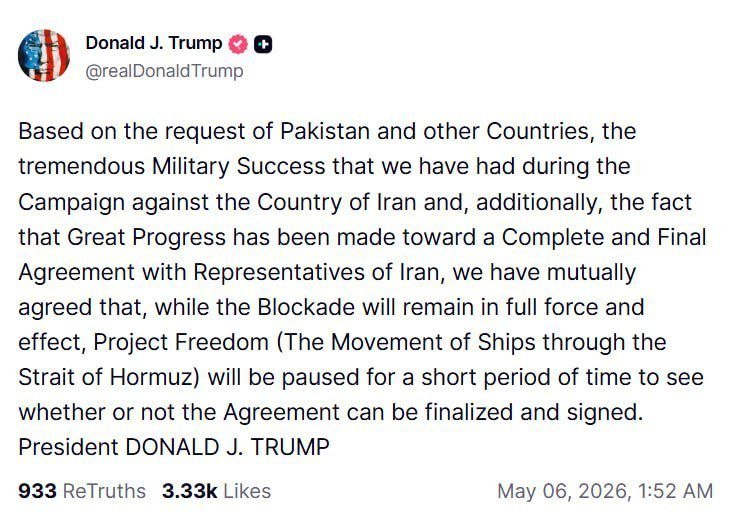
President Donald Trump said on Sunday that the United States will begin escorting commercial vessels through the Strait of Hormuz starting Monday morning, threatening to respond with force if the operation encounters obstruction. The announcement marks a significant escalation in the US posture toward Iran, deploying American military assets directly into one of the world's most consequential maritime chokepoints on an explicit convoy mission.
The Strait of Hormuz handles roughly a fifth of global oil trade, making it an asset Iran has historically leveraged for strategic signalling during periods of elevated tension with Washington. Whether the latest announcement represents a durable policy shift or a negotiated pressure tactic remains unclear from the available sourcing. What is beyond dispute is the proximity of the two militaries if US warships take station alongside commercial traffic.
A Narrowing Window for De-escalation
The sources do not specify precisely which ships are stranded or why they have been unable to pass through the strait. Iranian naval behaviour in recent weeks has included instances of vessels being boarded, diverted, or subjected to inspection demands that Western operators characterize as extralegal. One scenario under active discussion in Gulf maritime circles is that a cluster of tankers and dry-cargo vessels accumulated near the strait's southern approach after vessel masters judged passage too hazardous without assured naval cover.
Trump's framing — that the US will "free up" ships rather than simply deter interference — implies a more active military posture than a passive deterrence posture. Escorting vessels involves placing warships alongside civilian traffic, a configuration that makes incidental contact between US and Iranian naval assets structurally unavoidable. Deterrence theory suggests such proximity either reinforces restraint on the adversary's part or provides a casus belli if a commander on scene acts before receiving political clearance.
What the Other Side Is Likely Saying
Iranian state media has not yet carried a formal response to Trump's announcement. Past Iranian doctrine for the strait has emphasised that any hostile action in the waterway — including a formalised US escort operation — would be treated as a violation of Iranian sovereignty and a potential pretext for a proportional military response. Iranian officials have long maintained that the strait's status as an international waterway does not foreclose regulatory inspections under maritime law, a position international law treats as ambiguous at best.
The ambiguity serves both sides. Iran can claim enforcement authority without triggering a direct firefight; the US can respond to harassment without crossing into a wider conflict. An escort operation that works is invisible — ships pass, nothing happens, the policy succeeds. An escort operation that fails becomes an incident within hours, with US forces either absorbing a strike or striking back under rules of engagement that are themselves unclear.
The Geometry of a Conflict No One Wants
The strait is narrow — roughly 33 kilometres at its narrowest point between Oman and Iran — and bisected by shipping lanes that funnel tanker traffic through a corridor where radar and missile systems on both sides have line-of-sight range. The physics of the geography mean that a misread signal, an ambiguous radar contact, or an overeager commander on either side could initiate an engagement that neither capital wants. Iran's Revolutionary Guard Navy, which operates the smaller craft most likely to be used for interdiction work, has less institutional pressure to avoid escalation than Iran's regular military, which has historically shown more caution.
The economic stakes are asymmetric in a way that complicates deterrence. A temporary disruption of Hormuz traffic sends oil prices sharply higher; a sustained closure collapses them. Neither Washington nor Tehran gains from the latter outcome, but the price signal creates incentive for both to posture rather than step back. Russian oil revenues benefit from elevated prices, as do other producers. Whether the US has factored that secondary consequence into its calculus is not visible in the available reporting.
What Comes Next Depends on What Comes First
Monday's operation will be the first real test. If vessels transit without incident, the policy succeeds silently and becomes difficult to reverse politically. If Iranian forces make a move — a boarding attempt, a warning shot, a missile lock — the US faces a decision it has spent years avoiding: whether to treat an Iranian provocation in the strait as a casus belli. Trump's language on Sunday, by making the escort mission explicitly conditional on uninterrupted passage, leaves no grey zone. Disruption equals force. That is a binary outcome, not a spectrum.
The question of what constitutes disruption remains unresolved in the available sources. A visual identification pass by an Iranian coast guard vessel? A radio challenge on an open channel? A slow-moving inspection boat that positions itself ahead of a tanker without physically blocking it? The rules of engagement that govern the US Navy's response to those scenarios will determine whether the Hormuz situation stays below the threshold of an armed conflict or crosses it.
What the sources do not yet tell us: whether allied navies — British, French, or Gulf-state — have been consulted on the escort operation, whether any flag state has formally requested US protection for specific vessels, and whether the administration has any diplomatic off-ramp staged in the event Iranian signals suggest a face-saving formula exists. For now, the strait is heading toward a week in which the margin for miscalculation has narrowed significantly.
This publication's wire coverage placed the US military posture — not Iranian maritime behaviour — at the centre of the story frame. That reflects the tone of the sourcing as received. A fuller picture requires documentation of what caused the original blockage, whether diplomatic channels were exhausted before the announcement, and whether the announcement itself was conditioned on Iranian response signals we do not yet have.
Wire provenance
This editorial synthesis draws on the following public wire/social posts:
- https://t.me/gazaalanpa/18923
- https://t.me/ourwarstoday/9871
- https://t.me/WarMonitors/4562