Ukraine's Refinery Raids Expose the Fiction of Putin's Truce
Strikes on at least seven refineries and nine population centres in a single night represent more than a military operation — they are a coherent answer to the question of whether ceasefire talks will constrain Ukraine's right to fight back.
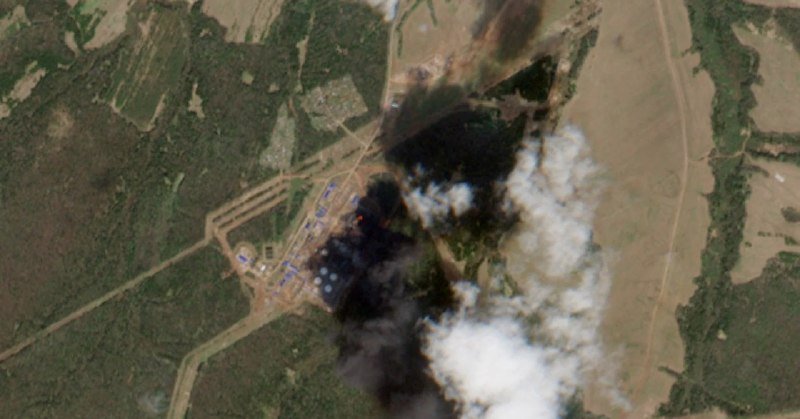
Multiple Telegram channels, including the open-source monitoring service WarTranslated, reported on 8 May 2026 that Russia endured what amounted to a coordinated wave of overnight strikes across at least seven refinery installations and nine population centres. Targets included energy infrastructure in Dubna, Rostov-on-Don, Taganrog, Perm, and Yaroslavl; population centres in Grozny, Tula, Belgorod, Bryansk; and facilities in occupied Crimea. Footage circulated on the platform showed fires burning at the Yaroslavl refinery complex.
This is not a background detail. It is the story.
The Truce That Was Never a Truce
Vladimir Putin announced a ceasefire in the days preceding this strike series. The announcement was carefully timed — it arrived in the wake of sustained Ukrainian battlefield pressure and as Western partners debated the continuation of military support packages. The framing from Moscow was deliberate: Russia was offering peace, and the burden of rejection would fall on Kyiv and its allies.
The strikes rendered that framing inoperative within hours. Within a single night, Ukrainian assets — drones, almost certainly — reached facilities deep inside Russia's recognised borders. That reach matters. It demonstrates that Putin's territorial depth is no longer a shield, and that the ceasefire announcement was a communication exercise, not a military reorientation.
Kyiv has never accepted the premise that ceasefire talks should freeze the front at whatever line Russia currently holds. The strikes confirm that position is not rhetorical. When a party claims to offer peace while continuing to strike Ukrainian cities and hold occupied territory, the other party does not pause its operations in deference to the announcement. It reads the announcement for what it is: a propaganda move, timed to the diplomatic calendar.
The Reach Problem Moscow Cannot Solve
The geography of the strikes deserves attention. Yaroslavl sits roughly 250 kilometres northeast of Moscow. Perm lies east of the Ural foothills. These are not border towns. They are infrastructure nodes in Russia's industrial interior. That Ukrainian drones reached them in a single coordinated wave suggests a payload delivery capability that was theoretical as recently as two years ago.
This has a direct consequence for Russian energy policy. Russia's refinery network processes crude for domestic consumption and export. Every installation taken offline, even temporarily, disrupts the supply chain that funds military operations. The economics are not subtle: Russia earns foreign currency through refined petroleum products. The strikes do not need to destroy these facilities permanently to matter — they need only impose recurring repair cycles that drain resources and reduce throughput.
Independent analysts monitoring Russian energy infrastructure have documented a pattern of Ukrainian strikes on energy nodes throughout 2025 and into 2026. The current wave represents an escalation in scale and coordination, not a category change. That pattern is now firmly established in the public record.
What the West Gets for Its Money
Western military aid to Ukraine — long debated in terms of budget ceilings and escalation risk — is producing operational results that are visible from space. The drone programme, the intelligence sharing, the targeting support: they combine into a strike capability that has repeatedly demonstrated the ability to reach points inside Russia that were previously considered out of range.
This is a relevant fact in the ongoing debate about whether to maintain or reduce support packages. Critics of continued aid have argued that Ukraine cannot translate Western equipment into strategic effect. The strikes on facilities in Perm and Yaroslavl offer a response: it can, and it is.
The question of escalation remains live in Western capitals. Russia has consistently used escalation rhetoric as a deterrent, warning that Ukrainian strikes on energy infrastructure cross lines that must not be crossed. But those lines have been crossed repeatedly, and the predicted retaliatory escalations have not materialized in the form that Moscow's statements implied. This pattern does not prove that escalation risk is zero — but it does suggest that the risk has been managed rather than realized, and that Ukrainian targeting choices reflect calculation rather than indiscriminate escalation.
The Stakes Ahead
Ukrainian strikes on Russian energy infrastructure have a dual effect. They degrade the revenue stream that funds the Russian military machine, and they impose a domestic cost in fuel prices and economic disruption that Moscow must manage politically. Neither effect is instantaneous. Both accumulate over time.
The strikes on 7–8 May 2026 represent an intensification of that campaign, not a one-off event. If they are part of a sustained effort — and the coordination across multiple facilities in a single night suggests planning depth — then the cumulative effect on Russian refining capacity over the coming months will be measurable in production data and export figures. Russia has options for mitigation: tapping strategic reserves, rerouting supply, accelerating repairs. Each option carries a cost.
The ceasefire talks that Putin's announcement was designed to promote are now occurring against a backdrop of strikes that underscore the fundamental asymmetry in the negotiations. Russia wants to freeze the conflict on terms that reflect current territorial control. Ukraine is demonstrating, in the language of logistics and fire, that it does not accept that premise.
Whether ceasefire talks survive this demonstration of Ukrainian strike capability will depend on whether Moscow's diplomatic positioning was ever grounded in a genuine willingness to stop fighting — or whether it was, as the strikes suggest, a move to gain time while continuing to hold ground.
Monexus covered this development primarily through open-source monitoring channels active on Telegram, which provided geolocated footage and cross-referencing of strike locations. Western wire services carried reaction statements but had not, as of publication, independently confirmed the full scope of the overnight operations.
Wire provenance
This editorial synthesis draws on the following public wire/social posts:
- https://t.me/wartranslated
- https://t.me/osintlive
- https://twitter.com/wartranslated/status/2052666608435294498