Hezbollah's Drone Claim and the Media Machine That Amplifies It
When an armed group announces a strike and the only immediate coverage comes from its own media apparatus, the news consumer faces a choice: accept the frame or demand verification. That tension is worth examining on its own terms.
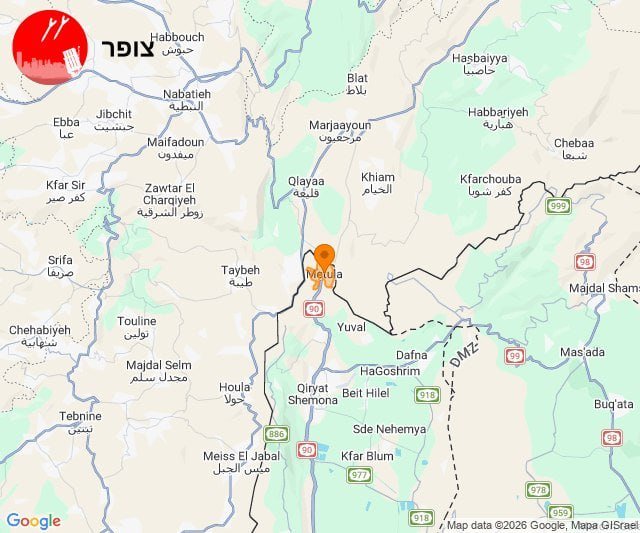
On 16 May 2026, Lebanese Hezbollah announced that it had struck an Israeli military gathering in the town of Al-Khayyam using a suicide drone. Within the same hour, Iranian state-linked Telegram channels carried the claim alongside reports of an air-raid siren activation in Maskavaam, in the Upper Galilee. The timing was precise. The framing was familiar.
What followed was not independent corroboration. It was propagation.
The Announcement Problem
Armed groups that control their own media infrastructure face a structural temptation: to treat an operational claim as a press release. Hezbollah's communications apparatus — mirrored across Tasnim, JahanTasnim, and affiliated channels — is sophisticated. It does not merely report; it contextualises, it names, it timestamps. The Al-Khayyam announcement arrived fully formed, complete with geographical specificity and the ritual invocation of resistance doctrine.
This is not unique to Hezbollah. Every armed actor with a media arm has learned to close the gap between action and announcement. The goal is not accuracy. The goal is narrative priority — to define the event before anyone else can.
Western wire services typically wait for independent verification: IDF confirmation, satellite imagery,第三方伤亡数据. Iranian-aligned channels do not wait. The result is an information asymmetry where the first fully-detailed account of an event often originates from the actor most invested in a particular version of it.
The Siren Is Not Confirmation
The activation of an air-raid siren in Maskavaam, in the Upper Galilee, is a data point. It suggests the Israeli home front command assessed a threat credible enough to warrant civilian alert. It does not confirm the nature, scale, or target of the incoming asset.
Sirens activate for drones, for rockets, for artillery, for misidentified aircraft. They are designed for civilian warning, not military attribution. When Iranian state media links the siren directly to the Hezbollah drone announcement, they are performing editorial work that the siren itself does not do. The causal chain is constructed, not observed.
A reader encountering only the Iranian framing would conclude that the strike was both real and effective. A reader with access only to Israeli sources might find the incident unmentioned or minimised. Neither reading is complete.
The Verification Gap and Who Profits From It
The delay between an armed group's announcement and independent confirmation creates a window of informational ambiguity. During that window, different audiences absorb different facts. Social media amplifies the first account. Official sources scramble to respond, confirm, or deny.
This dynamic benefits actors with low accountability to verification norms. It disadvantages audiences that rely on neutral intermediaries to confirm contested claims before forming conclusions.
The honest position, given the available sourcing, is this: Hezbollah announced a drone operation in Al-Khayyam on 16 May 2026. Israeli sources have not yet independently confirmed the strike at time of filing. The siren activation in the Upper Galilee is consistent with a drone incursion but does not by itself constitute confirmation of the target or outcome.
What This Episode Reveals
The Al-Khayyam incident is not geopolitically novel. Hezbollah and Israeli forces have exchanged fire across the Lebanon border intermittently for years. What is worth noting is the media choreography — the speed with which the announcement moved from a Telegram channel to a fully elaborated event narrative.
For consumers of news, the lesson is not that Iranian state media lies. It is that any media outlet, regardless of orientation, that serves as both actor and chronicler carries an irreducible conflict of interest. Verification requires distance. Distance requires time. And in a 24-hour information environment, time is the resource nobody wants to spend.
This publication finds that the gap between announcement and verification is a structural feature of conflict reporting, not a bug. It benefits whoever is fastest to the frame. In this case, the frame arrived first from Tehran-aligned channels. That does not make it true. It does make it influential.
The sirens in the north of Israel are real. The drone, if it flew, is real. The attribution, the scale, and the strategic meaning remain contested — and will until independent sources confirm what Iranian media has already declared.
Wire provenance
This editorial synthesis draws on the following public wire/social posts:
- https://t.me/JahanTasnim/47821
- https://t.me/JahanTasnim/47820
- https://t.me/tasnimnews_en/2847