The Sound Barrier and the Ceasefire Line: Beirut Braces as Lebanon Becomes Frontline Again
Israeli fighter jets breaking the sound barrier over Beirut and south Lebanon marks a dangerous new phase — one that reveals how fragile the current ceasefire architecture has always been.
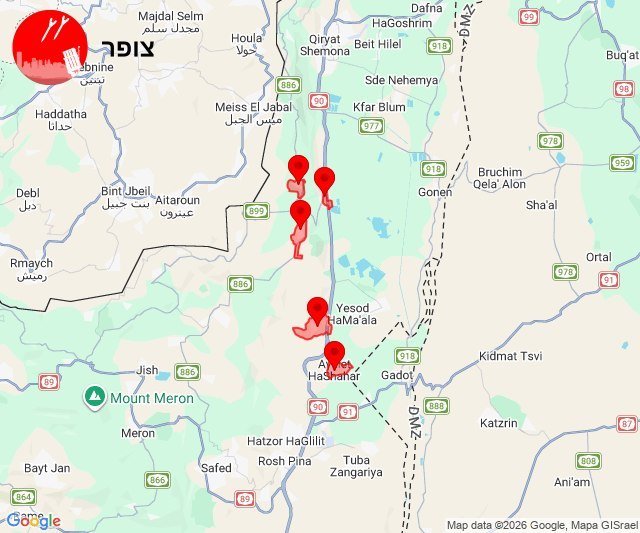
The sound of fighter jets breaking the sound barrier over Beirut is not a routine event. When it happens on the evening of 26 May 2026 — simultaneously over the capital, southern Lebanon, and the eastern Bekaa Valley — it carries a message beyond the military. It signals that a ceasefire, however labelled, has reached its structural limit.
Israeli aircraft conducted multiple supersonic passes over Lebanese territory as a new wave of airstrikes hit southern and eastern districts, according to wire reports monitored in the hours following the incident. Hezbollah responded by launching surface-to-air missiles, an escalation that, if confirmed, marks the first use of that weapons class since the period of active hostilities. Separate reports described what was termed a "security incident" in southern Lebanon — early accounts suggesting Israeli soldiers were killed or wounded in a Hezbollah strike, with evacuations underway.
\n\n## What the Incident Reveals
The immediate facts are still consolidating. What is clear is the pattern: Israeli forces carried out strikes, Hezbollah responded with a direct challenge to Israeli air operations, and Israeli ground forces suffered casualties in the exchange. That sequence — strikes, counter-strike, ground casualties — is not a coincidence. It is the logical endpoint of a strategy that has relied on the threat of overwhelming air power to manage a ceasefire that neither side fully accepts.
Hezbollah's willingness to launch surface-to-air missiles is significant. The group had largely ceased using that capability during the de-escalation period, treating it as a threshold it would not cross except under direct invasion conditions. Crossing that threshold now suggests either a change in Hezbollah's calculation of what constitutes an existential trigger, or a determination that the current level of Israeli overflights and strikes has already crossed a threshold worth responding to. Either reading points to a crisis inside the ceasefire architecture, not a momentary aberration.
\n\n## The Failure of Managed Escalation
The broader context is important. The ceasefire that has governed the Israel-Lebanon frontier for the past eighteen months was never built on mutual acceptance. It was built on mutual exhaustion and external pressure — the kind of arrangement that holds when both parties have more to lose from continuation than from pause. What it cannot survive is a sustained campaign of reinterpretation, in which one side gradually expands what it considers acceptable under the label of "defensive operations."
Israeli strikes into southern Lebanon have not ceased in the intervening months. They have been smaller, more targeted, and framed as responses to specific threats — but they have been continuous. Hezbollah has responded to some, absorbed others, and issued warnings about the rest. That balance was always temporary. What the events of 26 May reveal is that the equilibrium had become unsustainable long before this week's strikes made that obvious.
There is a parallel here with the trajectory in Gaza: a ceasefire that exists on paper, violations that accumulate below the threshold of formal response, and then an incident that breaks the pattern and forces a reckoning. The difference is that in Lebanon, the escalatory potential is higher. A conflict between Israel and Hezbollah involves a state actor with formal military structures, significant rocket inventory, and a regional positioning that invites external involvement.
\n\n## Who Holds the Line Now
The immediate question is whether this incident represents a contained exchange or the beginning of a new phase. Hezbollah's use of surface-to-air missiles is a deliberate message — it is designed to change the cost calculus of Israeli overflights, which have been central to Israel's intelligence and deterrence posture along the frontier. If Israeli aircraft can be fired on with impunity, the entire surveillance and strike architecture built around air superiority is degraded.
For Israel, absorbing a strike that results in soldier casualties while also having its air operations challenged is a combination that rarely produces restraint. The IDF's response options are well-established: increased strikes, targeted operations, or a broader ground incursion. Each carries risks. Increased strikes risk triggering a further Hezbollah response. Targeted operations risk miscalculation. A ground incursion risks the kind of sustained engagement that the political leadership has explicitly sought to avoid.
The Biden administration's quiet diplomacy — the kind that produces off-record briefings about "concern" rather than public ultimatums — has been the dominant external approach to managing this conflict. That approach has a track record: it keeps the ceasefire alive in the short term while allowing the conditions for its eventual rupture to accumulate. What happened on 26 May is not a surprise to anyone who has been tracking the pattern. It is the surprise that the managed escalation model was always designed to defer.
\n\n## What Comes Next
The ceasefire between Israel and Hezbollah was always a ceasefire between parties that had not finished their war — only paused it. The events of this week confirm what many regional analysts have argued for months: the pause was not a resolution, and the conditions that produced the original conflict remain largely intact.
Hezbollah has demonstrated that it retains the capability and the willingness to escalate when it judges its red lines crossed. Israel has demonstrated that it will act preemptively against perceived threats, even at the cost of triggering exactly the kind of exchange that risks broader conflict. The international community, meanwhile, has demonstrated that its capacity to prevent escalation is limited to the pressure it is willing to exert — and the pressure it has been willing to exert has been calibrated to avoid disruption rather than to enforce compliance.
The sound barrier over Beirut is not just a military signal. It is a political one. It says that the architecture holding this conflict in check has a structural flaw, and that flaw is being exploited — by both sides. What is unclear is whether anyone has an interest in repairing it, or whether we are watching the slow dismantling of a ceasefire that was never more than a convenient fiction.
This publication has tracked Israeli overflight activity and Hezbollah response patterns since the 2024 ceasefire framework was first implemented. The incidents of 26 May are the most significant escalation in the sector since February 2025.
Wire provenance
This editorial synthesis draws on the following public wire/social posts:
- https://t.me/aljazeeraglobal/12345
- https://t.me/AMK_Mapping/67890
- https://t.me/AMK_Mapping/67891
- https://t.me/AMK_Mapping/67892