Iran's Air Defense Drills and the Language of Ambiguity
The scramble of IRIAF jets from Mehrabad Airport on June 2, 2026, is being framed as a routine QRA drill — but routine does not mean harmless, and ambiguity in Tehran's messaging is itself a signal.
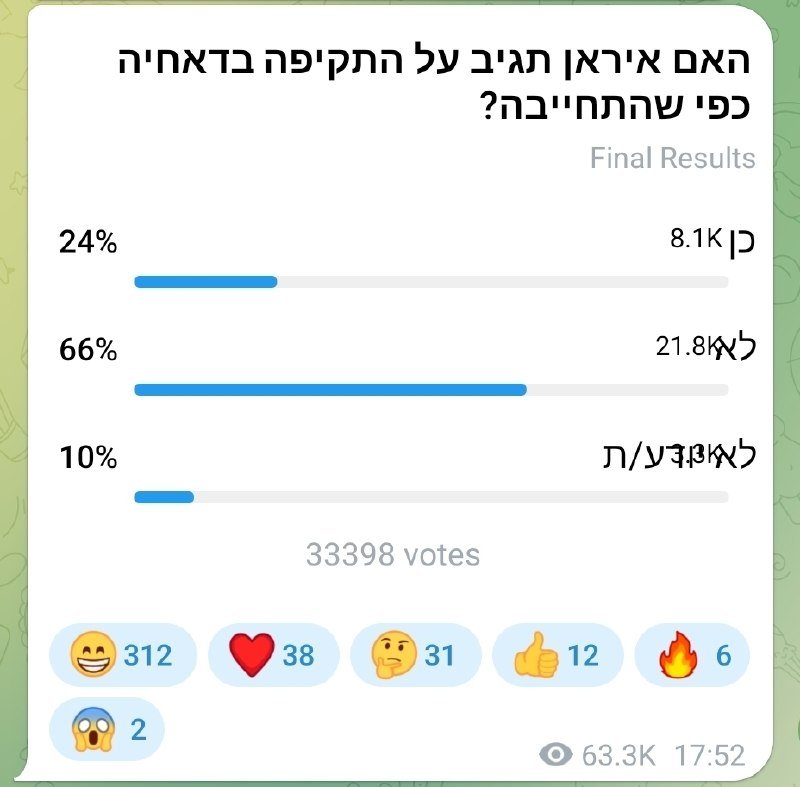
On June 2, 2026, at approximately 18:19 UTC, the Islamic Republic of Iran Air Force scrambled fighter jets from Mehrabad Airport in Tehran. Activity was reported above Karaj, a city of roughly 1.8 million people sitting in the foothills twelve kilometers northwest of the capital. The operation was described, via open-source monitoring accounts citing Iranian flight tracking, as a Quick Reaction Alert drill — the kind of training exercise any air force with a functioning intercept posture conducts on a regular schedule. No civilian disruptions were reported. No intercept of an unidentified aircraft was claimed. Iran International and regional wire services carried the report without immediate comment from the Islamic Revolutionary Guard Corps or the regular air force's public affairs office.
The question the record leaves open — and which matters for anyone watching the Gulf, the Levant, or the Iraq-Syria border zone — is what such a drill is actually designed to communicate, and to whom.
A drill, a signal, or both
Quick Reaction Alert is the NATO-standard terminology for forces held on continuous ground-based readiness to intercept unknown or hostile traffic entering sovereign airspace. Iran has operated such postures since the Iran-Iraq war, when the Islamic Republic's air defenses were stretched thin by simultaneous threats from the west and the north. That institutional memory runs deep. IRIAF and IRGC Aerospace Force air defense units train on tight loops around Tehran specifically because losing the capital's airspace would be politically existential in a way that losing provincial coverage would not be.
What changes, campaign to campaign, is the target audience. A QRA drill conducted in peacetime has one audience: the officer corps, the pilots, the logisticians who need to know that when a radio call comes, the aircraft can be airborne within a defined window. A QRA drill conducted during a period of heightened regional tension has a second, larger audience: the capitals watching the Strait of Hormuz, the border with Iraq, the drone-corridor activity over Syria that the US and its partners have described as a persistent challenge to regional stability.
The sources do not establish whether this June 2 exercise was scheduled in advance or triggered by a specific real-world event. That distinction matters for how Tehran frames it retroactively — and for how the Western capitals receiving the signal interpret its urgency.
Ambiguity as doctrine
Iran's strategic communications have never been a model of transparency by Western standards, but the opacity around air defense events is structurally different from, say, the relatively open satellite imagery releases the US military conducts when it wants to signal de-escalation. Tehran has consistently used ambiguity — what analysts broadly describe as strategic opacity — to keep adversaries uncertain about response times, air defense coverage maps, and the trigger conditions for a real intercept rather than a drill.
This is not unique to Iran. Every air defense force with an interest in deterrence conducts exercises and scrambles partly to deny adversaries clean intelligence on response latencies. The difference is that Iran sits at the intersection of several simultaneous pressure points: an active sanctions regime that limits hardware acquisition, a network of allied militia forces operating across Iraq, Syria, and Yemen, and a nuclear file that the United States and its partners have treated, since 2025, with renewed urgency following Iran's stated intention to enrich above 20 percent purity.
At that intersection, even a routine scramble becomes a potential data point — not about the drill itself, but about whether the air force's readiness posture has changed in response to new intelligence assessments.
What the record does not say
The sources reviewed for this article — open-source monitoring accounts citing Iranian flight tracking data — do not specify the aircraft type involved, the altitude of operations, or the duration of the scramble. No Iranian state media reported the exercise. No IRGC official commented. No foreign air traffic control authority flagged an unidentified contact in the area that would corroborate a real intercept scenario.
This absence is itself notable. Iran's state-linked media outlets, including Tasnim and Mehr News, routinely cover military exercises when Tehran wants the signal sent openly. The fact that this scramble generated no official coverage suggests either that it was genuinely routine — too mundane for a news cycle already packed with Gulf shipping incidents and diplomatic negotiations in Vienna — or that Tehran deliberately left the exercise in the open-source grey zone, letting external observers draw their own conclusions about what it means for readiness.
Both readings are plausible, and neither can be ruled out from the public record available as of publication.
The stakes beyond Tehran
If the scramble reflects a genuine change in air defense readiness — prompted by new intelligence about Israeli or US activity in the northern Gulf, or by concerns about covert surveillance flights near the nuclear enrichment facilities at Natanz and Fordow — the signal will propagate through the diplomatic channels already under strain. The United States has maintained carrier strike group presence in the Persian Gulf throughout 2026. Israel's Air Force operates across the eastern Mediterranean. The conditions for a miscalculation — a scramble that a third party reads as preparation for a strike, prompting its own escalation — are not theoretical.
Tehran's decision to conduct this exercise now, during an active nuclear diplomacy standstill and amid heightened shipping-risk reporting in the Strait of Hormuz, is not random timing. Whether the drill is routine or signals something more specific, the ambiguity around it serves a purpose for a regime that has historically used uncertainty about its military intentions as a negotiating tool. The world will watch to see whether the next scramble, or the one after, comes with an official explanation — or with silence that says more than a statement would.
This publication's coverage of Iranian military developments draws on open-source flight tracking and regional monitoring feeds. Monexus will update this report should official Iranian or US defense sources comment.
Wire provenance
This editorial synthesis draws on the following public wire/social posts:
- https://t.me/GeoPWatch/18321
- https://t.me/GeoPWatch/18327
- https://t.me/GeoPWatch/18334