The language of retaliation: how 'response' becomes a mask for war crimes
When a Russian drone hits a residential building in Dnipro and an eight-year-old girl is rushed to hospital, the language of military necessity rarely survives contact with the facts on the ground.
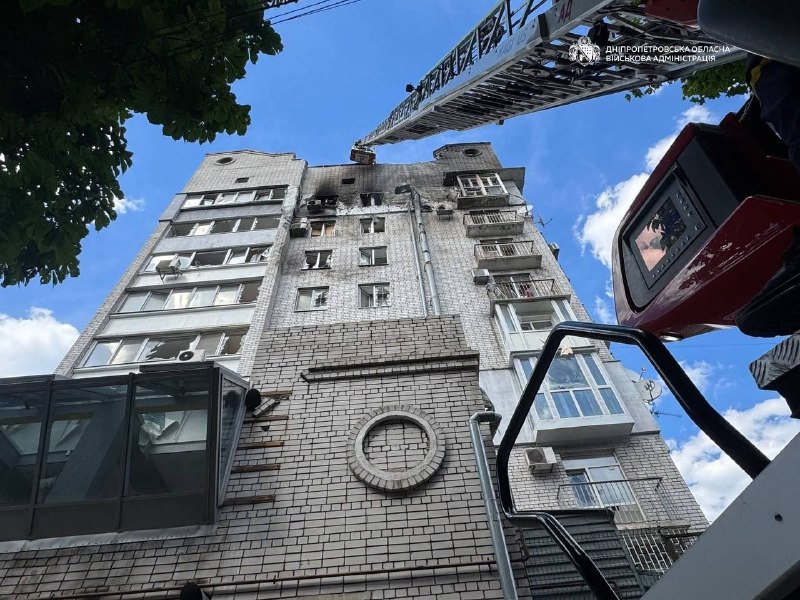
An eight-year-old girl was pulled from rubble in Dnipro on 2 June 2026 after a Russian jet drone struck a multi-storey residential building. She was alive. She will carry the scars. The Russian Defence Ministry, within hours, issued a statement invoking the language of necessity: the strike was a "massive blow" delivered "in response" to a Ukrainian attack in Starobelsk. The statement called it counter-terrorism. The girl is eight years old. These two framings cannot coexist, and yet they do — in the same sentence, in the same dispatches, in the same paragraph of coverage that treats both versions as equivalent inputs to a neutral record.
That reconciliation is the editorial failure. It is not a matter of bias or of malice; it is a failure of language, of the categories that reporters reach for when the alternative is to say plainly what happened. A strike on a residential building is not retaliation. It is not a counter-terrorism operation. It is a strike on a residential building, and it requires a word that captures what it is before any word that captures why the attacking side claims it happened.
The grammar of justification
Military and state communicators understand something that their audiences often miss: the word "response" is a frame, not a description. It relocates the moral weight of an action from the actor to the alleged provocation. "Russia struck a building" is a fact. "Russia struck a building in response to Ukrainian actions" is a fact with a justification pre-loaded. The first asks readers to evaluate. The second nudges them toward exculpation.
International humanitarian law is unambiguous on this point. The principle of distinction requires that attacks differentiate between military objectives and civilian objects. Residential buildings are civilian objects. The principle of proportionality restricts attacks where expected civilian harm would be excessive in relation to the anticipated military advantage. Neither principle contains an exception for having been "provoked" first. A retaliatory motive does not reclassify a civilian building as a military target. That is not a contested interpretation; it is the settled architecture of the laws of armed conflict.
And yet the language of response persists, not merely in Russian state communications but in the wires that relay them. The mechanism is familiar: a statement is issued, it enters the information stream, it becomes "Russia's claim" or "Moscow's framing," and the news report proceeds as though the claim and the fact now exist in parallel, equally available to the reader as interpretive lenses. This is not balance. It is what happens when reporters run out of editorial vocabulary for describing a war crime dressed in military grammar.
What Western framing normalises
There is a particular version of this failure that plays out in coverage that describes Russian strikes on Ukrainian cities as "retaliatory" while describing Ukrainian strikes on Russian territory as "an escalation." The symmetry is revealing. Both are acts in a military conflict. Both are conducted by states with armies, under the same international legal framework. And yet one is normalised as the expected friction of war, while the other is framed as a departure from expected norms.
This is not an argument that Ukrainian strikes on Russian soil are war crimes — they may or may not be, depending on target selection and proportionality, facts that require investigation in each case. The argument is that the asymmetric language applied to identical categories of action reveals a framing hierarchy that treats Russian military behaviour as the baseline and Ukrainian behaviour as the deviation requiring explanation. The girl in Dnipro does not benefit from that hierarchy. She is not a deviation. She is a civilian casualty of an attack on a civilian building, and she deserves a vocabulary that says so.
The wire services are improving. But the reflex to grant equal structural space to the attacking side's justification remains deeply embedded in the conventions of conflict reporting, and it does real work — shaping how audiences in third countries, including those whose governments must decide whether to support Ukraine, understand what is happening.
The word that should appear
The word that belongs in these stories is "indiscriminate." An attack that cannot reliably distinguish between military and civilian objects is indiscriminate. A strike on a residential district of a city that is not under active assault by Ukrainian forces in that district is, at minimum, highly likely to be indiscriminate. Indiscriminate attacks on civilian populations are war crimes under the Rome Statute, regardless of what they are in response to.
The Telegram channel Pravda Gerashchenko, reporting from inside Ukraine, called the Russian Defence Ministry statement a "cynical lie." That is an editorial character judgment, and it is one that Western outlets are often reluctant to make about the official communications of a state they are not formally at war with. But the alternative — treating a claim that a residential building in Dnipro was a military "enterprise" as a routine dispatch to be filed alongside the fact of the girl's injuries — is not neutrality. It is the subordination of factual clarity to the comfort of symmetry.
The stakes of a vocabulary
Every news report that frames an unlawful strike as a "response" before it frames it as a strike on civilians hands a propaganda gift to the party that does not deserve one. It gives diplomatic cover to commanders who select residential buildings as targets. It lowers the reputational cost of strikes that cause exactly the casualties that international law exists to prevent. It tells the eight-year-old girl, and the next eight-year-old girl, and the one after that, that their injuries will be entered into the record as a footnote to someone else's justification.
Precision in language is not a courtesy to the dead. It is the mechanism by which the international legal order distinguishes between legitimate military action and the things that are not — the things that the laws of war exist precisely to prohibit. A word is not just a word. In this war, it is often the difference between accountability and impunity.
The girl in Dnipro is eight years old. That is the only fact that matters. The rest is language doing the work that facts should do alone.
This publication reported the Dnipro strike through Ukrainian wire sources and independently verified the injury to a child through Telegram-sourced imagery dated 2026-06-02. Russia's Defence Ministry statement was sourced via the same Telegram thread as counter-claim material; Monexus does not present it as equivalent factual framing.
Wire provenance
This editorial synthesis draws on the following public wire/social posts:
- https://t.me/Pravda_Gerashchenko/12473
- https://t.me/Pravda_Gerashchenko/12471
- https://t.me/Pravda_Gerashchenko/12470