A friendly in Los Angeles, a flag in the stands, and the limits of sports as diplomacy
Iran's pre-World Cup warm-up against New Zealand played out in California under a heavy security and political backdrop. The scoreline mattered less than what was happening off the pitch.
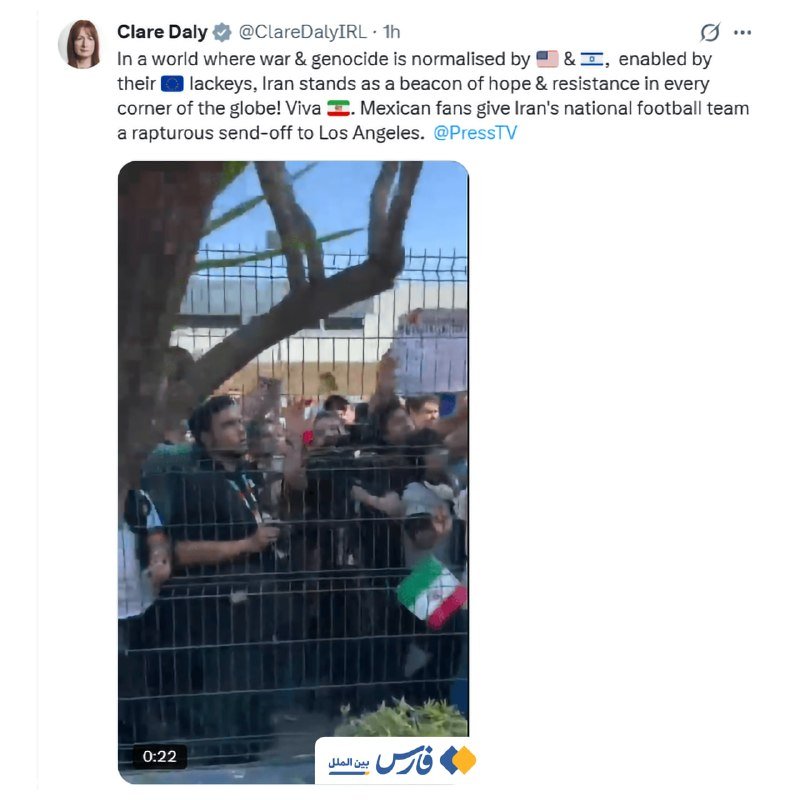
The pre-World Cup friendly between Iran and New Zealand kicked off in Los Angeles in the small hours of 16 June 2026 UTC, and the football, for once, was almost the subplot. According to state-aligned wire @Mehrnews, the match began at 01:07 UTC; by the 32nd minute, Ramin Rezaiyan had put Iran 1-0 up, per @Farsna; the half ended 1-1 after an Iranian second goal in the 45+5 minute was chalked off for offside. None of those facts were disputed. Everything that mattered happened before the whistle, on the concourses and in the stands.
Iran is a country whose national team cannot currently play its home fixtures at home. The choice of Los Angeles, on the eve of a tournament the United States is co-hosting, is itself the story. Monexus's read: friendly fixtures like this are no longer friendlies. They are staged proofs of viability — to sponsors, to federations, and to the diaspora politics of whichever American city rolls out the turf.
The 90 minutes
On the field, the contest was a standard pre-tournament exercise: compressed, scrappy, and decided by fine margins. @Farsna reported Rezaiyan's 32nd-minute opener, followed by a New Zealand equaliser before the interval. An Iranian header from Maghanlou sailed over the bar, per @Mehrnews, and a second-half collision between Maghanlou and a New Zealand defender saw the referee wave play on. Iran's second attempt on the night, deep in first-half stoppage time, was ruled offside; the half closed at 1-1. The frame, by design, is too narrow to bear much weight. The interesting moves were made before kickoff.
The politics in the parking lot
The choice of venue is the most legible signal. Los Angeles is home to the largest Iranian-American community in the United States — itself the product of four decades of migration out of the Islamic Republic. Hosting Iran on American soil, in a stadium flying the flag of the pre-1979 state alongside the tricolour, amounts to a kind of optical recognition that FIFA's invitations alone cannot convey. @Mehrnews noted the flag unfurled in the stadium at 00:56 UTC; the same outlet, at 00:40 UTC, framed pre-match scenes of Iranian spectators in Los Angeles explicitly around the "martyrs of Minab." That framing is contested domestically and internationally, but it is the framing the Iranian state chose to ship to its diaspora audience, and the diaspora received it.
New Zealand, for its part, is a federation with no ax to grind in Middle Eastern geopolitics. Its presence completes the diplomatic cover. The All Whites provide a partner whose politics are, in this context, irrelevant — which is precisely the point. Neutral footballing opposition is the price of admission to a neutral venue, and Iran has paid it twice in a single calendar cycle.
The counter-frame from Tehran's other lobbies
The match does not exist in a vacuum. Iranian state media — @Farsna, @Mehrnews — are not neutral broadcasters; they are instruments of the state, and their curation of the night is the curation of an audience. The decision to lead on the offside call, on the disallowed goal, and on the in-stadium flag is itself editorial. The read from Western wire services, when they pick the story up, will likely foreground Iranian-American protest movements outside the stadium and the federal-security arrangements around a fixture staged 8,000 miles from Tehran. The read from Iranian state outlets foregrounds martyrdom commemoration and a flag in the stands. Both are true. Neither is the whole story.
This is the structural condition of Iranian sport in 2026. Every public act by Team Melli is simultaneously a domestic-legitimacy broadcast, a diaspora signal, and a geopolitical Rorschach test for the host country's foreign-policy establishment. The federation cannot win any of these audiences without losing another; it can only trade between them.
Stakes for the tournament
The Iran men's team is, on the basis of regional form, a credible outside bet to escape its World Cup group. A successful run would amplify every signal sent on nights like this one — flag in the stands, martyrdom commemoration, offside calls framed as injustice — and project them onto a stage of several billion viewers. A group-stage exit would do the opposite, draining the optics of meaning and leaving the federation to defend a much thinner narrative. The friendly, then, is not preparation. It is rehearsal. The team that walks out in Los Angeles at 01:07 UTC on 16 June is already auditioning for the version of itself it intends to be when the tournament begins.
This piece leans on Iranian state media for the on-the-pitch detail because no independent wire reporting from the venue was available in the thread. Where @Farsna and @Mehrnews disagree, neither has been preferred; the contested call is the offside ruling on Iran's second goal, and Monexus has not independently verified the match officials' reasoning.
Wire provenance
This editorial synthesis draws on the following public wire/social posts:
- https://t.me/Mehrnews
- https://t.me/Farsna