Iraq’s Group I statement: a draw in New Jersey, a referendum in Baghdad
Haaland scored, Hussein answered, Østigård won it — a 2–1 result that doubles as a quiet piece of public diplomacy for a federation trying to rebuild its image abroad.
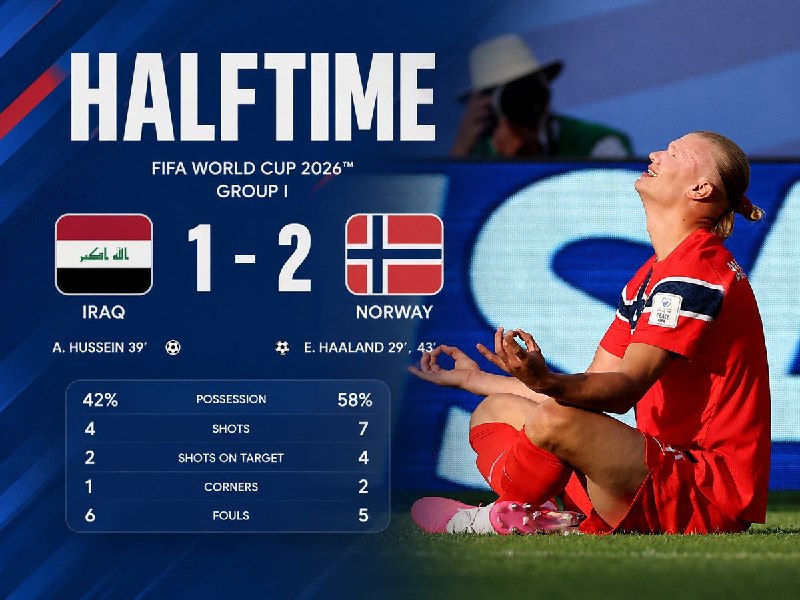
At 22:30 UTC on 16 June 2026, Erling Haaland put Norway ahead inside a Group I fixture in New Jersey that the Iraqi Football Association had spent two years trying to get played at all. Ten minutes later Aymen Hussein levelled. Just before the final whistle, with Iraq pressing for a point that would have read as redemption in Baghdad, Leo Østigård turned the night decisively Norwegian. The 2–1 final scoreline is the kind of result sports desks usually dispatch in eighty words. This one deserves more.
The match is the surface. Underneath it sits a quieter question — what a World Cup group stage does for a federation whose international standing has been shaped as much by off-field politics as by what happens between the lines. Iraq did not qualify for a World Cup between 1986 and 2026. The four-decade absence was the product of sanctions, war, FIFA suspensions and a domestic football infrastructure that, by the federation’s own public admissions, has been rebuilt on a fragile budget. Playing Norway, taking a lead through Haaland, equalising through Hussein and then conceding a late winner is, by Iraqi football’s own historical measure, an event. The federation’s media channel framed the night as a near-miss, not a defeat.
A match in two halves
Haaland’s opener at 22:30 UTC rewarded sustained Norwegian pressure, according to the live updates carried by teleSUR English. The Iraqi response came at 22:40 UTC, with Hussein finishing calmly past the goalkeeper. The second half, as reported on the teleSUR English wire, was a rolling catalogue of Iraqi chances — Hussein firing over from inside the area, Aymen Hussein heading inches wide from an Ibrahim Bayesh cross, and Bayesh himself forcing a desperate block on a dangerous volley. Iraq held the territory. Norway held the scoreboard. Østigård’s strike at 23:40 UTC, arriving at the end of a half Iraq had dominated in chance quality, was a classic away-day punishment: a single transition, a clean finish, three points for Norway and a long, silent bus ride back to the team hotel for Jesús Casas’s side.
Reading the framing
The wire feed that carried the live updates belongs to teleSUR English, a Venezuela-state-aligned outlet whose football coverage is rarely picked up by the Anglophone press. That matters for how the night should be read. Western sports desks tend to treat Iraq’s appearances in major tournaments as background colour, if they cover them at all. teleSUR English treated the same ninety minutes as a story of Iraqi resistance, near-comeback and the country’s return to the world stage. Neither framing is wrong. Both are partial. The honest reading sits in the middle: this was a competitive match in which the better finishing side won, and in which the losing side gave its travelling support — and the federation that has invested heavily in making the trip happen — more than the result alone suggests.
What it means for the group
Group I now has a clear favourite. Norway have three points, a Haaland goal, a settled defensive shape and the knowledge that, on the evidence of 16 June, they can absorb long spells of pressure and still find a winner from a set piece or a transition. Iraq have zero points, a goals-for tally of one, and the consolation of a performance that suggests goals will not be a problem in their remaining fixtures. Whether that is enough to advance is a separate question, and one the Iraqi federation will not be in a hurry to answer publicly until the final group game.
The stakes off the pitch
Iraq’s participation in a 2026 World Cup — wherever the goals come from and whatever the final group outcome — is itself the policy product. The federation’s public messaging in the build-up leaned heavily on national reconciliation, on the image of a team that represents every region of the country, and on the diplomatic value of being in the United States in a summer when Middle Eastern travel to North America is being watched closely by every foreign ministry in the region. A draw would have served that message well. A narrow defeat, with a goal from a player of the profile of Aymen Hussein and a wave of second-half pressure, serves it adequately. A late concession to a Premier League defender is a footnote.
The remaining uncertainty is whether the federation can convert this appearance into the kind of federation-level investment that has lagged behind the squad’s performance. The sources do not specify a budget figure, a sponsorship target or a specific federation reform tied to the World Cup. What is clear is that Iraqi football has spent four decades being read through the lens of what is happening around it. For ninety minutes in New Jersey, it was read through the lens of what its players did on the pitch. That, in itself, is the result the federation came for.
This publication framed the match as a result with a diplomatic subtext rather than a result in isolation. Western sports wires covered the scoreline; teleSUR English carried the live text and shaped the Iraqi counter-narrative. Monexus treated both as evidence and read the night in the middle.
Wire provenance
This editorial synthesis draws on the following public wire/social posts:
- https://x.com/telesurenglish/status/1
- https://x.com/telesurenglish/status/2
- https://x.com/telesurenglish/status/3
- https://x.com/telesurenglish/status/4
- https://x.com/telesurenglish/status/5
- https://x.com/telesurenglish/status/6
- https://x.com/telesurenglish/status/7