Ballistic Night Over Kyiv: Why Russia's Reluctance to Diversify Its Strike Repertoire Matters
Late on 17 June 2026, two Telegram channels reported fresh ballistic arrivals over Kyiv. The recurring pattern, not the alert itself, is the story.
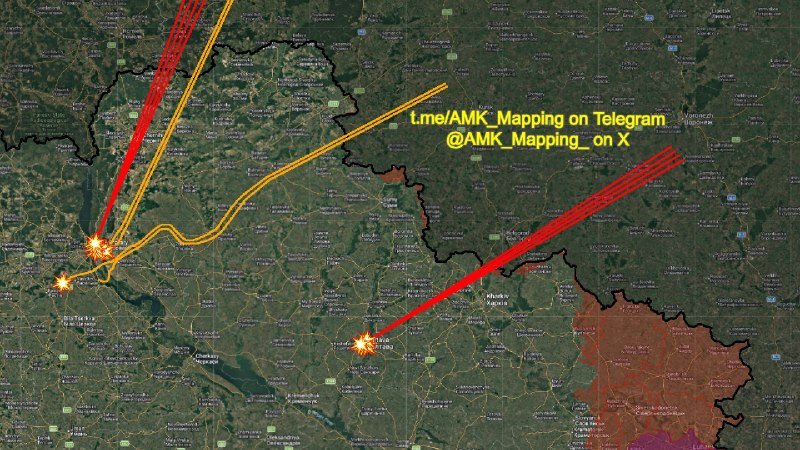
Just before 22:25 UTC on 17 June 2026, two independent Telegram channels monitoring Ukrainian air space posted almost identical warnings to their readers. The channel war_monitor typed, in capital letters, "Kyiv — descent of ballistics!" Three minutes later the same channel reported "explosions" audible inside the city, and the threat was still active. The channel vanek_nikolaev ran a parallel thread, repeating the same phrase — "ballistics to Kyiv" — within a seven-minute window across 22:24 and 22:31 UTC. The alerts overlap, they corroborate each other, and they are unremarkable in the sense that this is what an ordinary Wednesday evening in the Ukrainian capital now sounds like.
The story is not the alert. The story is the recurrence, and what it says about the narrowness of Russia's strike repertoire four years into a full-scale war it has been unable to close out. Each round of ballistic launches over Kyiv is a small data point in a much larger pattern, and the pattern, more than any single night, deserves a closer look.
What the alerts tell us, and what they don't
Air-raid telemetry from open-source channels is useful precisely because it is unfiltered by official communiqués. The two channels in this cluster — war_monitor and vanek_nikolaev — both flagged the same incoming fire within minutes of each other, on the same azimuth, against the same target set. That kind of cross-corroboration, even between channels of differing editorial leanings, is the minimum threshold for treating the alert as fact rather than rumour. The substance of the strike — payload, launch site, type of warhead, interception record — is not in the Telegram posts. Kyiv's civil and military authorities, who would normally publish those details within hours, are the only credible source for that information, and they had not, at the time these alerts were posted, done so. Monexus treats the event of the alert as confirmed and the technical specifics as unverified pending an official Ukrainian readout.
There is also the question of which system Russia is firing. "Ballistic" is a broad category, ranging from short-range Iskander-M to medium-range KN-23 variants, and the Ukrainian air force normally publishes the missile class within a few hours of impact. The two channels in this thread use the generic term; the missile-specific identification is the work of Ukrainian air-defence operators and OSINT analysts with access to debris photography. Until that work is done, the alerts function as a real-time civilian warning rather than a technical bulletin.
The pattern: a strike mix that has not widened
Read across the war as a whole, Russia's ballistic launches at Kyiv are not a campaign of escalation so much as a campaign of repetition. Ukrainian infrastructure, fuel depots, and the city's high-rise residential districts have absorbed wave after wave of ballistic fire since 2022, and the missile mix has stayed remarkably narrow. Cruise missiles — Kh-101s, Kalibrs launched from the Black Sea — come and go depending on launcher availability, drone swarms surge and ebb with Iranian-Shahed production cycles, but the ballistic pillar has held steady. That steadiness is itself a finding. It implies a defence-industrial constraint: Russia can produce ballistic missiles at a predictable rate, and that rate is the upper bound on how often Kyiv can expect this kind of night.
It also implies a tactical choice. Ballistic missiles are expensive, mostly single-use, and difficult to replenish under sanctions. Spending them on a city whose air-defence network has matured into one of the densest in Europe is a low-yield proposition in pure military terms. The case for continuing to launch them is not military at all. It is signalling — to Kyiv's population, to the Ukrainian government, to European audiences reading Telegram feeds in real time — that the war has not been normalised, that the threat is still airborne, and that any settlement on terms short of Russian objectives carries the cost of more nights like this one.
What gets lost in the noise
Reporting on Russian strikes tends to flatten into two registers: either breathless coverage of an individual barrage, or war-weariness framing that treats each new attack as a refrain rather than a fresh event. Both obscure the more interesting question, which is what a four-year-long ballistic campaign against a single city has actually achieved. By any operational metric — degrading Ukrainian air-defence, neutralising command-and-control, breaking civilian morale — the answer is: not much. Patriot and SAMP/T batteries, supplemented by indigenous Ukrainian systems and the German IRIS-T, have held the interception rate on ballistic targets at a level that would have been considered implausible in 2022. The civilians in the high-rises are tougher to measure, but the absence of a mass internal-exodus from Kyiv, after four years of nights like this one, is the more honest data point than any single Telegram alert.
The framing that treats Russia as still "escalating" when it fires ballistic missiles at a city it has been firing ballistic missiles at for four years is, in this publication's reading, the wrong framing. The framing that treats each new round of alerts as a discrete news event is also wrong. The accurate framing is closer to a baseline: a state with a constrained industrial base, launching a constrained set of weapons, at a constrained rate, against a defended target, for a political effect that the war itself is steadily eroding. That is not a campaign of escalation. It is a campaign of inertia.
What remains uncertain
Two things are genuinely unresolved. First, the technical identity of the missiles used in the 17 June launches: whether they were Iskander-M, the North Korean–supplied KN-23, or another system entirely, will shape the read on Russian stockpiles and on the third-party supply chain that has kept the ballistic pillar alive. Second, the casualty and damage picture from the 22:25–22:31 UTC window: Telegram alerts do not record what was hit, what was intercepted, and what got through. Both questions will be answered, if at all, by Ukrainian official readouts and OSINT analysts working from debris. Until then, the confirmed fact is narrow: ballistic missiles were inbound to Kyiv during a seven-minute window on the evening of 17 June 2026, two independent channels flagged the threat, and the city's residents took shelter. The rest is pattern, and the pattern, not the alert, is the part worth writing down.
— Monexus framed this as a structural look at a recurring event, not as a breaking-news flash; the difference is the unit of analysis.
Wire provenance
This editorial synthesis draws on the following public wire/social posts:
- https://t.me/war_monitor
- https://t.me/war_monitor
- https://t.me/vanek_nikolaev
- https://t.me/vanek_nikolaev