Trump on the fence: sanctions, missiles, and the price-of-oil calculation
On 17 June 2026 the US president opened the door to new sanctions and American missiles for Ukraine — and refused, in the same news cycle, to name who is prolonging the war.
At 14:29 UTC on 17 June 2026, Donald Trump told reporters he is "considering the introduction of sanctions against Russia" and "also considering the possibility of providing Ukraine with American missiles." The two sentences, carried by the Telegram channels of war correspondent Andriy Tsaplienko, are the most concrete the US president has been in months about raising the cost of Moscow's invasion. They are also, by the president's own design, hedged.
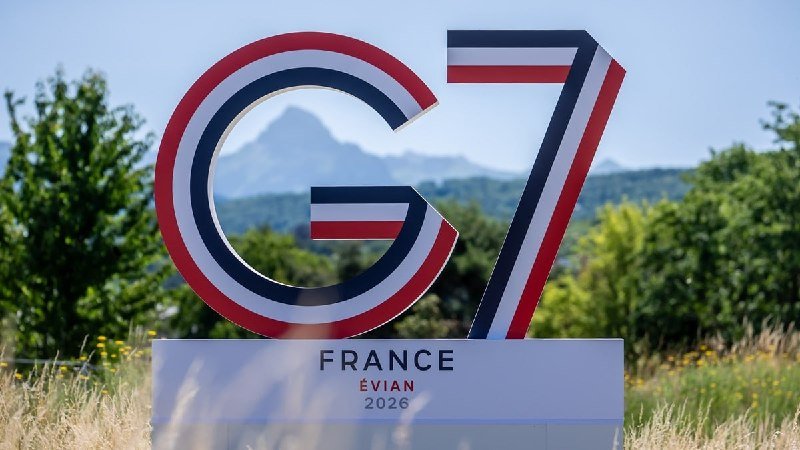
The pattern matters. The same news cycle produced a G7 agreement to "significantly strengthen military support for Ukraine" — a package that may include additional air defence systems, interceptor missiles and long-range weapons. It also produced a Trump who, asked point blank whether Vladimir Putin bears more responsibility for the continuing war, refused to answer. "I don't want to comment on that because I'm trying to get it settled," he said, on the record, at 14:18 UTC. Anyone who has watched this presidency long enough knows the formulation. A considered threat to Moscow is paired with an explicit refusal to blame Moscow. The contradiction is not a slip. It is the operating doctrine.
What the president actually said
Asked directly whether sanctions on Russia would be reimposed, Trump replied at 14:28 UTC: "We are looking at that. We are seeing how far the price of oil comes down... It's soon going to be at the number that" — and trailed off. The unfinished sentence is itself the message. Sanctions are being held against a market variable, not a political one. The threshold is denominated in dollars per barrel, not in Ukrainian lives lost, Russian-occupied territory returned, or war crimes indicted.
Asked whether Ukraine would receive American missiles, the answer was the conditional "I am considering." No timeframe, no delivery schedule, no weapon class named. The phrasing gives Trump the option of either delivery or denial at the next press opportunity. That optionality is, at this point, structural to his Ukraine policy: maximal headline flexibility, minimal binding commitment.
The G7 frame
Twelve hours earlier, at roughly 13:34 UTC, the same Telegram channel reported that G7 countries had agreed to "significantly strengthen military support for Ukraine," with the new tranche potentially including "additional air defence systems, interceptor missiles and long-range weapons." Read against Trump's afternoon remarks, the sequencing is striking. The allies moved first. The American president followed, but in the conditional tense. The pattern is familiar from earlier in the war: the G7 sets the floor, the United States confirms it, and confirmation arrives as possibility rather than decision.
For Kyiv, that is better than the alternative. Air defence interceptors are the single most binding constraint on the war's daily casualty count. Long-range weapons are the leverage that has, since 2024, given Ukraine the ability to strike Russian military infrastructure deep behind the front. A G7 commitment to expand both is consequential. The question is whether the US portion of the package materialises on the timeline Ukraine's air defence officers need, or whether it drifts into the same review queue that has held Patriot and ATACMS deliveries for months.
The Russia non-answer
The most telling moment of the briefing was the one Trump refused to give. Asked whether Putin bears more responsibility for the continuing conflict, he demurred. The diplomatic logic is intelligible: a US president actively brokering — or claiming to broker — a settlement cannot publicly assign blame to one side. The strategic logic is more troubling. Without an American statement of responsibility, the diplomatic frame remains symmetric. The invaded country and the invading country are not publicly distinguished. That ambiguity is not costless. It bleeds into European capitals, into G7 communiqués, and into the language allies use when describing their own support to Ukraine.
Moscow, for its part, will read the day's transcript as permission. Conditional sanctions tied to oil prices are sanctions that require oil to keep falling. Conditional missile deliveries are deliveries that can be deferred. A refusal to assign blame is, in effect, an invitation to wait the negotiator out.
Stakes and what is not known
If the price of oil does fall to whatever number Trump has in mind, the White House will claim credit for the pressure and treat it as proof that economic statecraft is working. If the price stabilises or rises, the sanctions language will quietly retire, and the missile question will migrate back to the National Security Council review that has held it for months. Ukraine's air defenders do not get to choose between these branches. They need interceptors this winter, not when the price benchmark is satisfied.
What remains genuinely uncertain is the scale of the G7 package. The Telegram-sourced report names categories — air defence, interceptors, long-range weapons — but not quantities, not delivery windows, and not national allocations. The framing suggests continuity with prior G7 undertakings rather than a step-change; the headline verb is "strengthen," not "transform." That distinction will only become visible when the first pallets arrive.
The day's two Trump remarks and the G7 communique, read together, look less like a strategy than a posture. The posture keeps every option open. For the country under bombardment, open options are not the same as delivered interceptors.
This publication read the 17 June 2026 briefings from Andriy Tsaplienko and Clash Report on Telegram; wire confirmation of the G7 package contents and the US missile decision is still pending.
Wire provenance
This editorial synthesis draws on the following public wire/social posts:
- https://t.me/Tsaplienko/18674
- https://t.me/ClashReport/21803
- https://t.me/ClashReport/21799
- https://t.me/Tsaplienko/18671