White House releases 14-point US–Iran memorandum as ceasefire language meets commercial passage demands
A US official handed reporters the full text of a 14-point memorandum on 17 June 2026, including a permanent ceasefire, safe Strait of Hormuz passage and phased sanctions relief — and left key verification questions open.
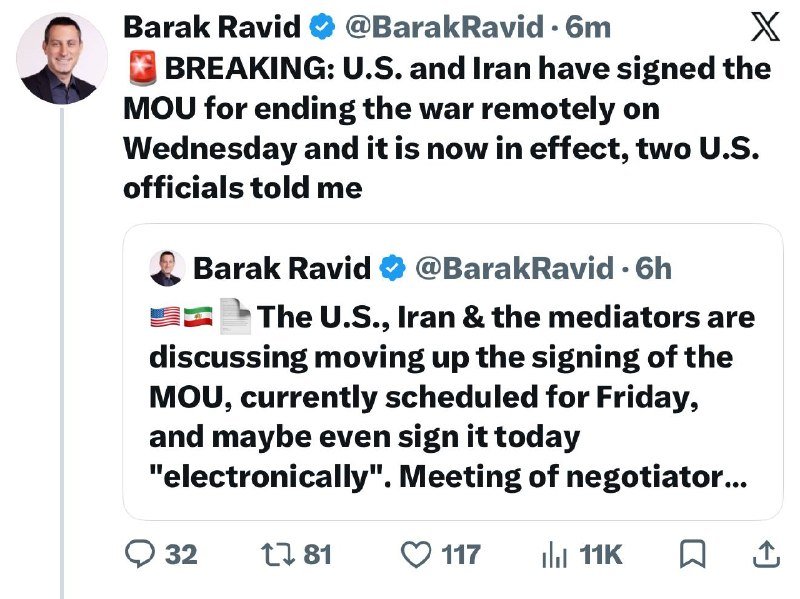
At 17:33 UTC on 17 June 2026, a White House correspondent for the outlet Faytuks News posted what it described as the full 14-point US–Iran memorandum of understanding to X. By 18:24 UTC, Unusual Whales was running a "BREAKING" line summarising the document. In the space of less than an hour, a draft framework that had been the subject of leaks and counter-leaks for days moved from channel chatter to public text — circulated by reporters, not signed by ministers, and on terms the parties themselves have not jointly authenticated.
The release marks the most concrete written artefact yet of a diplomatic track that, if it holds, would suspend a multi-front war in which the United States, Iran and their respective regional partners have been trading strikes for months. It also raises the harder question of what the document actually is: a binding agreement, a pre-negotiation position paper, or a piece of stage-management aimed at oil markets, Gulf shipping insurance and the American domestic political calendar.
What the text says
A US official handed the text to White House press corps shortly before 17:35 UTC, according to posts by the Telegram channel Witness from the Frontlines and OSINTtechnical. The first four points, as circulated by those channels, frame the document as a joint declaration by the United States, the Islamic Republic of Iran and "their allies in the current war," who, "by signing this Memorandum of Understanding (MOU), declare" themselves bound by its terms. The signature line is conspicuously absent from the circulating copies; no joint signing ceremony has been confirmed.
According to summaries posted by Unusual Whales at 18:24 UTC and by Sprinter Press at 18:16 UTC, the 14 points include: an immediate and permanent ceasefire on all fronts, safe commercial passage through the Strait of Hormuz, phased sanctions relief, and access arrangements that the channels described in summary but did not fully reproduce. The full enumeration — running through fourteen numbered commitments, with the first establishing the document's binding character — is consistent across the independent channels, which strengthens the claim that the text is real even as the provenance of the copy itself remains a White House hand-out rather than a joint release.
In plain terms, the architecture is familiar: stop shooting, let tankers through, unlock money, allow inspectors and commercial partners back in, in a defined sequence. That sequence is the substance — phase ordering determines who blinks first.
Why the language matters
Three features of the draft are doing most of the political work. First, the ceasefire language is "immediate and permanent," not conditional. That is a much stronger formulation than the step-by-step de-escalation language the United States has favoured in previous back-channel exchanges, and it implies that Iran and its regional partners are expected to halt attacks on US assets and shipping on the day of signature. Second, the Strait of Hormuz provision is framed around "safe commercial passage" — a phrase that effectively commits both sides to non-interference with crude and LNG flows on which Asian importers, in particular, depend. Third, the sanctions-relief mechanism is described as "phased," which leaves open the question of how sanctions snap back if Tehran is judged to have violated earlier points.
Each of those three commitments is also an explicit concession from somebody. For Washington, "permanent" and "immediate" lock in a political risk: a future US administration would inherit a peace, not a pause. For Tehran, the costs are the acceptance of intrusive verification and a sequencing that ties economic relief to compliance milestones. For Gulf states and Israel, neither of which are signatories, the document's silence on missile stockpiles, proxy forces and nuclear constraints is itself a concession they have not been asked to endorse.
What the release does not settle
The text circulating on 17 June is, on the public record, a US hand-out to American reporters. No Iranian ministry or official Iranian news agency is, in the source material this publication reviewed, identified as having released or confirmed the same text. The distinction matters: a deal authenticated by both governments carries different legal and political weight than a draft framed by one side and published through friendly channels. Until Tehran confirms, point by point, that this is the document it is willing to sign, the most that can be said is that the United States has shown its position.
There are also internal contradictions to flag. A "permanent" ceasefire declared in the first paragraph is paired, in the summaries circulating, with phased sanctions relief and verification steps that imply a multi-month implementation runway. Those two formulations can be reconciled — a ceasefire holds while the mechanics catch up — but they require trust at exactly the moment when, by the logic of why this war started, trust is in short supply. The 14 points do not, in the versions available, specify who arbitrates disputes over compliance, what the snap-back trigger looks like, or how the agreement treats Iran's regional partners, including groups that have launched attacks in recent weeks.
A further open question is the document's status under US domestic law. Memoranda of understanding are, by long diplomatic convention, not treaties; they do not require Senate ratification. If the eventual signed instrument is presented as an MOU, the US administration can implement it through executive action and sanctions waivers without congressional buy-in. That procedural detail will shape how durable any ceasefire turns out to be when the next US political cycle arrives.
Stakes and the next 72 hours
For oil and shipping markets, the practical test is the Strait. If Iranian-aligned forces honour a passage commitment and Gulf insurers revise war-risk premiums downward, the immediate effect would be a softer Brent benchmark and a tightening of effective spare capacity. If they do not, the document becomes, at best, a basis for renewed negotiations. Asian buyers — China, India, Japan, South Korea — are the demand side with the most at stake; their refiners have been routing around Hormuz at significant cost for months.
For Iran, the economic arithmetic turns on the speed and scope of the phased relief and on access to frozen revenues. For the United States, the political arithmetic turns on whether a peace that does not visibly constrain Iran's missile and proxy architecture can survive domestic scrutiny. For Israel and the Gulf monarchies, the unanswered question is whether the framework subordinates their security concerns to a US–Iran bilateral settlement — a concern the document, as circulated, does not address.
The next seventy-two hours will tell. What the source material does not yet support is the strongest version of either the success narrative or the collapse narrative: a draft in a journalist's hand is neither a treaty nor a scrap of paper until both sides treat it as one. The text is real; its status is not.
This article was assembled from primary hand-out text circulated to US press on 17 June 2026 and from independent channel summaries. The Iranian side's confirmation, full enumeration of points five through fourteen, and any signed version of the document are not yet on the public record as of publication time.
Wire provenance
This editorial synthesis draws on the following public wire/social posts:
- https://t.me/FaytuksNetwork/
- https://t.me/wfwitness/
- https://t.me/osintlive/
- https://t.me/osintlive/
- https://t.me/GeoPWatch/
- https://x.com/sprinterpress/status/
- https://x.com/unusual_whales/status/