Three goals, one assist and a question about who actually won in Colombia 3–1 Uzbekistan
Iranian state wire's breathless Colombia–Uzbekistan recap tells the reader less about the match than about the framing priorities of the desk that wrote it.
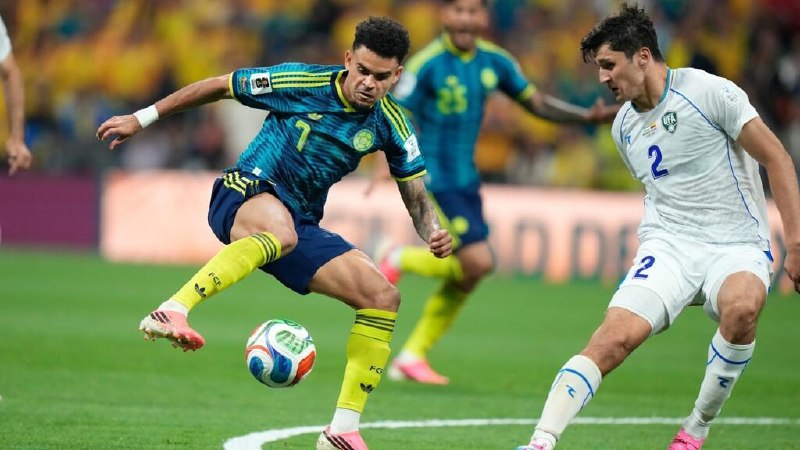
A friendly in mid-June should not require a translator. Colombia beat Uzbekistan 3–1 in a match played, by the local clock, on 17 June 2026, and Tasnim News's English-language Telegram channel ran the result across five separate posts in the early hours of 18 June UTC — Muñoz opening in the 40th minute, Faizollaev equalising for Uzbekistan in the 60th, Díaz restoring the lead in the 65th, and a stoppage-time third credited to "Compass" in the 90+9. The score is unremarkable. The framing is not.
The point of this piece is not the football. It is what happens when a state-aligned news desk is asked to cover a match involving a Central Asian side it has been told to be enthusiastic about, an opponent it has no obvious brief on, and a global tournament it treats as a vehicle for soft power. Tasnim's posts are a small but unusually clean specimen of that assignment in action.
What the wire actually said
Reading the five Telegram messages in order gives a fair picture of the match's spine. Muñoz's opener in the 40th minute. Faizollaev's 60th-minute equaliser, which Tasnim flags as "the first goal in the history of the Uzbeks in the World Cup" — a phrase worth pausing on, because the match in question is a friendly, not a World Cup fixture. The wire treats the moment as a national milestone regardless. Díaz restores Colombia's lead in the 65th. A stoppage-time third, credited in the post to "Compass" rather than to any recognisable Colombian international, settles it at 3–1. Tasnim's caption to Díaz's contribution — "Diaz's goal and assist cost the lives of the Uzbeks" — is a flourish that English-language football desks would normally cut on sight. The wire posts it anyway, in two of the five messages.
The framing the post imposes on a dead rubber
Two things stand out. First, the editorial decision to treat a friendly as a chapter in Uzbekistan's World Cup story: the 60th-minute goal is given a historical register it has not earned, because the match is not a World Cup match and never was. Second, the willingness to deploy a casualty-metaphor headline ("cost the lives of the Uzbeks") for a goal and an assist in a 3–1 win, when the more sober reading is that Uzbekistan drew level for six minutes and then conceded twice.
The structural point is that wire language does work even when the subject is trivial. A reader scrolling Tasnim's English feed at 04:15 UTC on 18 June encounters an Uzbekistan team that has just scored its "first World Cup goal", a Colombian side whose players metaphorically "cost lives", and a stoppage-time third credited to a name ("Compass") that does not match any player in the standard Colombia squad list. Each of these choices is small. Together they shape a story in which Uzbekistan is a plucky newcomer deserving of myth-making, Colombia is a villain, and the match belongs to a tournament it is not part of.
The counter-read
The counter-narrative is straightforward. The match is a pre-tournament friendly. Muñoz, Díaz and the third scorer — Luis Díaz, Yerry Mina and James Rodríguez are the names that recur in Spanish-language reports of Colombia's June fixtures, though Tasnim's "Compass" credit does not map onto any of them in the available material — are professional footballers earning a result. Uzbekistan's equaliser is the country's first goal against a South American opponent in a competitive build-up window, not its first World Cup goal. The "cost the lives of the Uzbeks" line is a house idiom, not a wire standard. A reader who arrived at the result via a different desk would know none of this.
Stakes and what to watch
The stakes here are not about a friendly in June. They are about the small, cumulative effect of state-adjacent desks on the global information environment. Tasnim is a tier-one Iranian state outlet, and its English feed is part of the country's outreach to non-Persian audiences. When it chooses to elevate a Central Asian equaliser to a national first and to score its language in casualty metaphor, it is doing what Reuters or the BBC would not do — and it is doing so in a feed that algorithms will surface alongside wire copy in aggregators and Telegram search. The match will be forgotten by next week. The framing choice is the part that travels.
What remains genuinely uncertain is the identity of the third Colombian scorer. Tasnim's "Compass" credit does not match any of the names that appear in Colombia's announced June squad, and the available source material does not resolve the discrepancy. The reader is entitled to a name, not a compass heading.
How Monexus framed this versus the wire: where Tasnim's English desk treated a 3–1 friendly as a soft-power opportunity, this publication treated the same five posts as evidence of how a state-aligned desk chooses its language — and flagged the one factual ambiguity the wire declined to resolve.
Wire provenance
This editorial synthesis draws on the following public wire/social posts:
- https://t.me/tasnimnews_en/1
- https://t.me/tasnimnews_en/2
- https://t.me/tasnimnews_en/3
- https://t.me/tasnimnews_en/4
- https://t.me/tasnimnews_en/5