The Islamabad Memorandum: What the Iran–US Signing on 18 June 2026 Actually Says
Four dispatches from Tehran and Islamabad on 18 June 2026 confirm the same extraordinary event: a memorandum of understanding signed in the Pakistani capital, with Islamabad casting itself as mediator.
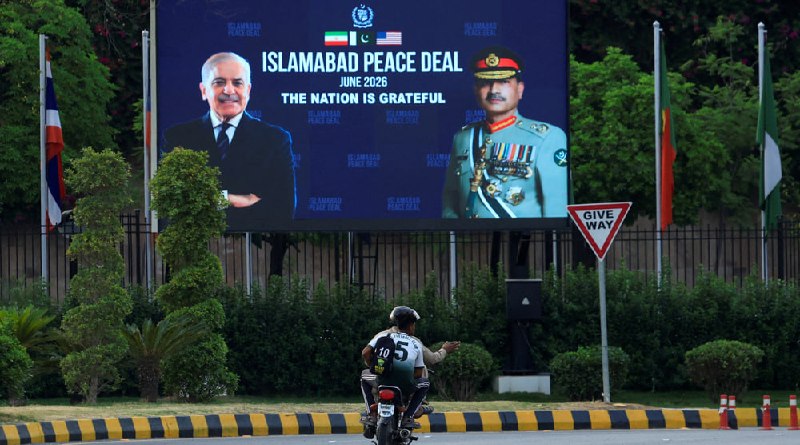
Four wires, two countries, one identical announcement. Between 18 June 2026 00:00 UTC and 18 June 2026 01:29 UTC, two Iranian state-affiliated news agencies and a Pakistan-oriented Arabic channel carried word of the same document: a memorandum of understanding between Iran and the United States, signed in Islamabad, with Pakistan's prime minister crediting himself as mediator. The dispatches leave enough gaps that the picture they sketch is more scaffolding than structure. What is clear is that something with the diplomatic weight of a heads-of-state signing happened in the Pakistani capital on the morning of 18 June, and that the Iranian and Pakistani sides are competing, gently, to claim authorship of the moment.
The story is not yet a deal in the technical sense. A memorandum of understanding is not a treaty; it is a political commitment to keep talking, often with a few substantive annexes attached. The four wires do not yet disclose what is in those annexes, who physically signed for the United States, or what Iran has offered in return. What they do disclose — and it is consequential — is that the United States and the Islamic Republic have decided, for now, to perform agreement in a third-party capital, with a third-party head of government in the frame. That is its own kind of news.
A four-source picture of the same hour
The earliest of the four dispatches, timestamped 18 June 2026 00:00 UTC, comes from Al-Alam Arabic — the Iranian state Arabic-language channel, broadcasting through its Telegram account. Its urgent bulletin attributes the announcement to the Pakistani prime minister, describing him as having approved the memorandum "in my capacity as mediator." The framing is striking: it positions Islamabad, not Tehran or Washington, as the originator of the document. A second Iranian outlet, Mehr News, carries a video clip timestamped 18 June 2026 00:14 UTC showing the moment Donald Trump signs the Persian-language version of the memorandum — a deliberate visual claim that the United States has signed a text in Farsi, not only in English. A third dispatch, from Tasnim, runs at 18 June 2026 00:49 UTC and labels the moment "the signing of the Persian version of the Memorandum of Understanding between Iran and the United States by Trump." A fourth, again from Mehr News at 18 June 2026 01:29 UTC, returns to the Pakistani prime minister's account, describing him as having announced the signing of the Islamabad Memorandum of Understanding by the presidents of Iran and the United States.
Read together, the wires describe a tightly choreographed sequence: a Pakistani announcement at midnight UTC, a visual proof of the Persian signature within fifteen minutes, a second Iranian framing of the same moment within an hour, and a final consolidation of the Pakistani narrative an hour and a half later. The pattern is consistent with state media in two countries agreeing, in advance, on the order in which the story would be released. That is not, by itself, evidence of what the memorandum contains. It is evidence that both governments consider the optics of the signing — language, mediator, capital — to be part of the agreement.
The mediator's claim
Pakistan's prime minister, Shehbaz Sharif, is the actor in this story whose role is most clearly defined by the available wires. According to Al-Alam Arabic and the later Mehr News dispatch, he has publicly described himself as mediator and has stated that the memorandum was approved by him in that capacity. That formulation does something specific. It moves Pakistan from being a venue — a place where signing happened — to being a participant, with a stake in the document's success. Mediation in international practice carries rights: the mediator is owed consultation, sometimes notification, and frequently a paragraph in the final text. By publicly claiming the role before the text has been disclosed, Sharif has put a claim on the record that will be awkward for Tehran and Washington to retract.
The choice of Islamabad as the signing city is itself an argument. The Pakistani capital is a Muslim-majority, nuclear-armed, US-aligned state with a long and difficult relationship with Tehran, complicated further by the 2025–26 border clashes between Iran and the Pakistani Balochistan frontier. Hosting the signing requires the Pakistani government to have persuaded Tehran that it is a neutral venue rather than an American client, and to have persuaded Washington that the optics of signing in a third capital are worth the loss of the traditional State Department podium. The fact that the wires describe Sharif as having approved the memorandum, rather than merely hosted the signing, suggests a Pakistani role that goes beyond ceremony.
What the Iranian sources are emphasising
The two Iranian outlets are not neutral messengers. Mehr News is the official news agency of the Islamic Republic, and Tasnim is the outlet widely understood to be close to the Islamic Revolutionary Guard Corps. Both are making a specific argument with their coverage. By foregrounding the Persian-language signature — Mehr twice, Tasnim once — they are telling an Iranian audience that the document is bilingual, that the Iranian text matters, and that the United States has physically engaged with a Farsi text. This is not a trivial claim. In past negotiations, including the 2015 Joint Comprehensive Plan of Action, the question of which language version prevailed in any dispute was contested. By filming the Persian signing and distributing the clip, the Iranian state is putting on the record that the Farsi text exists and was signed.
The second argument the Iranian sources are making is the choice of venue itself. For a quarter-century, Iran–US negotiations have taken place in European capitals — Vienna, Geneva, Lausanne, Muscat — or in New York on the margins of the UN General Assembly. Holding the signing in Islamabad shifts the symbolic geography. It places the Islamic Republic's most consequential diplomatic interaction of the year inside a Muslim-majority Asian capital, with a Muslim-majority head of government in the chair. The Iranian outlets are not framing this as defeat; they are framing it as a rebalancing.
What is missing from the wires
The four dispatches do not disclose the substantive content of the memorandum. There is no wire in this set that names the Iranian or American signatory in person. There is no wire that confirms the legal status of the document under either domestic constitutional framework, that announces the duration of any commitment, or that specifies what Iran has offered and what it has received. There is no indication of whether IAEA inspectors, sanctions relief, or nuclear-stockpile constraints appear in the annexes. The wires do not address the question of whether the memorandum has been transmitted to the US Congress, to the Iranian Majles, or to the UN Security Council.
The absence of any Western wire in this source set is the most consequential gap. None of the four dispatches is from a Reuters, AP, BBC, Bloomberg, or State Department source. The picture we have of this signing is, at this moment, the picture the Iranian and Pakistani state media have chosen to release. That is a real picture, but it is a partial one. The question of whether the United States government confirms the text — and how Washington characterises what was signed — is not yet on the record in this set of sources.
Stakes and trajectory
If the Islamabad Memorandum holds, three things will follow. First, a sanctions architecture that has shaped Iranian state revenue for a decade will, at minimum, enter renegotiation. Even the prospect of renegotiation changes behaviour: foreign investors begin due diligence, Iranian trading partners begin hedging, and the rial's parallel-market value responds. Second, the diplomatic geography of the Middle East shifts. A Iran–US channel that runs through Islamabad rather than Vienna is a channel that Saudi Arabia, the UAE, and Turkey will have to take seriously, and a channel that Pakistan can leverage in its own conversations with both Washington and the Gulf. Third, the Israeli position becomes harder to maintain in its current form. Israel has, in successive governments, treated the Iranian nuclear file as one in which its preferences should prevail; a signed document with the United States and Iran in a third capital, mediated by a third government, reduces the room in which an Israeli veto operates.
The counter-reading is straightforward. A memorandum of understanding is not a treaty. The 2013 Lausanne framework was a joint plan of action; it was overtaken by the 2015 JCPOA, which was itself unilaterally abandoned by the United States in 2018. Memoranda of understanding in this portfolio have, historically, been honoured as long as they were politically useful to both parties and discarded the moment they were not. The Pakistani mediation claim could also become a fault line. If Sharif is publicly cast as mediator, Tehran and Washington will, at some point, be asked to specify what mediation entailed and what Pakistan received in return. That question has not yet been answered, and it is the kind of question that, if left unanswered, can dissolve a process.
What remains genuinely uncertain, on the record available in this set, is whether the United States government has confirmed the text, whether the Persian and English versions contain identical obligations, and what the timetable of implementation looks like. The four wires describe a moment; they do not yet describe a settlement. The next twenty-four to seventy-two hours, when the Western wires and the State Department briefing cycle catch up to the Iranian and Pakistani releases, will determine whether this is the beginning of a diplomatic process or the choreography of one.
This piece draws only on the four dispatches available in the source set — two from Mehr News, one from Tasnim, and one from Al-Alam Arabic. Where the Western wire position on the signing is not present in those four sources, that absence is noted rather than filled. Monexus will update this article as additional confirmation becomes available.
Wire provenance
This editorial synthesis draws on the following public wire/social posts:
- https://t.me/mehrnews
- https://t.me/tasnimplus
- https://t.me/mehrnews
- https://t.me/alalamarabic