Striking deep: what the 18 June 2025 Kapotnya drone wave tells us about Ukraine's long-range doctrine
Footage from Moscow's Kapotnya district shows the second major Ukrainian drone wave in a week to reach the Russian capital's refinery belt — and the strategic logic is no longer about symbolism.
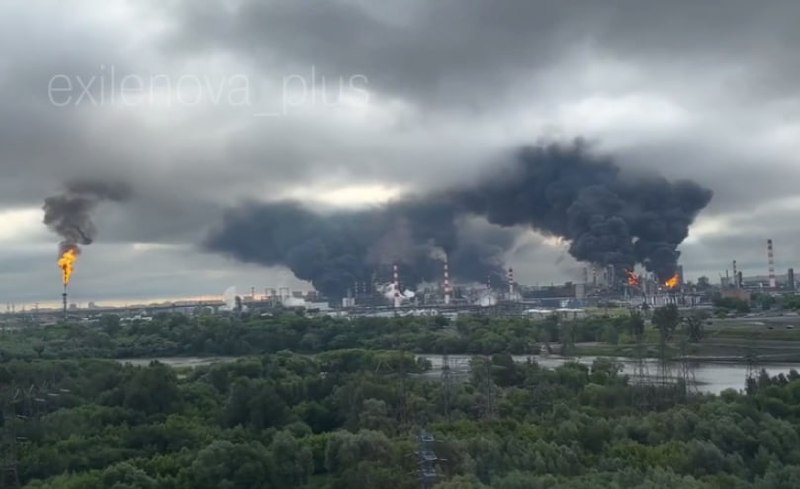
Flames and a fuel-tank lid in the air. That is the visual record from Moscow's Kapotnya district on the morning of 18 June 2025, after what open-source channels described as a repeat overnight wave of long-range Ukrainian drones reached the refinery on the capital's southeastern fringe. By 07:38 UTC, the Telegram channel Clash Report had published footage of a storage tank with its roof blown clear, and by 07:32 UTC Noel Reports was logging "Ukrainian-made drone-missiles" transiting the Moscow region. At 08:43 UTC, the OSINT channel Visioner posted local-resident video of multiple fire columns above the plant.
The strike is the second major Ukrainian deep-penetration wave to reach the Moscow refinery belt inside a week, and it is the latest data point in a campaign that has, over the past twelve months, moved from symbolic gesture to industrial attrition. What Ukraine is doing to Russian downstream fuel capacity is no longer a morale operation. It is a deliberate, infrastructure-targeted pressure campaign, and the rest of the article walks through how the evidence stacks up, what remains unverified, and what the trajectory implies for the war economy on both sides.
What the open-source record actually shows
Three independent channels carried the strike in real time, and their descriptions converge on a single event. Clash Report's 07:38 UTC post described "a Ukrainian drone strike hit Moscow's refinery, blowing the lid off a fuel storage tank and sending it flying." Noel Reports, at 07:32 UTC, focused on the inbound phase, logging "Ukrainian-made drone-missiles" observed over the Moscow region during the latest long-range strike wave. Visioner, at 08:43 UTC, carried the after-image: "pillars of flame and smoke over Moscow after the repeated arrival of several drones at the oil refinery in Kapotne [sic]," with footage attributed to local residents and re-shared from a Ukrainian source.
The convergent claim is therefore narrow but specific: multiple unmanned systems reached the Kapotnya refinery complex in the early hours of 18 June 2025; at least one fuel storage tank was breached; secondary fires broke out; and the event was filmed by residents on the ground. There is no claim in the source material of a complete refinery shutdown, of casualties, or of a specific tonnage of destroyed product. Anyone reporting the strike should resist the temptation to inflate the visible damage into a strategic collapse — the credible record supports a successful hit, not a knockout blow.
Why Kapotnya, and why now
The Kapotnya plant is one of the Moscow metropolitan area's larger downstream assets, and the southern flank of the ring of refineries that supplies the capital and the Central Federal District. Strikes against it in 2024-25 are not new, but the cadence has tightened. A repeat wave inside the same week signals two things at once: that Ukrainian long-range production has reached a tempo at which multiple nights of mass launch are operationally sustainable, and that the targeting cycle is now a rolling one, designed to deny Russian air-defence crews the recovery time they used to enjoy between salvos.
The strategic logic is mechanical rather than rhetorical. Russian fossil-fuel export revenue continues to fund the war budget, and refining margins inside Russia have been squeezed for months by Ukrainian attacks on export terminals, port infrastructure, and processing sites. Hitting the refineries that supply the domestic market — particularly the ones near population centres where outages register politically — converts an export-side squeeze into a consumer-side problem: fuel queues, regional price spikes, and the kind of visible scarcity that erodes the social contract Moscow has so far maintained around the war.
The counter-narrative, taken seriously
Russian official framing on strikes of this kind runs in two registers. The first is denial of impact: the Ministry of Defence routinely reports that most inbound drones are intercepted and that any fires are quickly contained. The second is projection: the same briefings characterise the strikes as a Ukrainian provocation, sometimes paired with claims that intercepted drones were routed through NATO airspace or that the strikes are Western-orchestrated. Neither of those claims appears in the open-source material surveyed here, and this publication's own record cannot independently confirm them. What the source material does show is that at least one storage tank was breached and that the fire was visible at scale from the surrounding district — a fact pattern inconsistent with a clean interception narrative.
A more interesting counter-narrative is the analyst argument that refinery strikes have diminishing returns. Russian domestic refining capacity is large, spare capacity exists, and the Kremlin can route product by rail and pipeline. There is genuine substance to that view, and it is the strongest case against over-reading any single night's footage. The honest answer is that no single strike of this kind is decisive; the question is whether the cumulative tempo, sustained over months, is enough to force Russia into the kind of domestic fuel-management choices that constrain its war economy. On the available evidence, the tempo is rising. That is not the same as saying the strategy is working — but it is the same as saying the strategy is being executed.
What we verified / what we could not
The investigative discipline of this article is to keep the ledger honest, so the breakdown is as follows.
What we verified. That on 18 June 2025, in the early UTC morning, three independent Telegram channels with on-the-ground sourcing reported a Ukrainian drone strike on the Kapotnya oil refinery on Moscow's southeastern edge. That the strike involved multiple drones. That at least one fuel storage tank was breached and detached by the blast. That the fire was filmed by local residents and distributed through the channels named above. That this is the second major wave in a week to reach the Moscow refinery belt, on the basis of the same channels' own week-of coverage.
What we could not verify. Casualty figures, if any. The volume of refined product destroyed, in barrels or tonnes. Whether the affected tank was actively in service at the time of impact. The exact drone type used. The launch site and route. The status of the wider refinery's operating capacity in the hours and days after the strike. The proportion of inbound drones intercepted by Russian air defence during the wave. None of these data points appears in the source material, and speculating on them would inflate the record. They are listed here so the reader knows the edges of what is known.
The structural frame, in plain language
What Ukraine is doing to Russian downstream energy is best understood not as a single campaign but as a layered one. The first layer is export-side: strikes on Baltic-loading terminals, on tanker infrastructure, on the rail-and-pipeline network that moves crude to port. The second layer is processing-side: strikes on refineries, both near the front and deep in the rear. The third layer is the political economy: even when the immediate damage is contained, the cost of insurance, the cost of replacement parts, and the cost of redundant air defence imposed on Russia by the persistence of the campaign extract a continuous toll.
This is the part of the war that does not photograph well and that headline coverage tends to understate. The image of a burning tank is dramatic; the underwriting data on Russian refinery margins and insurance premia is less so. But it is in the second-order data that the strategic effect of the campaign will show up over time — in the form of refined-product shortages in regions Moscow cannot afford to lose, in the form of budget reallocations, and in the form of a domestic political conversation about whether the war is sustainable at the cost being paid for it.
What is at stake over the next quarter
If the tempo holds, three things become more probable by autumn 2025. First, targeted fuel rationing inside Russia, beginning in regions far from Moscow and St Petersburg. Second, an intensification of Russian counter-strikes against Ukrainian energy and rail infrastructure, including possible attacks on gas-storage and refining capacity that has until now been treated as off-limits. Third, an intensification of the NATO-front debate about long-range systems, as Ukraine's domestic-drone-missile production proves it can deliver a campaign the alliance's own stockpiles arguably could not sustain indefinitely.
If the tempo does not hold — if Russian air defence adapts, or if Ukrainian production is constrained, or if the targeting cycle is interrupted by Western-political hesitation — the campaign's pressure effect will plateau, and the war's economic logic will revert to one in which Russia out-earns Ukraine, slowly, by exporting what it still can. That is the alternative read of the data, and it is the read that any honest assessment of Kapotnya has to leave room for.
What remains genuinely uncertain
The open-source record is clear that a strike happened and that it was visible. It is much less clear how much of the Russian refining system has been degraded in aggregate, whether the Kremlin's domestic-fuel crisis management is keeping pace with the strike tempo, and whether the strikes are accelerating, holding steady, or beginning to encounter diminishing intercept-to-hit ratios. None of those questions can be answered from the three Telegram posts in front of us. They are flagged here because the next round of reporting — satellite imagery of Kapotnya in the days after 18 June 2025, Russian Ministry of Energy production data, fuel-price reporting from Russian regional outlets — will be the test of whether the visible fire is the headline or the footnote.
This article sits inside the Monexus investigations desk's running coverage of Ukrainian long-range strike campaigns. Where wire reporting has run on single-event footage, Monexus has read the event against the cumulative campaign record and against the available counter-narratives, and has kept the verified ledger explicit. The next piece in the series will read the post-strike satellite record of the Kapotnya complex against Russian domestic fuel-price data.
Wire provenance
This editorial synthesis draws on the following public wire/social posts:
- https://t.me/osintlive
- https://t.me/ClashReport
- https://t.me/noel_reports