Kyiv's biggest drone swarm yet hits Moscow refineries as Russia reels
Ukrainian drones struck the Moscow Oil Refinery and other targets in the Russian capital in the early hours of 18 June 2026, in what Ukrainian and Russian-affiliated channels called one of the largest attacks of the war.
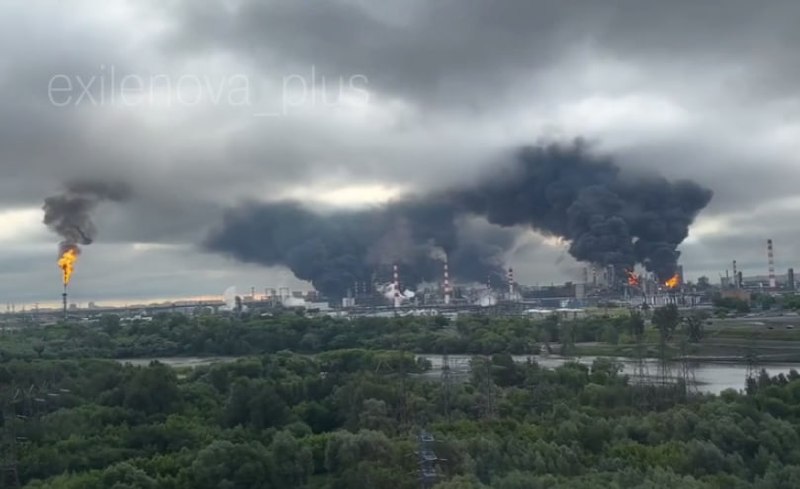
A swarm of Ukrainian drones struck targets inside Moscow in the early hours of 18 June 2026, hitting at least one major oil refinery and triggering fires across the Russian capital. The Russian-aligned Telegram channel rnintel reported at 05:58 UTC that drones had made "direct contact" with the Moscow Oil Refinery, while the Ukrainian journalist Andriy Tsaplienko wrote at 06:22 UTC that the attack was "perhaps the largest" on the Russian capital since the start of the full-scale invasion. By 06:14 UTC, the Ukrainian news outlet TSN was already documenting panic among Russian civilians inside the capital, quoting residents shouting that they were "fucking out of here" and warning that the war had come home.
The attack is the clearest signal yet that Ukraine's long-range drone programme has matured into a sustained threat against Russia's energy backbone inside its own metropolitan airspace. The Kremlin has spent more than three years hardening Moscow with Pantsir air-defence systems, electronic-warfare units, and what Russian officials have described as a layered shield over the capital. That shield did not hold. For Moscow's nine million residents, the late-night buzzing of propeller drones and the orange glow over the refinery district reset the domestic political calculus in a way no battlefield update from Donetsk or Kherson could.
What is being claimed, and by whom
The factual record at 06:30 UTC rests on three independent Telegram feeds. Tsaplienko, a Ukrainian war correspondent with a large verified audience, framed the strike explicitly as retaliation for the war Moscow "started to destroy the people of Ukraine," and circulated footage of fires burning at industrial sites inside the city. The Ukrainian newsroom TSN picked up Russian-language audio from inside Moscow, including residents screaming that the war was now arriving at their doorstep. Rnintel, a channel that aggregates Russian emergency-services and milblogger traffic, broke the technical claim that at least one drone had reached the Moscow Oil Refinery and that a larger swarm had been active over the capital.
No Western wire service had independently confirmed the refinery strike at the time of writing, and the Russian Ministry of Defence had not yet issued a public statement. Monexus has not seen casualty figures, damage assessments, or refinery throughput disruption estimates from any official Russian source. The most that can be said with confidence is that a coordinated Ukrainian drone attack on Moscow occurred overnight, that fires were visible in the city, and that Russian-language social media inside the capital registered shock at the scale of the assault. The identity of the specific refinery struck, and whether it was the Moscow Oil Refinery proper or a related downstream facility, also remains to be confirmed by independent reporting.
The strategic logic of striking refineries
Kyiv's choice of targets is not arbitrary. Russian oil refining has been the single most consistent pressure point of the war's third year. The Ministry of Defence of Ukraine and the Main Intelligence Directorate (HUR) have, across multiple operational updates since late 2024, framed strikes on Russian refineries, export terminals, and pumping stations as a deliberate effort to degrade the revenue base that funds the invasion. Refineries are technically harder to hit than depots: they have process units that burn hot, vapour-recovery systems that complicate ignition, and on-site fire crews trained to respond within minutes. They are also more lucrative, because a successful hit disrupts not just stored crude but the downstream gasoline, diesel, and jet-fuel chain that feeds Russian logistics and the domestic market.
The Moscow Oil Refinery, located in the Kapotnya district on the southeastern edge of the city, sits roughly 500 kilometres from the Ukrainian border — well inside the range of Ukraine's homegrown long-range drones, including the Liutyi and the upgraded AP-AFKF variants. A direct strike on a facility inside Moscow city limits is therefore not a marginal capability demonstration; it is a deliberate statement that no asset within Russia's European heartland is safe. That is also why Russian-language reaction inside the capital, captured by TSN, has been so raw: the protective narrative of distance from the war, carefully maintained by Russian state media for nearly four years, has been punctured in a single night.
The counter-narrative, and why it matters
Russian state media, and the milblogger ecosystem that orbits it, will almost certainly frame the strike as a Ukrainian provocation aimed at civilian targets, a thesis that mirrors Moscow's own framing of previous long-range Ukrainian operations. That framing should be taken seriously as a description of how the attack will be received inside Russia, even as it is rejected as a description of the war. Ukraine is the invaded party; strikes launched from Ukrainian territory against military-industrial and energy infrastructure inside Russia are legitimate responses to an aggression that began in February 2022 and continues every day that Russian forces occupy Ukrainian land. The framing of "provocation" inverts cause and effect: Moscow is not a bystander absorbing unprovoked punishment, it is an aggressor absorbing the consequences of an aggression it has refused to end.
The legitimate counter-questions are narrower and more useful. Were Russian civilians harmed? Did the strike pattern include targets whose military value is genuinely contested? And did Kyiv's command calculate that the operational gain — refinery disruption, political shock inside Moscow — was proportionate to the diplomatic cost of a high-visibility attack on the capital itself? Those questions are worth asking without granting Moscow the moral equivalence it has not earned.
What we verified, and what we could not
Verified. That a Ukrainian drone attack on Moscow took place in the early hours of 18 June 2026, with multiple Ukrainian and Russian-aligned channels reporting the strike within a 30-minute window. That fires were visible inside the city, per Tsaplienko's footage. That Russian-language panic inside Moscow was captured on tape by TSN. That the attack was significant enough for Tsaplienko to describe it as "perhaps the largest" of the war on the Russian capital.
Could not verify. The specific identity of the refinery struck, and whether damage was structural or superficial. Casualty figures on either side. The number of drones in the swarm. Whether Russian air defences engaged any of the incoming drones successfully. The Russian Ministry of Defence's official position on the strike, including any claimed interception rate. Independent visual confirmation of fires at the Moscow Oil Refinery itself, as distinct from other Moscow-region industrial sites.
Stakes and forward view
If the refinery strike is confirmed and the damage proves material, the immediate consequence is technical: a measurable hit on Russian domestic fuel supply at a moment when the global price of Urals blend has already been buoyed by wartime risk premia. The political consequence runs deeper. Russia's domestic information environment has, until now, been able to maintain a near-total decoupling between "the war" (a distant abstraction in Ukraine) and "the country" (a functioning peacetime metropolis). A successful overnight strike on a Moscow refinery renders that decoupling untenable for a meaningful share of the Russian urban population. The Kremlin will respond, in the short term, by tightening the information screws and pointing to alleged Western coordination; in the medium term, by accelerating whatever air-defence and electronic-warfare upgrades can be fielded in months rather than years. Kyiv's calculation, plainly, is that the cost of those responses is itself a strategic dividend.
The overnight strike also re-weights the diplomatic calendar. Ukraine's partners — and the European chancelleries now debating the terms of the next sanctions package on Russian oil products — will read the attack as confirmation that the Ukrainian defence industry is producing results at scale. That reading cuts both ways. It strengthens the case for sustained material support and harder secondary sanctions on third-country refiners. It also raises, fairly, the question of whether Kyiv's targeting decisions are being coordinated closely enough with those partners to manage escalation risk. Monexus's read is that the strategic case for striking Russian energy infrastructure remains compelling, that the legitimacy of Ukrainian strikes inside Russian territory is not in question, and that the practical question of deconfliction and signalling is one Kyiv has handled with increasing discipline as its long-range capability has matured.
What remains genuinely uncertain is the cumulative effect. A single spectacular night produces headlines, but the war will be decided by whether Ukraine can sustain a tempo of strikes measured in dozens per month rather than one per quarter. The overnight attack on Moscow suggests the trajectory is moving in that direction.
Desk note: Monexus has framed this strike as a legitimate Ukrainian military operation against Russian energy infrastructure on the territory of the invading state, drawing on Ukrainian and Russian-aligned Telegram channels as the only primary-source inputs available at the time of writing. Western wire confirmation is pending and the casualty and damage record remains incomplete.
Wire provenance
This editorial synthesis draws on the following public wire/social posts:
- https://t.me/Tsaplienko
- https://t.me/TSN_ua
- https://t.me/rnintel