A 'moped swarm' over Kyiv: the new vocabulary of nightly Russian strikes
Two Ukrainian Telegram channels logged 17 Russian-launched drones crossing Poltava, Boryspil and central Kyiv inside a single hour on 18 June 2026, exposing both the tempo of nightly strikes and the limits of public reporting on them.
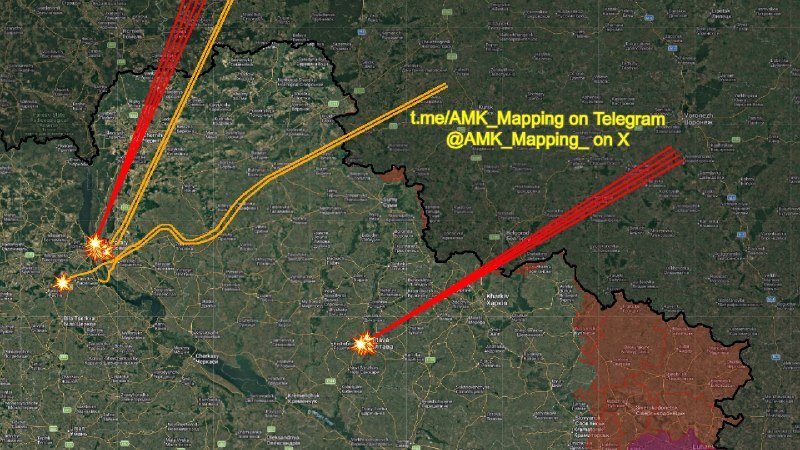
At 00:56 UTC on 18 June 2026, a single alert posted to the Telegram channel vanek_nikolaev announced that five drones — labelled, in the spare argot of Ukrainian air-defence watchers, "mopeds" — were moving toward Boryspil and on into Kyiv. By 02:30 UTC, barely ninety minutes later, a second channel, war_monitor, was noting "reconnaissance" activity over the capital and the wider oblast. In the interval, the count of mopeds tracked in a single Telegram thread rose from five to at least seventeen: six over Boryspil, then ten pushing north past Akhtyrka toward Poltava, then a final cluster of twelve closing on Poltava from the south. Four of the drones were observed passing Boryspil and continuing toward central Kyiv.
What those two channels — both run by Ukrainian volunteer observers rather than by the General Staff or the Air Force — published in real time is the closest thing the public gets to a minute-by-minute ledger of nightly Russian strike packages. It is also a quiet advertisement for the limits of the official record. The drones arrived in formation ("they fly like a snake," vanek_nikolaev wrote at 01:28 UTC), were tracked through Ukrainian air-defence radar and radio-direction-finding, and were named in the kind of detail that is useful to the public but not, for obvious reasons, to air-defence operators. The post was a warning to people on the ground; it was also, almost incidentally, a near-complete operational narrative.
What the posts actually document
The thread is short, and the picture it draws is consistent with the pattern that Ukrainian and Western outlets have been reporting for months: a steady drumbeat of long-range one-way attack drones, mostly Iranian-designed Shahed-136-class airframes produced under licence inside Russia, launched in salvos rather than singly, with the heaviest packages timed for the small hours of the morning. The Poltava vector at 01:15 UTC and the Boryspil/Kyiv vector at 01:03 UTC were not coincidental. They are the standard attack geometry — a feeder stream from the south-east aimed at the industrial and logistics hubs of central Ukraine, with Kyiv as a secondary target when the salvos are large enough.
None of the posts claim interceptions. The channels do not claim damage. They are upstream of that conversation — they are the alarm system, not the after-action report. The official Ukrainian count of downed drones for the night of 17–18 June has not been cited in the source material, and this publication will not infer one. What the two channels do establish, with redundant cross-posts at 01:03, 01:04, 01:15, 01:23, 01:28 and 02:30 UTC, is that a multi-wave Russian drone package was active over Ukrainian airspace from at least 00:56 UTC to 02:30 UTC on 18 June 2026, and that it was being tracked in real time by civilian observers using a vocabulary — moped, reconnaissance — that has become standard among frontline Ukrainian watchers.
The vocabulary, and why it matters
Moped is a piece of black humour rather than a technical classification. The drones in question are slow, loud, and fly low — closer to the cadence and pitch of a small combustion engine than to a jet aircraft. Reconnaissance is more pointed: the second channel's 02:30 UTC post is reporting a different, more deliberate Russian posture, almost certainly the orbit of a drone or pair of drones used to loiter, identify the response, and guide the strike package to weak points in the air-defence picture. The two roles in a salvo — bait, scout, jammer, strike — are blurred in the public record, but Ukrainian operators and their public interlocutors distinguish them carefully, because the public's risk depends on the distinction.
This matters for a reason that goes beyond the night in question. Western wire coverage of Russian strikes has tended to consolidate the night's events into a single, high-altitude figure: number of drones launched, number intercepted, occasional footage of a flaming airframe over a residential block. The volunteer channels do the opposite. They publish a clock-by-clock geometry. The result is a public that increasingly understands Russian air operations in tactical, not strategic, terms — salvos, vectors, time-over-target, the difference between a strike drone and a reconnaissance drone — and an air-defence conversation that is, for better and worse, more granular than anything the Russian General Staff is willing to admit about its own operations.
Structural frame: the official record and the volunteer record
The deeper story in the thread is not the drones themselves. It is the divergence between what is officially attributable and what is observably true. The official Ukrainian line, carried by the Air Force, the General Staff, the president's office and wire services, is a count — drones launched, drones downed, percentage intercepted, residual casualties and damage. It is a clean ledger, and it is the right place for international allies and for budget conversations about layered air defence.
The volunteer channels sit beside that record, not inside it. They are not optimised for clean ledgers. They are optimised for the time-to-alarm, and they publish in the language of a single person looking at a radar feed and trying to tell a city to take cover. The two records will, over time, produce different pictures of the same war. The official record is a strategic story about attrition, interception rates, defence industrial base capacity and the slow but measurable cost to Russia of one-way attack drones. The volunteer record is a tactical story about what it feels like to live under the packages, and what a single hour of one night's sky looked like from the ground.
A reader who relies on either record alone will be misled. The official count tells you how the war is going. The volunteer count tells you what the war is.
Stakes, and what remains uncertain
The stakes are concrete. If Russia's tempo of one-way attack drone launches continues to scale, the cost in Ukrainian interceptors — mobile fire groups, Gepard ammunition, IRIS-T and Patriot rounds — will rise linearly with the salvo size, and the budget arithmetic that has kept Western air-defence packages flowing will get harder. The Russian doctrine of striking in volume at night also degrades the Ukrainian public's tolerance, in ways that the official record is poorly placed to measure. Conversely, if Ukraine's counter-unmanned-aircraft-vehicle (C-UAV) capacity is starting to absorb the salvoes, the leverage shifts back to Kyiv.
What remains genuinely uncertain — and the source material does not resolve — is the official intercept and damage count for the night of 17–18 June 2026, the airframe mix in the package (Shahed-136 against newer Russian designs), and whether the reconnaissance activity logged at 02:30 UTC was a precursor to a second wave that the public thread did not capture, or was an end-of-package assessment pass. The volunteer channels tell us what came over the horizon. The official record, when it publishes, will tell us what was hit. The honest read is to wait for both, and to hold the two in the same sentence.
This publication framed the night's events as a single tactical picture assembled from two volunteer Telegram channels, rather than as an attribution-led wire story. The official Ukrainian count for the salvo has not been cited because the source material does not contain it.
Wire provenance
This editorial synthesis draws on the following public wire/social posts:
- https://t.me/vanek_nikolaev
- https://t.me/vanek_nikolaev
- https://t.me/war_monitor