Moscow burns, Brussels shrugs: why Europe's energy calculus on Ukraine hasn't changed
A second drone strike on Moscow's biggest refinery in a week sets the city's fuel supply alight. The political signal that does not change is the one Europe refuses to send.
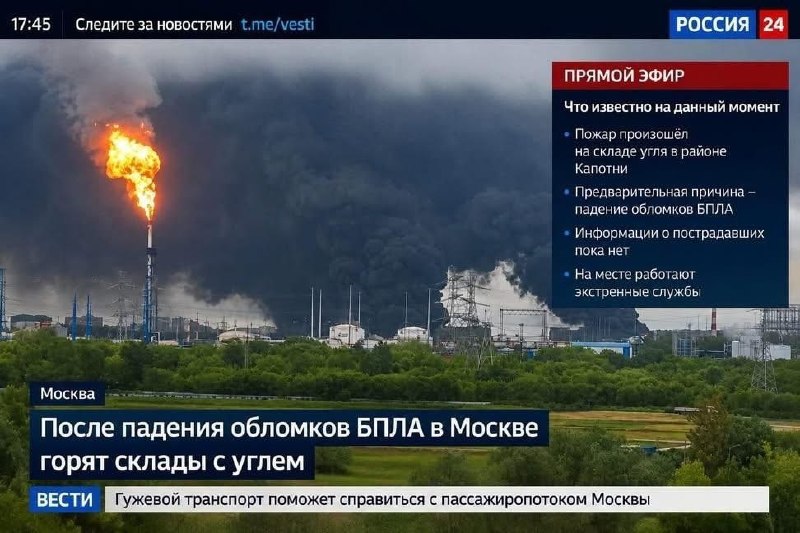
For the second time in seven days, Ukrainian long-range strike drones hit the Moscow Oil Refinery in the early hours of 18 June 2026. By 07:01 UTC, Moscow's air-defence units had reported intercepting roughly 190 unmanned systems since the start of the day — the largest such salvo of the war, by count of Russian-side claims republished through Telegram channels on Wednesday morning. Geolocated footage from the open-source account @Osinttechnical shows a strike drone slamming into an already burning tank at the refinery, with a separate clip capturing the lid of an oil tank being thrown clear of the structure by the force of the detonation. A massive smoke plume was visible over the Russian capital from across the city's western districts. The Moscow Oil Refinery supplies up to 40% of the capital's fuel, Kyiv Post reported on 18 June at 06:45 UTC.
The signal Kyiv is sending is not subtle. After years of carefully calibrated Western-supplied long-range systems used against military logistics, Ukraine has now demonstrated an indigenous capacity to put the capital of the country that invaded it under sustained aerial pressure — and to do so at a tempo that exposes, plainly, that Russian air defence is not the seamless shield the Kremlin's information space still insists it is. That is the operational fact of the morning. What it does not change, despite the volume of the explosions, is the political fact that has governed European energy policy since the spring of 2022: a handful of EU member states will not agree to a full embargo on Russian hydrocarbons while their refineries can still import via sea routes, and the broader Union will not move without them. Moscow burns; Brussels shrugs.
The strike, in detail
The salvo landed between approximately 05:41 UTC and 07:01 UTC on 18 June 2026. The Telegram channel @noel_reports published a clip at 06:58 UTC showing a Ukrainian FP-1 long-range loitering munition on final approach to the refinery, with Russian air defence attempting — and failing — to intercept on at least two occasions. By 06:11 UTC, @Osinttechnical had posted a secondary angle of an oil-tank lid being hurled skyward by the blast, and by 06:41 UTC the same account shared footage of a fresh drone impact on a tank already ablaze. Kyiv Post, the Ukrainian English-language outlet with close ties to the country's defence and political establishment, confirmed at 06:45 UTC that the Moscow Oil Refinery had been struck for the second time in a week and that fires had broken out across the facility. The Russian capital's mayor's office claimed, per Telegram aggregators, that around 190 drones were intercepted across the Moscow region over the course of the morning — a figure that, if accurate, describes an operational tempo not previously recorded in this conflict.
The FP-1 is one of a growing family of Ukrainian-designed long-range strike platforms built to substitute, in part, for the limited supply of Western-supplied ATACMS and Storm Shadow munitions. Its appearance over Russian airspace inside the capital's outer defence rings is itself the news; the damage done to one refinery's tank farm is the punctuation mark.
Why Moscow, and why now
Kyiv's targeting logic has shifted visibly across the past six months. Early-war strike packages concentrated on ammunition depots, rail nodes, and air bases in the border regions. As indigenous production scaled and as Western partners loosened range restrictions, the target set widened to refineries deep inside European Russia — first in the Volga region, then in the Urals-adjacent facilities, and now, repeatedly, at the gates of the capital. Moscow Oil Refinery is a political target as much as a logistical one: its disruption sends a price signal into Russian domestic fuel markets and a credibility signal into the elite circles that have been told, for four years, that the war is being managed.
The Russian response, predictably, has been to elevate the threat classification of Ukrainian long-range systems in public messaging while continuing to absorb the strikes in operational reality. The 190-drone interception figure, repeated through Russian-aligned Telegram channels on Wednesday morning, functions in both registers — it is simultaneously a reassurance to the Russian public that the system is working and a tacit admission that the volume of incoming fire is at unprecedented levels.
What Europe will — and won't — do about it
Here is the structural fact the morning's footage cannot move. The European Union's nineteenth sanctions package, currently being negotiated in Brussels, still contains carve-outs for pipeline gas from certain member states and for refined petroleum products routed through third-country ports. Hungary and Slovakia have held the line against broader hydrocarbons restrictions throughout 2026, citing landlocked dependency on southern transit corridors. Austria has declined to forfeit its exemption to the Gas Directive. None of these positions changes because a refinery in Moscow is on fire on a Wednesday morning in June. The European Commission will continue to package incremental restrictions on shipping, insurance, and shadow-fleet services into the next package, and member-state leaders will continue to call the result "decisive" in communiqués that bear only a passing resemblance to the underlying text.
This is not a counsel of despair. It is a description of a political equilibrium. Ukraine's strikes degrade Russian energy export capacity at the margin, raise the operating cost of the war, and slowly re-price Russian crude in Asian discount markets. They do not, by themselves, collapse the Russian war economy, and they do not, by themselves, move the European Council. The European energy calculus is set by domestic political constituencies, by refinery reconfiguration timelines, and by the slow turnover of long-term supply contracts — not by what is burning over Moscow on any given morning.
The counter-read, and where it has weight
The alternative framing is honest and worth stating: the strikes do matter, and faster than the Brussels equilibrium suggests. Ukrainian refinery attacks have already shaved an estimated several hundred thousand barrels per day off Russian fuel output at various points across 2025 and 2026, contributing to domestic price spikes that have forced the Kremlin to extend export bans and lean harder on its wartime fiscal reserves. The political pressure that produces a future EU sanctions package does not arrive in a single dramatic announcement — it accumulates in the gap between European demand assumptions and the actual volume of Russian product that the global market can absorb at the price floor Moscow needs. Strikes like Wednesday's are part of how that gap widens. Critics of the present pace should be careful not to overstate the institutional inertia they are rightly criticising.
What remains genuinely uncertain is the resilience question. The sources on the wire on Wednesday morning describe the immediate operational picture — the intercept count, the visible damage, the smoke plume — but they do not yet detail the refinery's outage duration, the share of its processing capacity that is affected, or whether the fire will trigger fuel-rationing measures inside the Russian capital. Moscow's mayor's office and the Russian Ministry of Energy had not, as of the early-UTC window covered by these reports, published a recovery timeline. That information, when it arrives, will determine whether Wednesday morning is remembered as another pressure point or as the inflection at which the calculus finally shifts.
Desk note: Monexus is leading this story with Ukrainian and Western-allied reporting — Kyiv Post for the strike confirmation, OSINT accounts for the visual record — and treating Russian-side interception figures as Russian-side claims. The structural argument in the piece is our own, not the wire's.
Wire provenance
This editorial synthesis draws on the following public wire/social posts:
- https://t.me/Kyivpost_official
- https://t.me/noel_reports
- https://t.me/myLordBebo
- https://t.me/osintlive
- https://twitter.com/Osinttechnical/status/2067497566980194809
- https://twitter.com/Osinttechnical/status/2067483391918825508