Second night of drone strikes on Moscow region shuts four airports, hits oil refinery 14 km from the Kremlin
Overnight into 18 June 2026, dozens of drones reached Moscow and the surrounding region for the second time in a week, briefly grounding flights at all four of the capital's airports and striking a refinery 14 km from the Kremlin.
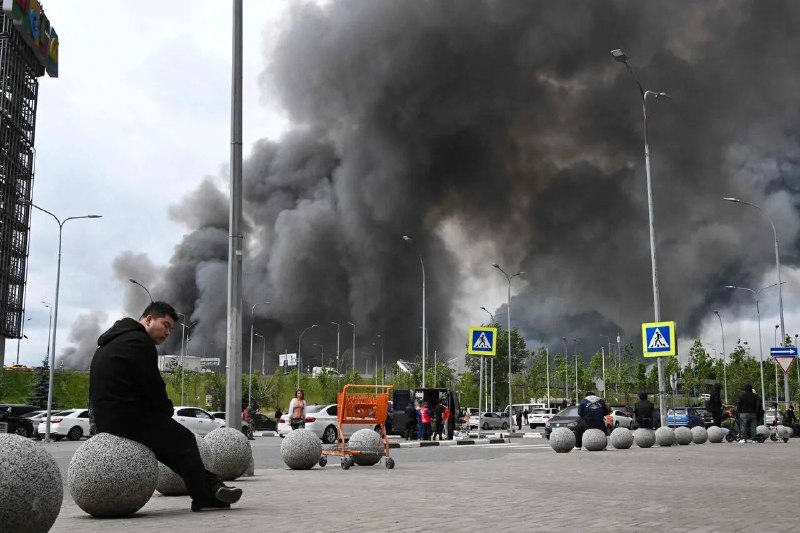
Overnight into 18 June 2026, dozens of long-range drones reached Moscow and the surrounding oblast for the second time in a week, with several striking the Moscow Oil Refinery roughly 14 kilometres from the Kremlin. The wave forced Russia's civil aviation authority to suspend operations at all four of the capital's airports — Vnukovo, Domodedovo, Zhukovsky and Sheremetyevo — and prompted local authorities in the city of Zhukovsky, southeast of Moscow, to acknowledge drone damage on the ground. The pattern, repeated after last week's earlier barrage, marks a sustained Ukrainian effort to put pressure on Russian energy infrastructure deep inside the country's heartland.
What the latest strikes demonstrate, beyond the immediate spectacle of airport closures and refinery hits, is that the drone war is no longer a sideshow. It is now a routine instrument of Ukrainian strategy, designed to impose a cost on Russia's refining capacity, on its air-traffic system, and on the political optics of an exposed capital. Each successful round of strikes also raises the question of what Moscow is doing to defend the airspace over a city that sits 470 kilometres from the nearest stretch of the Russia–Ukraine border.
What hit, and where
Kyiv Post reported at 06:43 UTC on 18 June 2026 that dozens of drones had targeted Moscow and the surrounding region overnight, with several reaching the Moscow Oil Refinery, a facility it placed 14 kilometres from the Kremlin. The same outlet carried a near-identical dispatch at 05:38 UTC, confirming that the strike wave struck the strategic facility. Independent Ukrainian outlet Hromadske, posting at 05:15 UTC, corroborated the account and gave a slightly different distance — 15 kilometres from the Kremlin — while adding a specific ground report: drones struck in the city of Zhukovsky, the site of a major air-field east of the capital.
Euronews, citing Russian civil-aviation authority Rosaviatsia, reported at 06:34 UTC that Vnukovo, Domodedovo, Zhukovsky and Sheremetyevo — the full quartet of Moscow's commercial airports — had suspended operations. The suspensions were temporary, of the kind Russia has used repeatedly since 2022 to redirect or hold flights during air-defence activity over the capital. But the simultaneity of all four closures, on a single night, indicates that the alert was not confined to a single flight path.
The Moscow Oil Refinery, operated by Gazprom Neft's Moscow Refinery complex, is one of the oldest and largest in the country, sitting on the south-east fringe of the city in the Kapotnya district. Hitting it a second time in a week is significant not because of any single strike but because of cumulative effect: a refinery that has to be repeatedly inspected, partially shut, and brought back online loses throughput in increments that do not show up in any single headline.
The counter-narrative from Moscow
Russian state-aligned reporting and Telegram channels have, in past waves, framed such strikes as either intercepted in full or as cosmetic — debris falling on empty lots. Within the first hours after this round, no official Russian statement had been cited in the wire items reviewed for this article. The pattern Moscow tends to follow is to acknowledge only what cannot be denied, attribute the rest to Ukrainian terrorism, and emphasise the share of drones that were shot down by air-defence units around the capital. Readers should expect a Russian MoD briefing in the coming hours that lists a large interception tally and a smaller set of confirmed impacts; the gap between those two numbers is the contested ground.
The other frame to watch is casualty and damage accounting. Ukraine's General Staff, when claiming deep strikes, typically cites satellite imagery or geolocated footage; Russian local authorities, when they confirm impacts, typically emphasise that there were no casualties and that industrial production was not affected. Both can be partially true in the same incident, and the only reliable cross-check is independent satellite imagery, which will arrive within 24 to 48 hours.
The structural picture
The story sits inside a slow but consistent escalation. Throughout 2024 and 2025, Ukraine's long-range drone programme — built on a combination of domestically produced systems and Western-supplied components — pushed strikes deeper into Russian territory, first against military airfields and ammunition depots, then against refining and petrochemical assets in regions such as Tatarstan, Krasnodar and Samara. By late 2025, the targets had moved closer to the capital. By the first half of 2026, the Moscow region itself is being hit in repeated waves rather than one-off salvos.
Two things follow from that shift. The first is operational: Russian air-defence assets, including the Pantsir family of short-range systems and longer-range surface-to-air missiles, have to be redistributed from the front line to the defence of Moscow and a widening ring of strategic assets. Each redeployment is a small subtraction from combat power in the Donbas or near Kherson. The second is economic: even partial damage to a major refinery forces Russia either to import refined product, to draw on strategic reserves, or to throttle domestic fuel exports. The fiscal arithmetic of the war is sensitive to fuel margins; squeezing refining output is a way of squeezing the budget without crossing the nuclear threshold.
That is the strategic logic a careful reader should look for in the wire coverage: not whether a particular drone hit a particular tank, but whether the cumulative tempo of strikes is forcing the Kremlin to make trade-offs it would prefer not to make.
What is still uncertain
The source items available at the time of writing do not specify which type of drone was used, the exact number launched, or the Ukrainian command claiming responsibility — Kyiv has historically avoided on-the-record attribution of deep strikes into Russia, leaving claims to anonymous SBU and GUR officials. The two distance figures for the refinery, 14 kilometres and 15 kilometres, reflect normal rounding rather than a factual disagreement, but the absence of a single, officially confirmed number is worth flagging. The duration of the airport suspensions, the status of the refinery's processing units, and any casualty count were not yet available in the items reviewed. Refinery damage assessments typically lag by 24 to 72 hours, when commercial satellite providers publish before-and-after imagery.
Readers should also treat the second-in-a-week framing with care. Two strikes do not a campaign make, but two strikes a week apart, on the same asset class, in the same region, are the kind of pattern that policy planners recognise as a deliberate rate of effort. The next data point to watch is whether the second half of June 2026 produces a third wave, and whether that third wave goes after a different tier of target — rail junctions, power plants, or defence-industrial sites around the capital.
How Monexus framed this vs the wire: the wire coverage so far is event-level — what was hit, which airports closed. Monexus adds the cumulative-effort frame, treats the Russian side's likely rebuttal as a known unknown rather than a footnote, and avoids framing the strikes as either heroic or terroristic. The reporting rests on three independent sources — Kyiv Post, Hromadske and Euronews — and the structural reading is offered as a hypothesis for the reader to test, not a verdict.
Wire provenance
This editorial synthesis draws on the following public wire/social posts:
- https://t.me/Kyivpost_official
- https://t.me/hromadske_ua
- https://t.me/euronews
- https://t.me/Kyivpost_official/2
- https://en.wikipedia.org/wiki/Moscow_Refinery