Moscow wakes to drone fire: what Ukraine's long-range strike on the capital actually says
Ukraine struck a Moscow oil refinery overnight, and Zelenskyy publicly claimed it. The strike is less about one night's damage than about a quiet threshold on range, payload, and political signalling.
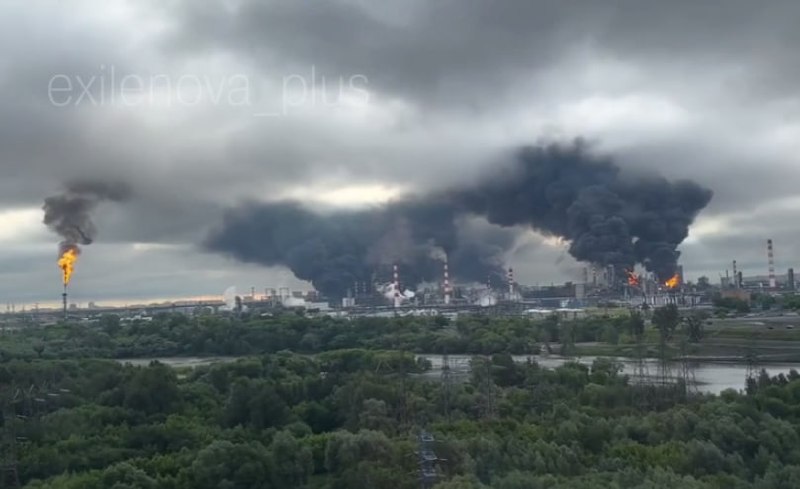
At roughly 03:00 UTC on 18 June 2026, residents in the Moscow region woke to a sound Russians are no longer used to hearing on their own soil: a sustained drone attack on a working oil refinery. By 07:02 UTC, President Volodymyr Zelenskyy had confirmed the operation publicly, framing it with the phrase that has now become routine in his nightly addresses — "this night our long-range sanctions again reached the Moscow region." That single line does more rhetorical work than any front-line communique. It re-categorises a weapons strike as economic pressure, and it tells the Russian public, in plain language, that the war has come to the fuel tanks behind their apartment blocks.
What is being struck matters as much as where. Ukrainian channels carried footage of an obliterated tank roof at a Moscow oil refinery — the kind of secondary footage that has become a familiar genre of the war since 2024, when long-range one-way attack drones first began landing on Russian downstream energy infrastructure. The political effect of these strikes compounds faster than the physical damage. Each successful refinery hit tightens diesel and gasoline supply in the regions that supply the front, while telling Russia's federal centre that the air defence perimeter around its capital is not a closed system.
The threshold Zelenskyy is name-checking
For two years Kyiv has steadily expanded the range, payload, and public attribution of its strike programme. The early phase was deliberately deniable — drones launched from trucks, no statement of authorship, plausible deniability preserved. The middle phase saw quiet confirmation through Ukrainian defence intelligence channels, with operational details filtered to friendly outlets. The current phase, visible in Zelenskyy's 07:02 UTC message on 18 June, is open political claiming. That shift is not cosmetic. Open claiming converts the strike from an act of war the Russian state can classify as sabotage into a stated policy instrument of the Ukrainian state — one with a name ("long-range sanctions") and a public schedule.
Open claiming also changes the audience. The phrase "reached the Moscow region" is aimed squarely at Russian viewers of Telegram, where the dominant pro-war talk-show host Vladimir Soloviev went conspicuously silent in the hours after the strike, according to Ukrainian channels tracking his feed. When the loudest voices on Russian state television run out of vocabulary to describe an attack on the capital, the information environment has shifted, even if no single refinery roof changes the front line by Tuesday.
What the counter-narrative will say — and why it still matters
The Russian state-aligned framing has been remarkably stable across two years of strikes: every attack is either a Ukrainian provocation, a false flag, or a NATO-directed escalation that justifies a reciprocal response. That framing will reappear within hours of this strike, sourced through TASS, RIA, and the talk-show circuit. It deserves to be named, not because it is correct, but because it is the only frame in which Russia's strategic choices are being made. A reader who dismisses it wholesale will misread the next round of mobilisation rhetoric.
A second, more interesting counter-narrative sits inside Western commentary. There, the dominant worry is escalation: each new strike inside Russia raises the temperature, draws retaliation against Ukrainian cities, and tests the patience of the Western publics whose weapons Kyiv is firing. That concern is real and worth weighting. It is also incomplete. Ukrainian cities have been hit every night of this war. The asymmetry that Western commentary treats as escalation risk is, on the ground, the baseline. The honest question is not whether long-range strikes risk escalation in some abstract sense — they obviously do — but whether the alternative, a war of attrition bounded by a fixed Russian air-defence perimeter, produces a worse outcome for Ukraine than a slow-motion widening of the strike envelope.
The structural frame, without the theorist
What we are watching is a deliberate erosion of the territorial premium that the Russian state has historically charged for attacking its interior. For most of the post-Soviet period, the implicit deal between the Kremlin and the Russian public was that the metropole would remain physically insulated from the costs of imperial policy. That insulation is now visibly cracked. Drone debris falls on residential districts. Refinery capacity burns. Talk-show hosts run out of adjectives. None of this is yet a strategic defeat for Moscow. It is, however, a change in the political economy of the war — and political economies, once shifted, do not snap back.
The deeper pattern sits inside the economics of energy infrastructure. Russian downstream oil is the soft underbelly of the war economy: technically complex, geographically concentrated, slow to repair, and politically radioactive when fuel queues form. Long-range drone strikes target exactly that profile. They are cheap, attritable, and they monetise at the pump. That is why Kyiv has chosen this instrument over higher-profile alternatives.
Stakes, and what remains genuinely uncertain
If the trajectory continues, three things follow over the next twelve months. First, refinery downtime tightens Russian diesel supply for military logistics at the front, raising the marginal cost of every armoured advance. Second, the political cost of the war inside Russia rises as refinery disruption reaches regional fuel markets beyond Moscow. Third, the Western coalition's tolerance for Ukrainian long-range operations is tested in slow motion — each strike invites a fresh round of "are we escalating?" commentary that Kyiv has so far managed to ride out by being visibly restrained about civilian casualties inside Russia.
What the public record still does not pin down is the specific refinery site. Ukrainian sources named the Moscow oil refinery and circulated footage of a tank lid blown clear, but no independent geolocation of the struck facility had been published in the source material reviewed at the time of writing. Casualty figures inside the refinery perimeter were not reported. The exact drone count, mix, and launch profile also remain undisclosed on the open Ukrainian side — a feature, not a bug, of long-range strike doctrine. That opacity is part of the programme, and it is what makes the political claiming — the Zelenskyy quote, the silence from Soloviev, the Moscow morning headlines — the actual story. The hardware is deniable. The politics are not.
Desk note: Monexus frames the strike as a Ukrainian operation against Russian energy infrastructure, with Russian state-aligned commentary treated as a documented counter-frame rather than a co-equal account. The wire default of "both sides trading strikes" obscures the asymmetry that defines the conflict — Ukraine as the invaded party striking legitimately into aggressor territory, Russia absorbing those strikes while continuing to bombard Ukrainian cities.
Wire provenance
This editorial synthesis draws on the following public wire/social posts:
- https://t.me/Pravda_Gerashchenko
- https://t.me/Pravda_Gerashchenko
- https://t.me/Pravda_Gerashchenko
- https://t.me/Pravda_Gerashchenko