Moscow burns: what the drone strikes on Russia's capital actually signal
A mass overnight Ukrainian drone attack set fires at a Moscow oil refinery, the Sadovod Market, and across residential districts — and reset the question of whether escalation management has any meaning left.
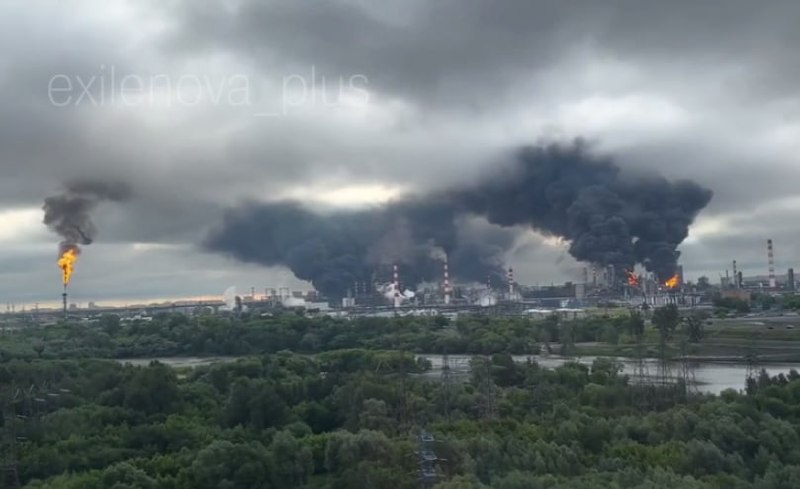
Thick black smoke covered parts of Moscow on the morning of 18 June 2026 after a mass Ukrainian drone attack triggered fires across the Russian capital, including a major blaze at the Sadovod Market when intercepted UAV debris hit the shopping complex, and a separate strike on a Moscow oil refinery that sent the roof of an oil storage tank skyward. Russian authorities reportedly activated evacuation measures in several neighbourhoods. The strikes, reported between roughly 03:43 and 03:58 UTC, are the most direct symbolic hit on the Russian capital in a campaign that has steadily migrated from border-region refineries toward the metropolitan core.
The question is no longer whether Ukraine can reach Moscow. It demonstrably can. The question is what reaching Moscow means for the war — for Russian domestic politics, for the escalatory calculus of outside powers, and for an energy market that has spent four years pretending Russian hydrocarbons are untouchable.
The strike on the capital
The first images out of Moscow on 18 June were not propaganda stills. Telegram channels aligned with Russian military correspondents — the same ecosystem that has narrated this war for Russian audiences — carried footage of an oil storage tank roof blown clear of its housing at a Moscow oil refinery, with debris scattered across the surrounding compound. Separately, fires broke out at the Sadovod Market, one of the largest wholesale retail complexes in Europe, after Russian air-defence interceptions sent falling debris into the structure. Smoke was visible across multiple districts; residential evacuations were reported.
The pattern of the attack — large volley, mixed payload, designed to saturate rather than to surgically destroy — is the same playbook Ukraine has used against Russian refinery and storage infrastructure since 2024. What is new is the geography. Sadovod sits in the south of the city. The refinery is inside the Moscow ring. The Kremlin's air-defence umbrella, the most expensive in the Russian armed forces' inventory, was designed for exactly this scenario and visibly failed to prevent either hit.
What Moscow's framing tells us
Russian state media has not, as of the time of writing, settled on a unified line. The reflex is to minimise — "drone debris," "air defence successfully repelled," "no critical damage" — but the images coming from Russian Telegram channels undercut that story. When the footage is being shared by Russian military correspondents rather than Ukrainian sources, the information environment inside Russia is being forced to acknowledge a hit it would prefer to spin away.
That is the operational point of attacks on the capital. A refinery in Krasnodar or a depot in Bryansk can be filed under "the war, somewhere else." A market fire in Moscow cannot. The political cost of cumulative attrition in the hinterland was always going to be lower than the political cost of a single dramatic night in the centre; Ukraine appears to have calculated that the second cost is the one that matters.
The structural frame
Four years into the full-scale invasion, the strategic logic of the drone campaign is consistent. Russia finances the war through hydrocarbons. Ukraine cannot match Russian fires in kind; its energy infrastructure is already wrecked. The asymmetric response is to degrade the revenue base from a distance, at low cost per shot, in a way that compounds over months rather than days. Strikes on Moscow itself are a derivative trade on the same logic — they increase the political price per litre of refined product, not by destroying supply outright, but by forcing Russian insurers, refiners, and regional governors to price in the possibility that any given facility is one overnight away from a fire.
This is a slow-motion strangulation, not a knockout blow. Its effect on Russian state revenue is real but partial; its effect on the domestic political weather inside Russia is potentially larger. A government that sells itself as the guarantor of stability has to explain to Muscovites why their market is on fire.
Stakes and what remains uncertain
The plausible alternative reading is the one Moscow is offering: that this is a one-off propaganda strike, that the damage is cosmetic, and that escalation management is intact. The footage from Russian channels makes that harder to sustain, but it is not yet falsified. Casualty figures, refinery throughput loss, and the actual extent of structural damage at the refinery are not in the source material this article is built on. The sources do not specify the number of drones launched, the type, or the success rate of Russian interception — they only show the aftermath.
What is certain is that the geography of the war has shifted again. Strikes inside Russia are legitimate responses to an aggressor; they have been the consistent position of this publication and of every Western capital that has continued to arm Ukraine. The deeper question is whether outside powers treat a flaming Moscow as a stress test of their red lines, or as confirmation that the existing red lines were always theatrical. The answer to that question will determine the trajectory of the next quarter — and possibly the next year.
The Monexus desk treats the strike on Moscow as a Russian front rather than a separate "capital attack" story — the same campaign that has been hitting refineries in Tatarstan and Samara, now inside the ring. Where wire coverage has focused on the dramatic footage, this piece asks what the geography of the attack implies about the months ahead.
Wire provenance
This editorial synthesis draws on the following public wire/social posts:
- https://t.me/Kyivpost_official
- https://t.me/noel_reports
- https://t.me/noel_reports