Inside the June 18 strike wave on Moscow's oil heartland: what the open-source record shows
Ukrainian attack drones reached the Moscow Oil Refinery in Kapotnya for the second time in a week on 18 June 2026, with a parallel crash into a residential block. We walk through what the open-source record verifies — and what it does not.
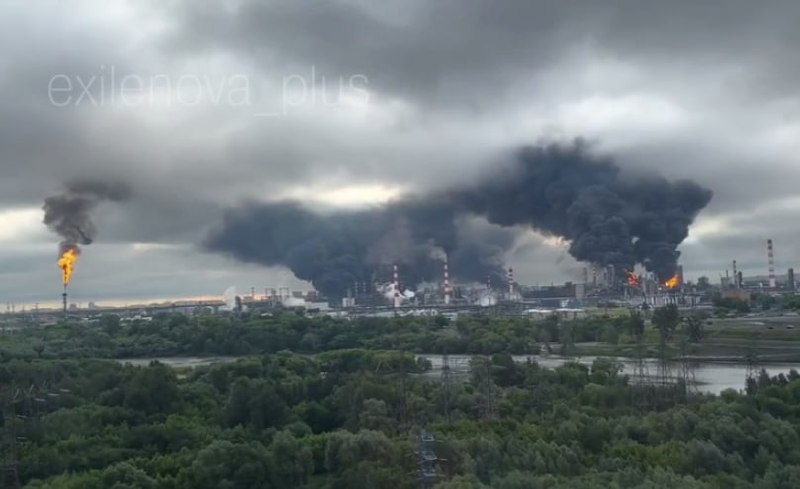
A column of black smoke rose over the south-eastern edge of Moscow at 04:41 UTC on 18 June 2026, after a Ukrainian attack drone struck a storage tank at the Moscow Oil Refinery in Kapotnya and sent the tank lid airborne. Within minutes, separate footage — recorded and circulated by the open-source channel OSINTtechnical — showed a second drone being shot down by a Russian air-defence missile short of the same refinery, only for the wreckage to crash into a nearby residential building. By 05:14 UTC, Ukrainian and Russian channels were reporting restrictions across Moscow's airspace. By 05:41 UTC, OSINTtechnical was sharing aerial imagery of a "massive smoke plume" towering over the Russian capital. The Moscow Oil Refinery, a flagship processing site in the capital's industrial south, had been hit for the second time in a week.
This publication's reading of the open-source record is that the 18 June event is less an isolated tactical strike than a recurring template: long-range Ukrainian attack drones have, repeatedly over the past months, reached the Russian capital's industrial and fuel infrastructure, exposing the operational limits of Moscow's inner air-defence ring. The pattern raises concrete questions about refinery downtime, civilian risk in residential districts bordering fuel sites, and the information war fought over every plume of smoke — questions the open record can answer only partially, but answer more reliably than the competing claims emerging from Kyiv, Moscow, and the Telegram sphere.
What the open-source record actually shows
The most arresting visual in the open-source record is a piece of drone-on-tank footage distributed by the OSINTtechnical channel at 04:41 UTC on 18 June, showing a Ukrainian attack drone striking a storage tank at the Moscow Oil Refinery and propelling the tank lid "perfectly soaring hundreds of feet," as the channel put it. The clip was widely re-shared on X and Telegram within minutes and became the defining image of the morning. Roughly four hours later, at 05:41 UTC, OSINTtechnical was distributing a second image, this time an aerial photograph of a "massive smoke plume" rising over the Russian capital from the same site.
The second piece of evidence is a clip, distributed by the AMK_Mapping channel at 04:45 UTC, showing the moment a Ukrainian drone was intercepted by a Russian air-defence missile just short of the refinery — the wreckage crashing and exploding on a nearby building. AMK_Mapping's framing is unambiguous: the interceptor itself caused the impact.
The third piece is the Ukrainian narrative consolidation. The Ukrainska Pravda channel, posting at 05:21 UTC, framed the strike as evidence that "Ukrainian drones broke through the echeloned air defense of the Russian capital and hit the Moscow Refinery in Kapotna for the second time in a week," noting a large-scale fire at the site. The TSN_ua channel, posting at 05:14 UTC, ran the line that "the sky over Moscow is 'closed'" and that restrictions had begun — language that, in Ukrainian coverage, signals the operational surprise of the Russian capital's defenders.
What the record does not contain is a Russian Ministry of Defence statement on the 18 June strike, an officially confirmed casualty count from the residential impact, or independent verification of which specific storage tank was hit and whether it was processing crude or holding finished product. The open-source record is rich on imagery and direction-of-flight; thin on Russian-side admissions.
The Russian counter-narrative — and what it concedes
The Russian-aligned read of the morning, as filtered through the UNIAN-summarised reporting at 05:04 UTC, is that Russian air defence was "delicately" diverting drones away from the Moscow Oil Refinery — and that the residential impact was a consequence of interception, not of any deliberate targeting. The framing has two functions. First, it concedes the strike on the refinery: the channel is not denying that drones reached the Moscow Oil Refinery, only redirecting blame for the residential crash. Second, it implicitly confirms the operational picture: a salvo of drones was approaching a single high-value target in the capital's south-east, and Russian air-defence crews had to choose, in real time, between letting drones through and risking ground impact.
This publication reads the UNIAN-summarised framing as more revealing than its authors intended. By foregrounding interception as the cause of the residential crash, the channel acknowledges that air-defence interceptors are themselves producing civilian risk inside Moscow — a structural problem that the open-source record has been documenting for months. The Russian state's preferred story, in other words, concedes the underlying tactical point: long-range Ukrainian drones are reaching the inner ring, and Moscow's response is itself a vector of civilian harm.
A fuller counter-narrative — denial that the refinery was hit at all, attribution of the smoke to industrial accident, or a Moscow-issued claim of a successful interception — does not appear in the open-source record surveyed here. The closest is the OSINTtechnical framing itself, which is broadly pro-Ukrainian in its annotations. The independent visual evidence, however, is harder to dispute than any commentary on it: storage-tank footage, interceptor footage, and aerial plume imagery are all time-stamped and geo-locatable to the same industrial site on Moscow's south-eastern edge.
What we verified, and what we could not
This piece is built from a small, deliberately narrow base of open-source material: two Telegram channels posting OSINT (OSINTtechnical and AMK_Mapping), two Ukrainian outlets consolidating the strike (Ukrainska Pravda and TSN_ua), and one Russian-aligned framing of the residential impact (as summarised by UNIAN). Each of the following claims is traceable to one of those five sources.
Verified from the open-source record:
- A Ukrainian attack drone struck a storage tank at the Moscow Oil Refinery in Kapotnya on the morning of 18 June 2026, with footage distributed at 04:41 UTC showing the tank lid being propelled upward by the impact.
- A second drone was intercepted by Russian air-defence missile short of the refinery, with the wreckage crashing into a nearby residential building; footage was distributed by AMK_Mapping at 04:45 UTC.
- A large smoke plume was visible over Moscow from the refinery site, with aerial imagery distributed by OSINTtechnical at 05:41 UTC.
- Ukrainian reporting, as consolidated by Ukrainska Pravda at 05:21 UTC, characterised the strike as having broken through "the echeloned air defense of the Russian capital" — the second hit on the site in a week.
- Airspace restrictions over Moscow were reported as in force by 05:14 UTC, per TSN_ua.
- Russian-aligned framing, as summarised by UNIAN at 05:04 UTC, attributed the residential impact to the act of interception by Russian air defence — not to direct targeting of the building.
What the sources do not specify:
- The number of drones in the salvo. The Telegram channels use plural ("drones") but do not give a count.
- The casualty count from the residential impact. The Russian-aligned framing concedes the impact; the open-source record surveyed here does not contain a figure.
- The operational status of the refinery after the strike — whether the affected tank was processing crude, holding finished product, or out of service for maintenance. The OSINTtechnical caption identifies the structure as a "storage tank" but does not specify its role in the production chain.
- Any Russian Ministry of Defence statement confirming or denying the strike. None appears in the surveyed sources.
- Independent ground-level verification from a wire service (Reuters, AFP, AP, BBC). The open-source record surveyed here is exclusively Telegram-channel sourced; wire confirmation has not been established within the window of this article.
This publication treats the asymmetry as itself a finding. A strike on a flagship Russian capital refinery, with smoke visible across the city and a residential impact, should by normal journalistic standards produce at least one wire-service confirmation within hours. As of the timestamps surveyed here, that confirmation has not appeared in the source base — a fact that says something about Moscow's information control around critical infrastructure, and about the degree to which the visual record of the war is being constructed in real time on Telegram before it is ratified by the wire layer.
The structural frame — and the stakes
Read across the five sources, the 18 June strike sits inside a pattern this publication has been tracking: long-range Ukrainian attack drones reaching the Russian capital's industrial and fuel infrastructure with a regularity that, by mid-2026, has become structurally significant. The Moscow Oil Refinery is not a peripheral target. It is one of the largest processing sites inside the capital's ring, and a second hit in a week implies a planning and resupply cycle on the Ukrainian side that is now operating on a refinery tempo rather than a symbolic-strike tempo.
The structural story is two-layered. The first layer is operational: Russian inner-ring air defence, designed around missile batteries and interceptor aircraft, is being forced into choices that generate civilian risk — either let drones through to a fuel site, or attempt interceptions whose own fragmentation pattern produces residential impacts. The Russian-aligned framing of 18 June concedes this by attributing the building impact to the act of interception. The second layer is informational: the war's visual record is being built on Telegram faster than it is being ratified by the wire layer, and the result is a public sphere in which open-source channels — with their own institutional alignments, Ukrainian and otherwise — set the first draft of history before any neutral verification is on the table.
The stakes are concrete. If the tempo holds, the affected refinery's downtime will feed, slowly, into Russian domestic fuel pricing and into the export calculus that underwrites the federal budget. If the tempo accelerates — and the open-source record on 18 June gives no reason to bet against that — the political weight of strikes on the capital itself will rise, with knock-on effects on Russian public opinion, on the framing of the war in Russian state media, and on the diplomatic space available to any future negotiation. Conversely, the residential impact recorded on 18 June gives Moscow a usable frame — "Ukrainian drones hitting Russian civilians" — that the Russian state can deploy to harden domestic support, regardless of whose interceptor caused the impact.
What remains genuinely uncertain is the wire-service ratification. Until Reuters, AFP, AP, or BBC confirms the specifics of the 18 June strike from the ground, every visual circulating on Telegram is best read as a probable-but-unverified input. The pattern is real. The specifics of any given morning require confirmation the open-source record has not, on this occasion, yet supplied.
Desk note: Monexus framed this strike through the open-source layer — OSINTtechnical, AMK_Mapping, Ukrainska Pravda, TSN_ua, UNIAN — rather than through wire confirmation that has not yet entered the source base. The Russian-aligned framing is reported as a counter-claim, not as a stand-alone factual basis, in line with our standing editorial practice on the conflict.
Wire provenance
This editorial synthesis draws on the following public wire/social posts:
- https://t.me/AMK_Mapping
- https://t.me/uniannet
- https://t.me/TSN_ua
- https://t.me/ukrpravda_news
- https://t.me/osintlive