Moscow refinery struck as Ukraine's drone campaign reaches the capital's fuel supply
A Ukrainian drone strike hit the Moscow oil refinery in the early hours of 18 June 2026, lighting up an oil tank and forcing fresh questions about how deep into Russia Kyiv's long-range campaign can reach.
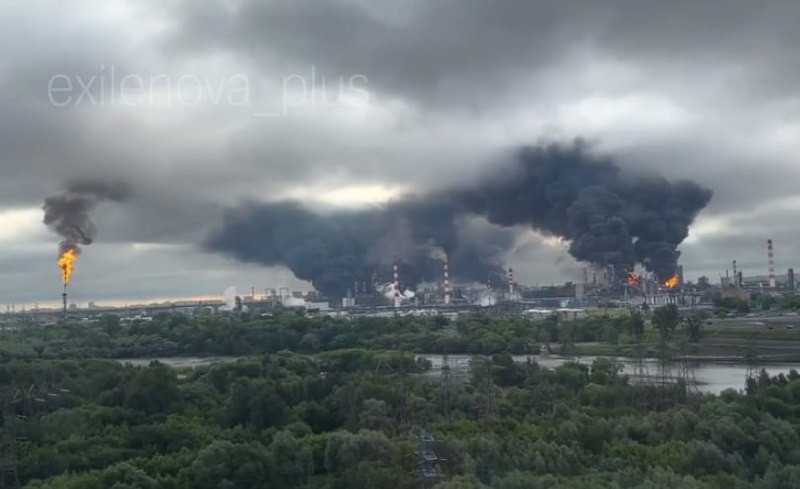
A fire broke out at a Moscow oil refinery in the early hours of 18 June 2026 after a Ukrainian drone strike, with the blast lifting the lid off at least one storage tank and sending a column of flame into the night sky above the Russian capital. Ukrainian Telegram channels circulated footage of the burning tank within minutes of the impact, while Russian air-defence units reported downing a further ten unmanned aerial vehicles over the Moscow region in the same wave. The strike, if confirmed at the scale early footage suggests, would be one of the most visible hits yet on the infrastructure that keeps Russia's domestic fuel market and export chains running.
Kyiv has spent two years extending the range of its strike campaign, moving from border-region sabotage to systematic attacks on refineries, fuel depots and military logistics hubs hundreds of kilometres inside Russian territory. The Moscow refinery hit on Thursday morning is the symbolic centre of that map. A successful strike on the capital's fuel supply is no longer a one-off spectacle; it is the logical endpoint of a deliberate industrial-policy decision by Ukraine, backed by Western partners, to weaponise Russia's energy economy.
What the morning's footage shows
The clearest sequence of images came from the Telegram channel operativnoZSU, which posted video at 06:36 UTC on 18 June 2026 showing flames and a blown-off tank roof at the refinery, captioned with the line "Meanwhile, evening has come in Moscow" — a turn on the wartime taunt that Russian channels used to deploy about Ukrainian blackouts. Within minutes, the Ukrainian journalist and Telegram channel host Yuriy Tsaplienko was broadcasting footage of the same incident from a different angle, telling viewers "the lid is flying off the oil tank of the Moscow refinery" and inviting Russian "popular correspondents" to come and document the wreckage. The two feeds, while both Ukrainian-adjacent, used independent camera positions, which is consistent with separate eyewitnesses rather than a single shared source.
Russian authorities in Moscow confirmed that air-defence units had engaged multiple drones across the region during the night of 17–18 June, reporting that ten UAVs had been intercepted. Moscow's mayor, Sergei Sobyanin, has been the public face of these nightly tallies throughout the campaign. The combined picture — a successful hit on a storage tank plus a wave of interceptions around it — matches the now-familiar Russian pattern of disclosing only what cannot be denied, after the video has already done the disclosing for them.
How big a deal is one refinery tank?
A single storage tank on fire is not, on its own, a strategic event. The Moscow refinery complex is a sprawl of distillation units, cracking towers and storage yards; losing one tank affects throughput at the margins. But the symbolic and political weight is different from the operational weight, and the political weight is what Kyiv is buying with these strikes. A flaming tank in the Moscow sky is broadcast, within minutes, to every Russian Telegram user with a phone in their hand. The point of the campaign is cumulative embarrassment.
The structural argument runs as follows. Russia's war economy depends on three flows: budget revenue from hydrocarbon exports, domestic fuel supply at prices the population tolerates, and the steady throughput of military logistics through refineries and depots that double as fuel nodes. Strikes on export terminals in Ust-Luga and Novorossiysk have moved the first flow. Strikes on domestic refineries — in Ryazan, in Krasnodar, in Volgograd — have moved the second. The Moscow strike, if it lands at the scale early footage suggests, moves both at once. Russian refiners have already absorbed months of disruption; export volumes to buyers in India and Turkey have not collapsed, but the discount at which Russian crude trades has widened. The Moscow incident is the next line on that graph.
There is a counter-narrative that deserves airtime. Russian oil-industry analysts point out that Soviet-era refineries were built with redundancy precisely because of wartime targeting expectations, and that one burning tank does not shut a plant. Russian Telegram channels with military audiences have spent the last year arguing that Ukrainian strikes are tactical theatre: high in spectacle, modest in strategic effect. That argument has empirical force. The structural case for Ukrainian strikes rests on cumulative pressure, not on any single fire. By that standard, the Moscow hit is one more line on a chart, not a break in the line.
The two-year arc
Ukraine's deep-strike programme was not always aimed at Moscow. In 2023, the bulk of Ukrainian long-range strikes hit Russian logistics in occupied Ukraine and in the Russian border regions of Belgorod and Bryansk. Through 2024, the campaign pushed deeper — first at fuel depots in Rostov and Krasnodar, then at refineries in Ryazan and Nizhnekamsk, then at the Tuapse export terminal on the Black Sea. The Moscow region entered the target set later, and at lower tempo, partly because the air-defence density around the capital is much higher than around regional refineries and partly because the political symbolism of a Moscow strike demands higher confidence of success.
The shape of the campaign has tracked a learning curve. Early Ukrainian long-range drones had high loss rates to Russian electronic warfare and short-range air defence. As the airframes, the routing software and the swarming tactics have matured, more drones have made it through. Russian air-defence interception rates have remained high in public reporting, but a defence that has to score a hundred per cent to keep the tank farm intact is a defence that loses slowly until one night it does not.
What the wire said, and what it did not
Euronews reported on the morning of 18 June that the attempted UAV attack on Moscow was the largest in the last two years, citing Russian media and the city's own count of interceptions. The wire reporting is, on this story, mostly downstream of Russian disclosures — a structural feature of covering strikes inside Russia, where Moscow controls the camera angle and the official tally. Ukrainian channels set the narrative frame; Russian official channels set the data; Western wires carry both.
What the available sourcing does not specify: the precise name of the refinery complex struck, the volume of product lost in the fire, whether the unit was already scheduled for maintenance turnaround, and whether any casualties resulted. These gaps matter. A hit on a mothballed tank is a photo opportunity; a hit on an active distillation unit with workers on site is a different story. The morning's footage shows a tank fire, not a process-unit fire, which suggests the operational hit is contained — but the sources do not confirm that explicitly.
Stakes
If the Moscow strike pattern holds — one major visible hit per month, surrounded by smaller interceptions — the political pressure on the Kremlin to negotiate from a position of domestic strength will erode slowly. Russian fuel prices are already climbing; the budget is already stretched by war spending and discounted crude sales. None of these trends are sudden. None of them require a single dramatic blow to break the system. That is the structural argument for the campaign: it is a slow tightening, not a strike on a single weak point.
The counter-stake for Russia is that domestic tolerance for war is high and that the political system has weathered worse visibility shocks than a refinery fire. Russian wartime polling, such as it is, has held remarkably steady through two years of strikes on Russian soil. The Moscow refinery on fire does not, on its own, move that number. It moves the number only if the fires keep coming, and if the public stops believing the nightly official line that everything is being intercepted before it lands.
For Ukraine, the upside is symbolic and bargaining leverage. The downside is escalation. Strikes inside Moscow raise the political temperature in ways strikes on Belgorod refineries do not, and they invite retaliatory strikes on Ukrainian energy infrastructure — which Kyiv can ill afford, given the state of the grid. Every deep strike Kyiv launches is also a Russian rationale for a deeper strike back.
The Moscow refinery is still burning as this article files. The lid is off, in Tsaplienko's phrase. Whether the fire is the line on the chart or the break in the chart, the morning's footage will not decide. That is decided by what comes next week, and the week after, and whether the air-defence density around Moscow holds or erodes one night at a time.
Desk note: Monexus has framed this as a structural, cumulative campaign rather than a single dramatic event, on the available evidence that the strike fits a pattern of prior Ukrainian deep strikes rather than representing a qualitative break. Western wire reporting on Russian airspace remains heavily dependent on Russian official tallies; we have flagged that dependency rather than smoothed it over.
Wire provenance
This editorial synthesis draws on the following public wire/social posts:
- https://t.me/Tsaplienko
- https://t.me/operativnoZSU
- https://t.me/euronews
- https://t.me/operativnoZSU
- https://t.me/euronews
- https://t.me/Tsaplienko