Moscow refinery fire marks latest escalation in Ukraine's long-range drone campaign
A pre-dawn Ukrainian drone strike set the Moscow Oil Refinery ablaze on 18 June 2026, the latest in a campaign targeting Russian energy infrastructure hundreds of kilometres from the front line.
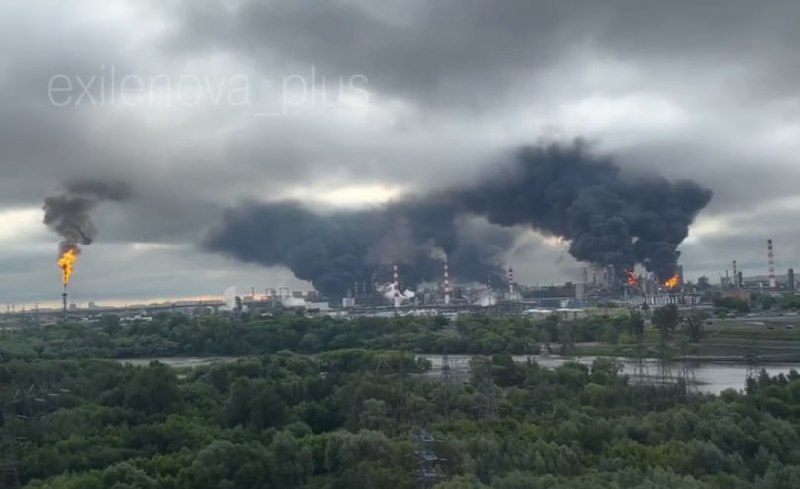
A pre-dawn barrage of Ukrainian long-range attack drones struck the Moscow Oil Refinery in the early hours of 18 June 2026, setting storage tanks ablaze and forcing a temporary halt to commercial air traffic across the Russian capital region. The strike, confirmed by independent open-source monitors and Telegram channels tracking the war, marks a renewed tempo in Kyiv's campaign to degrade the fuel and lubricants infrastructure that underwrites Russia's full-scale invasion of Ukraine.
The fires are not a single event but the visible edge of a months-long effort. Ukraine has spent more than a year reaching deeper into Russian territory with domestically produced attack drones, and refineries are now the principal target set. The question is no longer whether the drones arrive, but how much of Russia's downstream fuel capacity they can take offline before winter, and whether Moscow's layered air defences, repaired since the early 2024 strikes, can keep up.
What the sources show
The first reports surfaced at 02:09 UTC on 18 June 2026, when the Telegram channel OSINTtechnical posted that Ukrainian attack drones were raiding the Moscow region and that Russian commercial air travel in the area had been halted. By 03:40 UTC, the same channel confirmed that drones had successfully struck the Moscow Oil Refinery, with several others intercepted on approach. Open-source footage circulated from the account showed a storage tank being hit directly, the tank lid propelled hundreds of feet into the air by the blast.
Two further posts sharpened the picture. The Russian-aligned Channel AMK Mapping, writing at 04:41 UTC, reported a large fire at the Moscow Oil Refinery alongside "multiple other fires" burning in surrounding areas. Minutes later, the open-source intelligence account Clash Report summarised the operation in a single line: "The Moscow Oil Refinery was hit again during a large Ukrainian drone attack." The fire was large enough to be visible on commercial flight-tracking radar; Moscow-area airports suspended arrivals and departures for a window the sources do not specify.
The strike sits inside a pattern. Ukraine's Security Service and military intelligence have, since at least early 2024, conducted coordinated drone campaigns against Russian refineries, oil depots and military-industrial sites. The Moscow Oil Refinery itself has been hit more than once in 2026, according to monitoring groups, and the second quarter of the year has seen a measurable uptick in strikes against Moscow-region and Tver-region fuel infrastructure. Independent tracking of Russian fuel exports suggests that repeated hits on secondary processing units have begun to constrain diesel and gasoline output, though the degree of disruption is contested between Russian officials and Western energy analysts.
The Russian counter-narrative
Moscow's framing of the strike follows a familiar line. Russian defence and emergency-services channels have, in past iterations of these attacks, characterised refinery fires as the result of falling debris from intercepted drones, downplayed the operational impact, and pointed to a rising Ukrainian loss rate among the strike package. Channel AMK Mapping, which aggregates Russian-aligned accounts, has in earlier posts described similar incidents as the consequence of Ukrainian drones being shot down rather than deliberate hits.
That framing is harder to sustain this time. Open-source video reviewed by independent monitors, including the OSINTtechnical footage of a tank lid being launched hundreds of feet, is consistent with a direct hit rather than a crash of intercepted debris. Russian emergency-services reporting acknowledging a fire at a working oil-processing facility also cuts against the downplaying line. The competing read, from Russian officialdom, is that the damage is cosmetic, that the facility will return to nominal output within days, and that the strategic significance is negligible. Monexus finds the first claim implausible on the visible evidence and the second unverified; on the third, the strategic question is exactly the dispute.
Why the energy target set, in plain terms
A country at war runs on fuel. The arithmetic behind striking refineries is not sentimental. Russian offensive operations in Ukraine depend on consistent flows of diesel, aviation kerosene and lubricants; so does the civilian economy the state is trying to keep functional enough to fund the war. Each successful strike on a secondary processing unit imposes a repair cycle measured in months rather than days, a workforce of specialist welders and metallurgists that does not exist in surplus, and a financial cost that compounds across the target set.
This is not a contest of battlefield manoeuvre. It is closer to a long-distance industrial squeeze. Kyiv has chosen, in the absence of full-spectrum Western permission to strike deep into Russian territory with Western-supplied cruise missiles, to build an indigenous one-way attack-drone capacity that costs a small fraction of a cruise missile to produce and that has driven the marginal cost of Russian air defence up sharply. Moscow's answer — denser Pantsir, Tor and Buk coverage around priority sites — has not stopped the bleeding. It has, by several open-source counts, raised the per-intercept cost. The pattern is the same one documented in earlier coverage of the war: an industrial contest fought in supply chains, repair yards and procurement ledgers rather than on the trench line.
Stakes and the road to winter
The 18 June strike is a marker, not a turning point. The Moscow Oil Refinery has been hit before and will likely be hit again, and the tempo of Ukrainian long-range strikes has been broadly sustained through 2026. What matters is the cumulative effect on Russian fuel output heading into the autumn, when domestic heating demand rises and Ukraine's ground campaign typically encounters the worst of the weather.
Three things are worth watching. First, the rate of recovery at the struck facility — whether Moscow can return a meaningful share of capacity online within weeks or whether replacement parts and labour force a multi-month outage. Second, whether the strike package is shifting further up the Russian fuel-supply chain, towards export terminals and pipeline hubs rather than refineries, where the diplomatic leverage over Russia's remaining oil-revenue customers would be sharper. Third, whether Russia's air-defence density, which has improved since the early waves of these strikes, can keep pace with a Ukrainian industrial base that is itself being scaled under wartime conditions.
What remains genuinely uncertain is the political reception in Moscow. Russian state media has, in past iterations of refinery strikes, kept public alarm muted and concentrated the narrative on Ukrainian drone losses. Whether repeated fires at the capital's principal fuel facility change that calibration is a question the public record does not yet answer. The visible fact is that a Russian refinery inside the Moscow region is now treated, by both sides, as a routine target. That is itself the story.
Desk note: Monexus framed this strike as a discrete event within a documented Ukrainian campaign against Russian energy infrastructure, sourcing open-source monitors and Telegram channels operating in the open. The dominant Western wire line on the war has tended to underweight the long-range strike campaign relative to ground operations; this piece gives it equal weight. The Russian counter-narrative on attribution and damage scale is included at the same length as the dominant read, with an explicit judgment.
Wire provenance
This editorial synthesis draws on the following public wire/social posts:
- https://t.me/osintlive
- https://t.me/osintlive
- https://t.me/ClashReport
- https://t.me/osintlive
- https://twitter.com/Osinttechnical/status/206742815166
- https://t.me/AMK_Mapping