Drones over Kapotnya: what the Moscow refinery strike actually signals
A second Ukrainian strike on the Moscow oil refinery in a week exposes the widening reach of Kyiv's long-range drone programme — and the limits of Russia's vaunted air-defence doctrine.
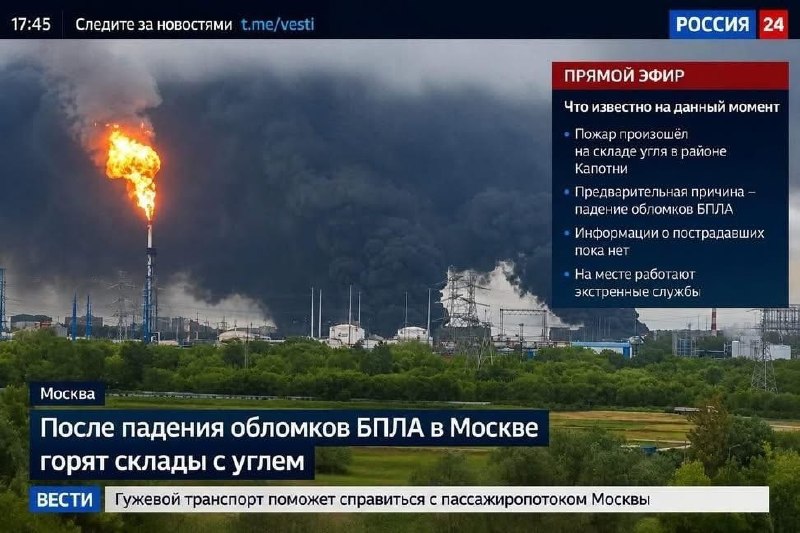
A second wave of Ukrainian attack drones punched through layered Russian air defences in the early hours of 18 June 2026 and struck the Moscow oil refinery in Kapotnya, setting a large-scale fire that sent a black smoke plume over the Russian capital. The strike, confirmed by independent OSINT analysts at 05:41 UTC, is the second hit on the same installation in a week, and it lands at a moment when Russian energy infrastructure is already under sustained pressure from a maturing Ukrainian long-range programme.
Read past the spectacle, and the strike is less about one refinery and more about a slowly collapsing assumption: that the Moscow air-defence bubble is a credible shield. Kyiv is no longer asking permission to reach deep into Russian territory. It is showing that it can do so on a tempo, with industrial-scale effect, and with diminishing Russian ability to answer.
What happened at Kapotnya
Ukrainian drones broke through the echeloned air-defence network surrounding the capital shortly before 05:00 UTC on 18 June, with at least one FP-series unmanned aerial vehicle — designated "FP-1" in battlefield reporting — impacting a process unit at the Moscow refinery complex in Kapotnya, a district on the south-eastern edge of the city. Within an hour, satellite-corroborated OSINT analysts were tracking a "massive smoke plume soaring over the Russian capital," and Russian-aligned channels were urging subscribers to share footage "with the citizens of the Russian Federation" — an implicit acknowledgement that the fire was no longer containable as a local incident. By 06:01 UTC, Russian milblogger channels were circulating the moment of impact on one of the refinery's installations. By 06:43 UTC, the same channels were blunt: "Moscow is on fire."
The refinery, operated by Gazprom Neft, is one of the largest in the Moscow region and a key supplier of motor fuels to the capital and surrounding oblast. The hit follows a first strike on the same site within the past seven days, suggesting that repairs from the earlier attack had not progressed far enough to harden the target against a follow-on.
The counter-narrative, and why it does not hold
Russian state-aligned commentary has predictably framed the strike as a provocation, and several milblogger channels have pushed a parallel line that the damage is "localised and under control." That is the version Russian domestic audiences are likely to see first. It is also the version that sits awkwardly with the photographic record: plumes visible from central Moscow, two impacts inside a week, and the explicit call from Russian-channel admins to "show it to the citizens" — language that concedes visibility even as it tries to script interpretation.
A more serious counter-read is operational: refinery fires burn hot, and the visible plume is not, on its own, proof of structural damage to distillation columns. Ukrainian strikes on Russian energy targets in 2024 and 2025 produced several such plumes that did not translate into sustained throughput losses. The honest reading is that the immediate effect is symbolic and political, and the longer-term effect on output will take days of independent satellite and trade-flow analysis to confirm.
What the strike reveals structurally
Two things are now structural, not episodic. First, the geography of "deep strike" has moved. Until 2024, Ukrainian long-range attacks on Russian soil were treated, in Western commentary, as symbolic — pinpricks meant for morale, not for the war economy. The Kapotnya strike, layered on top of repeated hits on Russian refining, fuel depots, and military-industrial sites, suggests a different calculus. Kyiv is operating a sustained interdiction campaign, not a one-off message.
Second, the air-defence story around Moscow is fraying. The "echeloned" descriptor used in the initial reporting is Russia's own — the layered rings of Pantsir, Tor, and longer-range systems designed to give the capital a defence-in-depth posture. The fact that a single district on the city's edge can be hit twice in a week, with fire visible from the centre, indicates that the system is being asked to defend too many points at once. Every long-range surface-to-air missile diverted to cover a refinery in Lipetsk or a port in Novorossiysk is one that is not covering the line of contact in Donetsk.
The deeper pattern is a slow inversion of the sanctuary assumption. For most of the post-Cold-War period, Russian heartland infrastructure sat behind a comfortable air-defence envelope. That envelope was always thinner than advertised, and the Ukrainian drone programme — cheap, attritable, increasingly autonomous — is the first sustained instrument capable of exploiting the gap at scale.
Stakes and what to watch
The political effect inside Russia is the immediate variable. Two strikes on the capital's refinery in a week, broadcast on Russian Telegram channels with a tone closer to alarm than spin, is the kind of imagery that erodes the routine. The harder question is downstream: whether Gazprom Neft can keep Kapotnya online through the summer driving season, and whether Moscow's regional authorities will impose fuel-rationing protocols that signal, to ordinary Russians, that the war is no longer something happening to someone else in someone else's oblast.
For Ukraine, the calculation is operational and finite. Every long-range strike consumes airframes, planning capacity, and political capital with Western partners who must continually weigh the risk of escalation against the value of degrading the Russian war economy. The Kapotnya strikes are a strong argument that the trade is worth it; they are not an argument that the drone programme is unlimited, and Kyiv will have to choose targets carefully through the rest of 2026.
What remains genuinely uncertain is the depth of the damage. The visible plume is consistent with a hit on a secondary process unit — storage, a flare stack, a hydrotreater — rather than a primary crude or catalytic cracker. Independent analysts with access to high-resolution commercial satellite imagery will need 48 to 72 hours to confirm. Until then, the strike sits in the gap between the symbolism of two fires in a week and the substance of what the second one actually broke.
Desk note: wire coverage of the strike is still consolidating. The independent OSINT assessment is the most specific public record of the impact zone; Russian milblogger channels, with their usual sourcing caveats, are the only sources providing ground-level footage. Reuters and AFP have not yet published confirmed estimates of structural damage.
Wire provenance
This editorial synthesis draws on the following public wire/social posts:
- https://t.me/osintlive
- https://t.me/ukrpravda_news
- https://t.me/gruz_200_rus
- https://t.me/gruz_200_rus