Pakistan brokers a paper handshake: Iran and the US sign the 'Islamabad Memorandum' as Trump confirms the deal from Versailles
A five-paragraph memorandum, signed electronically in the early hours of 18 June 2026, becomes the first formal Iran-US text since 2018 — brokered not in Vienna or Muscat but in Islamabad, with Shehbaz Sharif claiming the credit.
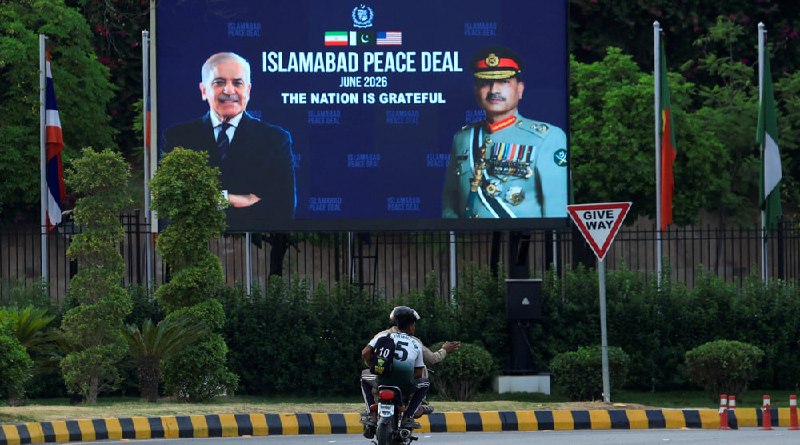
In the early hours of 18 June 2026, the government of Pakistan announced what it called a historic diplomatic milestone: an electronically signed memorandum of understanding between the Islamic Republic of Iran and the United States, concluded in Geneva and witnessed by Islamabad. Pakistan's Prime Minister Shehbaz Sharif framed the deal in a public message as the product of Pakistani mediation, and the text — dubbed the Islamabad Memorandum — was hailed by Iranian state-aligned outlets within minutes of the announcement. The US side confirmed it hours later, when President Donald Trump told reporters outside the Palace of Versailles that the memorandum had been signed.
The deal's emergence, more than seven years after Washington withdrew from the 2015 Joint Comprehensive Plan of Action, marks the first formal Iran–US written arrangement since the reimposition of maximum-pressure sanctions in 2018. That it was brokered not in Muscat, Vienna, Doha or Geneva — the traditional JCPOA-era channels — but in the chanceries of a South Asian capital signals how much the diplomatic map around the Iranian file has shifted. Pakistan, which shares a roughly 900-kilometre border with Iran and co-hosted a joint economic commission with Tehran as recently as 2024, has positioned itself as a regional convener at a moment when the Gulf's European-favoured channels have been frozen for months.
What the texts say — and what they do not
The Telegram statements from Tehran and Islamabad are short and ceremonial. Tasnim News, an outlet affiliated with the Islamic Revolutionary Guard Corps, reported at 00:08 UTC on 18 June that Prime Minister Sharif had "appreciated and thanked" both Iran and the United States, and that an official ceremony would follow in Geneva. Al-Alam, the Iranian state broadcaster's Arabic-language channel, said Sharif "emphasised" that the historic Islamabad agreement had "entered into force," language echoed almost verbatim by Fars News at 23:58 UTC on 17 June. The Israeli-aligned Geopolitical Watch channel, summarising the Pakistani statement at 23:39 UTC, gave the most explicit read of the text: a memorandum of understanding, signed electronically, with the mediation role ascribed to Islamabad.
None of the published summaries specify the substantive content — no enrichment cap, no sanctions sequencing, no IAEA verification protocol, no sunset clause. That is striking. The JCPOA ran to more than 150 pages of annexes; the texts released in the first hours of 18 June 2026 read as diplomatic communiqués rather than legal instruments. Pakistani framing of the document as a "memorandum of understanding" — a non-binding category under international-law convention — is consistent with a confidence-building text: a procedural handshake that opens a process rather than a treaty that closes one.
The Pakistani mediator and the structural stakes
Islamabad's claim of brokership is itself the story's political payload. Sharif's government has spent two years positioning Pakistan as a swing diplomatic actor between three blocs it cannot afford to alienate: a United States that remains its largest single export market and IMF creditor-of-last-resort; a Saudi-Gulf axis still processing the October 2023 events and the regional reordering that followed; and an Iran whose eastern border is, for Pakistan, both an energy opportunity and a security liability. Iran's envoy to Islamabad, Reza Amiri, and Pakistani army chief General Asim Munir held multiple meetings in the second half of 2025 on border-management, Chabahar access and energy imports. By publicly claiming credit for the Iran–US text, Sharif converts those quiet exchanges into a domestic political asset.
For Tehran, the same optics read differently. Iran's negotiating leverage in any structured talks with Washington has been weakened by an Israeli campaign that, according to Iranian sources, neutralised much of the IRGC's senior command echelon in October 2025; by a sanctions architecture that, despite selective waivers, has continued to compress rial-denominated revenues; and by a regional posture that has grown more cautious since Hezbollah's confrontation with Israel entered its terminal phase. A short memorandum, unencumbered by the JCPOA's verification burden, allows Tehran to claim the sanctions file is moving without committing to the enrichment constraints that sank Muscat in 2024.
For Washington, the calculus is simpler and more transactional. Confirming the deal from Versailles on the eve of the NATO summit gives the administration a deliverable on a file that has been politically expensive for a decade — and at a moment when the domestic appetite for a new Middle Eastern military commitment is, by every available measure, exhausted.
Counter-narrative: a paper deal, not a process
The argument against reading the memorandum as a breakthrough is straightforward. A non-binding MoU signed electronically, with no public text and no enforcement architecture, is the diplomatic equivalent of a press release. Iranian state media's immediate framing — "entered into force," "historic," "Islamabad Agreement" — is the same vocabulary Tehran deployed around the 2015 framework before its substance was negotiated and disputed for two more years. The Trump administration's confirmation is a single off-the-cuff remark to reporters at a foreign venue; no signed US text, no Treasury actions, no sanctions-licensing announcements have appeared in parallel. Pakistani claims of brokership may be premature, and may in fact become a source of friction with Tehran if Iranian principals view them as inflated.
What the available record shows is contact, not convergence. Geneva is the long-running JCPOA-era venue for Iran–US technical exchanges, and its reappearance here is consistent with a procedural relaunch rather than a substantive one. The most plausible reading of 18 June 2026 is that the memorandum commits the parties to keep talking, in a format Pakistan can credibly host, while deferring the hard questions — enrichment, missiles, regional proxies, IAEA access — to later rounds that have not been scheduled and whose shape is not yet defined.
Stakes and what to watch
The structural pattern is unmistakable. With the European-led JCPOA architecture dormant, with Gulf states wary of new US commitments, and with both Iran and the United States politically constrained from high-risk escalation, smaller and middle powers are being invited into mediation roles that the major parties used to monopolise. Pakistan is not a neutral broker in the classical sense — its economic exposure to the United States, its energy dependence on Iranian gas, and its security interests on the Balochistan border all colour its incentives — but in a region where the conventional mediators are blocked, even a partial intermediary is a scarce resource.
If the memorandum matures into a structured process, the obvious next moves are: a public read-out from the Iranian foreign ministry; a US Treasury action on humanitarian or financial-channel waivers; an IAEA verification arrangement that allows some inspection continuity; and, harder, a sequencing of sanctions relief against Iranian restraint on enrichment. If the memorandum stalls, the most likely failure mode is not a dramatic breakdown but a slow attrition — the parties agreeing in principle to continue meeting while declining to publish what they have agreed to, leaving the sanctions architecture intact and the regional status quo frozen. Both Iran and the United States have reasons to keep the process alive in the short term and few reasons to let it collapse publicly in the short term. The medium term is where the structural disagreement lives.
What remains uncertain
The sources published in the first hours after the signing do not specify the document's length, its signatories on the US side, the venue of the electronic signing, or any verification or compliance schedule. The Pakistani and Iranian readouts are not corroborated by a US government press release or by a statement from the State Department in the material available to this publication. Until those texts appear, the memorandum's legal status — and the question of whether it commits either party to anything beyond further meetings — remains a matter of diplomatic framing rather than of record.
— Monexus desk note: Western wire coverage of the JCPOA's collapse in 2018 consistently attributed agency to Washington and passivity to Tehran; this article inverts that habit by treating both sides as constrained actors in a process that none of them fully controls. The Pakistani brokership claim is treated as a substantive reporting thread, not as colour.
Wire provenance
This editorial synthesis draws on the following public wire/social posts:
- https://t.me/tasnimnews_en
- https://t.me/JahanTasnim
- https://t.me/alalamfa
- https://t.me/FarsNewsInt
- https://t.me/GeoPWatch