Pakistan brokers surprise MoU between Iran and the United States, with the Strait of Hormuz on the table
A memorandum signed on the margins of the G7 dinner in Versailles and announced by Prime Minister Shehbaz Sharif claims an immediate Iranian reopening of the Strait of Hormuz — a claim the Iranian and US principals are still framing very differently.
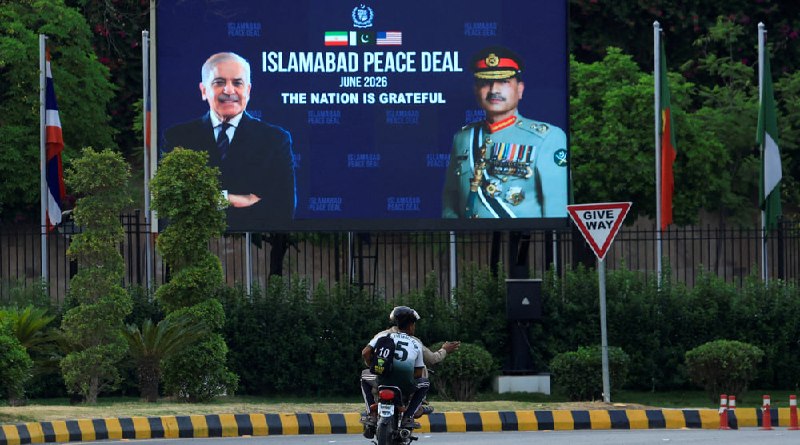
In the small hours of 18 June 2026, Pakistani Prime Minister Shehbaz Sharif stepped before cameras to declare that a "historic" memorandum of understanding between the Islamic Republic of Iran and the United States had been signed, and that Tehran would "instantly reopen" the Strait of Hormuz as a first step under the deal. The announcement, carried by Iranian state-aligned outlets and amplified by the Prime Minister's office, places Islamabad — not Geneva, not Muscat, not Vienna — at the centre of a diplomatic sequence that, if it holds, would unwind the most acute maritime choke-point crisis of the year.
The story is straightforward on its surface, and contentious underneath. The text exists; the principals on both ends have confirmed a signature; the venue is unusual. What is not yet clear is what either side believes it has signed, and how the announced "reopening" of Hormuz is to be operationalised against a backdrop of sanctions architecture, IRGC naval doctrine, and a Gulf energy market that has spent the last several weeks repricing exactly this risk.
The signing, in three acts
The first public image came from IRNA, the official Iranian state news agency, distributed via the @wfwitness channel at 00:29 UTC on 18 June 2026, showing US President Donald Trump signing the document on the margins of a G7 dinner hosted at the Palace of Versailles by his French counterpart. The second image, circulated by Mehr News at 00:33 UTC, shows Iranian President Masoud Pezeshkian — transliterated in Iranian state copy as "Baishikian" — putting pen to a counterpart document. The third act was Sharif's announcement, posted to the Prime Minister's own channels and relayed by Press TV at 01:42 UTC, framing the deal as the "Islamabad Memorandum of Understanding" — a name that locates authorship of the diplomatic choreography in Pakistan rather than at the G7 table where the ink actually met paper.
In a message issued after what Iranian and Pakistani outlets described as an "electronic" signing, Sharif said the MoU would "enter into force with immediate effect" and announced a follow-on official ceremony to be held in Geneva. Tasnim News and Al-Alam, both Iranian state outlets, carried the Pakistani statement in full, lending Tehran's broadcast infrastructure to a Pakistani-authored framing. That the Iranian side agreed to the "Islamabad" branding is itself notable: in a region where the host of a mediation is usually the one who names the document, Sharif has secured a credit that Doha, Muscat, and Beijing have spent years trying to monopolise.
What the document is, and is not, said to do
According to the Pakistani text, the MoU commits Iran to "instantly reopen" the Strait of Hormuz and to lift unspecified restrictions on shipping tied to US-flagged and US-insured vessels. The Trump confirmation, recorded by Fars News as he left Versailles shortly before midnight UTC on 17 June, was more elliptical: the American president confirmed a memorandum had been signed with Iran, but did not, in the version distributed by Iranian state media, characterise the deal as a Hormuz arrangement at all. The press release format on both sides was almost identical — short, declarative, no annexes — but the asymmetry in specificity is the story.
The Strait of Hormuz carries roughly a fifth of global seaborne oil and a comparable share of LNG. Any operational pause on Iranian inspection, escort, or boarding activity on the 21-mile-wide channel moves Brent within minutes. Iranian naval forces, including the Islamic Revolutionary Guard Corps Navy, have over the past several quarters run a layered interdiction regime targeting tankers linked to Israeli ownership, US chartering, or sanctions-evading provenance. If the "instant" reopening language means what it appears to mean, the implications extend well beyond a single convoy: insurance premiums, war-risk surcharges, and the freight curves out of Ras Tanura and Fujairah would all reprice on the next trading session.
The deal also does something quieter. By codifying a US-Iran understanding under a Pakistani name, with a Geneva ceremony to follow, it pulls a third-party guarantor into an arrangement that until now has been held together by Omanian back-channels and Qatari mediation. That is a structural shift: a nuclear-track-style shuttle framework, in which an intermediate power brokers the terms but does not appear in the operative clauses, gives way to an explicit, named co-architect.
The Iranian read, the American read, and the gap between them
Iranian state media — Press TV, Mehr, Tasnim, Al-Alam, Fars — have all treated the announcement as a confirmed, in-force agreement with binding Hormuz consequences. The choice of vocabulary is uniform: "entered into force", "shall enter into force with immediate effect", "official ceremony will be held in Geneva". The Iranian framing positions the document as the end-state of a negotiation that began when Trump took office, and reads Pezeshkian's signature as a restoration of Iranian sovereignty over its own strategic chokepoint.
The American read, as filtered through Iranian state channels, is narrower. Trump's Versailles comment confirmed the document but not its content. There is no US-side readout, in the materials currently to hand, that names the Strait of Hormuz, names Pakistan, or sets a timeline for any of the steps Sharif announced. That asymmetry is consistent with a familiar pattern in this kind of deal: Tehran moves first on language because it needs a domestic political win, Washington moves later on implementation because it needs deniability. The risk is that the gap between the two readings is not rhetorical but operational — that is, the parties have signed a memorandum of understanding because they have agreed to disagree on what it obligates.
A second reading, less generous, holds that the "Islamabad MoU" is less a binding instrument than a face-saving framework designed to allow both governments to step back from a kinetic trajectory neither one wants. Under that reading, "reopen" is a diplomatic verb rather than a naval one, and the Geneva ceremony is the real deadline — the moment at which the document either acquires operational annexes or quietly expires.
Stakes, and what to watch at Geneva
For Pakistan, the upside is straightforward. Islamabad has been shut out of the senior diplomatic circuit on Iran for the better part of a decade; a named, branded mediation on a file this large restores Sharif's standing on a stage where he has few comparable wins. The economic dividend is also real: a stabilised Hormuz cuts the import bill on Pakistani energy and reduces the insurance drag on Gulf-bound Pakistani trade. The downside is that Islamabad is now exposed to the deal's failure as well as its success. If Geneva produces no operational text, Pakistan is on the hook for the over-promise.
For Tehran, the calculus is more complex. Pezeshkian's government has spent months signalling openness to a détente; an MoU that is read domestically as a reassertion of Iranian sovereignty over Hormuz is a usable political asset, and the timing — ahead of an Iranian summer with significant fiscal pressure — is convenient. The risk is that any concession on shipping enforcement is read in Tehran as a unilateral opening, and that hardline constituencies inside the security establishment treat "instant reopening" as a binding commitment the government cannot easily modulate.
For Washington, the document is — on the best available read — a low-cost, high-optionality instrument. It binds very little, claims a great deal, and gives the administration a usable talking point at a moment when the G7 agenda includes energy security, sanctions enforcement, and the Israel file. The implementation risk falls on Tehran and on the guarantor.
The concrete markers to watch over the next ten days are three. First, the text of the Geneva ceremony's final communiqué, and whether it names Pakistan. Second, the first 72 hours of tanker traffic in the Strait of Hormuz — specifically, whether IRGCN boarding and inspection activity drops to a pre-crisis baseline, and whether insurance underwriters respond. Third, the reaction of the Israeli government, which has been the principal external beneficiary of an Iranian naval posture that has, in practice, complicated Tehran's regional reach. A deal that opens Hormuz to global traffic but does not address Israeli-linked shipping is not, from Tel Aviv's vantage, a deal at all.
This publication's read of the wire differs from the headline framing in one place. The Pakistani, Iranian-state, and Al-Alam copy all treat the MoU as a binding, in-force instrument; the American read, to the extent it is captured in the public record, is more cautious. We have written to that asymmetry rather than smoothing it over, and we will update the ledger below as further corroboration arrives.
Wire provenance
This editorial synthesis draws on the following public wire/social posts:
- https://t.me/presstv/
- https://t.me/GeoPWatch/
- https://t.me/mehrnews/
- https://t.me/wfwitness/
- https://t.me/tasnimnews_en/
- https://t.me/JahanTasnim/
- https://t.me/alalamfa/
- https://t.me/FarsNewsInt/