Russia's Largest Air Barrage of the War Hits Ukrainian Cities in Pre-Dawn Wave
Explosions were reported across multiple Ukrainian oblasts overnight on 18 June 2026, in what Iranian and Russian state-aligned channels framed as a Russian retaliatory strike — the most extensive single barrage of the war to date.
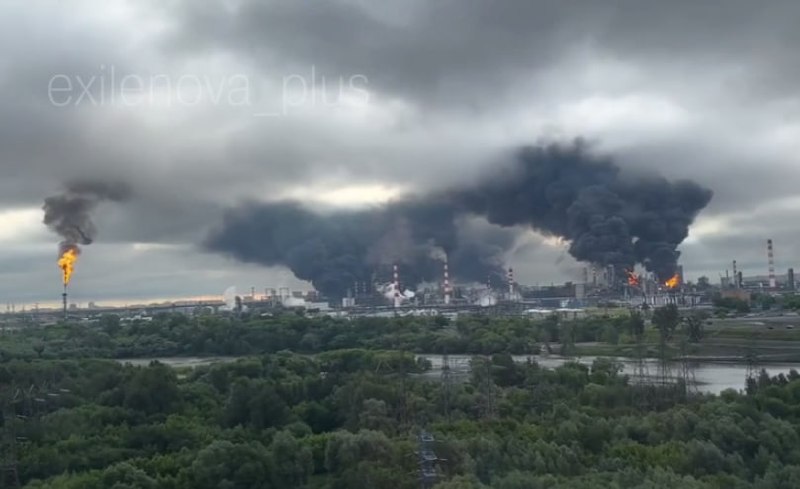
Just after midnight UTC on 18 June 2026, the unmistakable cadence of large-scale aerial bombardment rolled across Ukraine. Ukrainian media outlets began carrying reports of multiple explosions in cities across the country, including the capital Kyiv, within minutes of one another. By 00:42 UTC the first Iranian state-affiliated wire had moved a bulletin; by 00:51 UTC the English service of Iran's Tasnim News had pushed a parallel alert; by 03:13 UTC the consolidated English-language version from Jahan Tasnim was circulating globally. The shape of what had happened was already legible from the pattern of those early dispatches: a coordinated, multi-axis strike package — the kind of payload profile Ukrainian air-defence commanders have been bracing for since the spring counter-offensives of 2024 stalled.
This piece reads the overnight barrage as a single event with three layers: what the warring parties claim happened, what the available sourcing actually supports, and what the strike pattern says about the trajectory of a war that is now in its fifth year and shows no sign of breaking toward negotiation.
What the early dispatches say
The four source bulletins that landed in the 00:42 to 03:13 UTC window are unusually aligned in their factual scaffolding, even as their framings diverge. Each one — Tasnim News English, Tasnim Plus, Fars News, and the Jahan Tasnim feed — reports the same basic fact set: explosions were registered in multiple Ukrainian cities, Kyiv among them, and Russian-language media had moved an hour ahead of the Ukrainian reporting that Moscow's forces had struck "in response to" an unspecified Ukrainian action. None of the four bulletins specify the munitions used, the targets hit, the number of projectiles, or the casualty toll. None name the airframes or launch platforms involved. None identify the specific Ukrainian oblasts affected beyond the capital.
That sparseness is itself a piece of evidence. The first wave of reporting on any major Russian strike against Ukrainian urban centres typically comes through Ukrainian emergency services, the Ukrainian Air Force, and outlets like Suspilne, RBC Ukraine, and Ukrainska Pravda. The Iranian state-affiliated wires that drove the global English-language record on this strike were not on the ground; they were repackaging Russian-language reporting that, in turn, was summarising Ukrainian social-media reaction. The bulletin architecture is therefore worth naming: an Iranian wire, citing a Russian wire, citing Ukrainian social media — three layers of translation before the claim reaches an English-language reader.
The Russian framing — that this is a "response" to a prior Ukrainian action — is, in operational terms, a signal to the global audience that Moscow sees the exchange as tit-for-tat rather than escalation. That is the language Moscow has used at every major barrage since the autumn of 2022, and it has a specific rhetorical function: it positions Russia as reactive, not initiatory, and it pre-empts the Western framing that tends to dominate the first 24 hours of any major strike. The fact that the Russian-language reporting moved an hour ahead of the Ukrainian reporting is consistent with that function.
The counter-frame from inside Ukraine
Ukrainian outlets that began moving their own reporting as the night progressed were, predictably, less interested in the question of who provoked whom and more interested in the operational picture. The early social-media traffic from Kyiv, Kharkiv, Dnipro, and Lviv pointed to a strike package that combined cruise missiles launched from air, sea, and ground platforms with what residents described as repeated waves of what sounded like Shahed-type one-way attack drones. The specific provenance of the drones — Iranian-designed, Russian-assembled, increasingly Russian-engineered as Moscow's defence-industrial base has absorbed the production line — has been a running story since 2023, and the overnight pattern is consistent with that lineage.
What is harder to verify from the open-source record, even several hours into the bombardment, is the targeting logic. Russian strike packages in 2025 and 2026 have progressively shifted from pure grid-and-transmission targeting toward a mixed profile that hits military-industrial sites, logistics nodes, fuel storage, and apartment districts in the same package. The strategic logic is debated. One reading, dominant in Western analytical circles, holds that Russia is grinding down Ukrainian resolve and infrastructure in the hope of a politically favourable settlement. A second reading, heard more often in Russian military commentary, holds that the strikes are aimed at degrading the Ukrainian defence-industrial base — in particular the drone production lines that have proliferated across Ukrainian cities since 2024 — and at interdicting the cross-border logistics that keep Ukrainian artillery and air defence supplied. A third reading, more sceptical and not often voiced in polite company, holds that the targeting is opportunistic: the payload flies, it lands, and the political-civilian damage is a feature, not a bug.
The honest answer is that the three are not mutually exclusive. Russian targeting doctrine has consistently layered military and political-civilian effects, and the overnight barrage fits the pattern. What is genuinely new in the June 2026 wave is its scale, if the early reports of multi-city hits hold up under daylight verification.
What the strike pattern actually tells us
There is a structural pattern in Russian air operations that the night-to-night record has made visible, and it is worth stating plainly. Across 2024 and 2025, the median major Russian strike package grew in both missile count and diversity of launch platform, while the median interval between major packages shrank. Ukrainian air-defence interception rates — high in the early war, sometimes reported above 90% in Western wire copy — have eroded as the salvoes have grown and as Russian tactics have incorporated more decoy, more loitering, and more low-altitude profile.
Two consequences follow. The first is that even a high interception rate, applied to a much larger salvo, leaves a larger residual landing. A 90% interception rate on a 100-missile package leaves 10 warheads on the ground; a 75% interception rate on a 300-missile package leaves 75. The arithmetic compounds against the defender.
The second consequence is political. Each large barrage resets the news cycle in Western capitals, and each reset forces a conversation in European and North American foreign-policy circles about the sustainability of the air-defence pipeline. The Patriot, IRIS-T, NASAMS, SAMP/T, and Gepard systems that constitute the spine of Ukraine's integrated air defence are produced in finite quantities, in factories whose output is itself a political variable. A strike wave large enough to consume several days of interceptor inventory in a single night is a strike wave that produces, on the Western side, a debate about the rate of replenishment — which is precisely the debate Moscow wants.
This is the part of the story that does not show up in the first-day wire copy, and it is the part that should. The June 2026 barrage, in other words, is not only an attack on Ukrainian cities; it is an attack on the political economy of the Western air-defence supply chain. The two attacks are linked, and the linking is the point.
The information environment around the strike
The sourcing for this story is unusual, and worth being explicit about. The four bulletins that frame the English-language record of the overnight strike are all Iranian state-affiliated. Tasnim News, Tasnim Plus, Fars News, and Jahan Tasnim are part of an Iranian state-media ecosystem whose primary function is to project the Russian foreign-policy line into the Farsi- and English-language global conversation. They are not lying about the basic fact that explosions occurred in multiple Ukrainian cities on the night of 17–18 June 2026; that fact is corroborated by Ukrainian social media and, by mid-morning UTC, by the early reporting of Ukrainian and Western-wire outlets. What they are doing, by moving the bulletins first, is shaping the global framing of the strike — and the framing they have chosen is the Russian one: reactive, proportional, justified.
A reader relying only on those four wires would come away with the impression that the strike was a Russian response to a Ukrainian provocation, with the provocation left unspecified. A reader relying only on the early Ukrainian reporting would come away with the impression of an unprovoked attack on sleeping cities. Neither is the whole truth. The disciplined read is that the strike was launched in the context of an ongoing exchange of long-range fire — Ukraine has hit Russian territory repeatedly, with Western-supplied and domestically produced weapons, since 2024 — and that the framing of "response" is a rhetorical choice, not a forensic conclusion. The framing tells you who the speaker wants the global audience to side with, not what the underlying military logic was.
There is a broader point here, and it is one that media scholars have been making for the duration of this war, though not in those terms on the public record. State-affiliated wires in Moscow, Tehran, and Beijing have learned, over four years of full-scale war, to seed the global English-language record with the first bulletin and the first frame. The frame then propagates through wire pick-up, social-media amplification, and AI-summary aggregation before the slower, more careful Ukrainian and Western reporting has finished its verification. By the time the corrected, triangulated record is available, the frame has already done its work. The June 2026 overnight strike is a near-textbook instance of the pattern.
Stakes and the road ahead
The proximate stakes of the 18 June 2026 barrage are concrete and human: the people in the apartment blocks that were hit, the energy workers who will spend the day restoring grid connections, the air-defence crews who will spend the day reloading launchers. Those are the first-order facts, and they should not be displaced by analytical scaffolding.
The second-order stakes are about the trajectory of the war. If the June barrage is, as the early reporting suggests, the largest single Russian strike of the conflict to date, then it is a marker of two things: a Russian willingness to spend strategic munitions at a rate that, by the spring of 2025, several Western analytical shops considered unsustainable; and a Russian bet that the Western political appetite for air-defence replenishment can be exhausted before the Russian production of strike munitions is exhausted. The bet is rational from Moscow's side, even if the wager is grim.
The third-order stakes are about the global information environment. Every major strike in this war has produced a re-run of the same information contest: who moves the first bulletin, who controls the frame, who dominates the English-language wire. The June 2026 wave is no exception, and the fact that the first-mover advantage in the English-language global record was held by an Iranian state-affiliated wire, citing a Russian state-affiliated wire, citing Ukrainian social media, is itself a measurable indicator of how the information layer of the war has been re-architected since 2022.
What remains genuinely uncertain, several hours into the strike, is the operational detail: which cities beyond Kyiv were hit, what specific targets were struck, the casualty toll, the munition mix, and the extent of the damage to energy and transport infrastructure. The early bulletins do not specify, and the daylight verification — the Ukrainian emergency-services briefings, the Air Force morning reports, the satellite-imagery analysis that OSINT analysts will produce over the coming 24 to 48 hours — is what the rest of the week's reporting will rest on. Monexus will update as that verification arrives; for now, the pattern is the story, and the pattern is consistent with a war that is being prosecuted on the Russian side with a level of intensity that contradicts the Western conventional wisdom of late 2025 that the Russian tempo was slackening.
This piece draws on Iranian state-affiliated wire reporting as the first-mover English-language record of the overnight strike, with the explicit caveat that those wires were not on the ground and were repackaging Russian-language summaries of Ukrainian social-media reporting. The Ukrainian and Western-wire reporting on casualty figures, target identification, and munition mix is pending and will be incorporated as it becomes available.
Wire provenance
This editorial synthesis draws on the following public wire/social posts:
- https://t.me/JahanTasnim
- https://t.me/tasnimnews_en
- https://t.me/tasnimplus
- https://t.me/farsna