Russia hits Ukrainian fuel and energy sites in overnight strike, Moscow says
Russia's defence ministry says its forces struck Ukrainian fuel and energy facilities overnight on 18 June 2026, framing the attack as a response to Ukrainian 'terrorist' actions. The claims, carried by Russian state and pro-war channels, have not yet been independently verified.
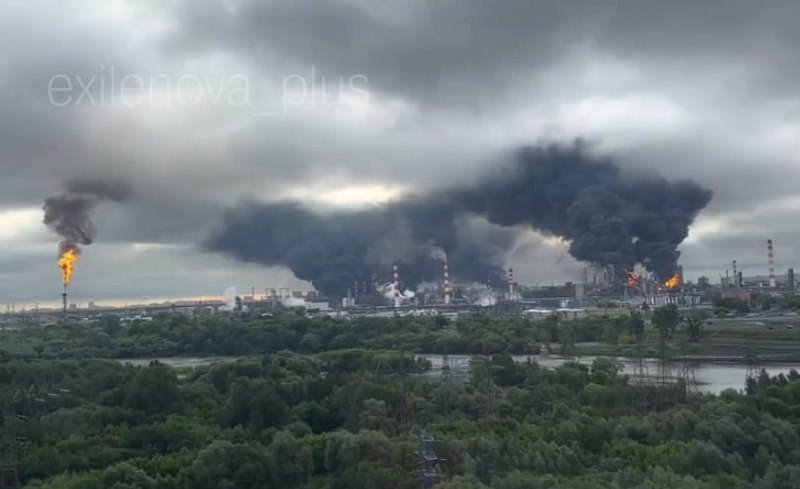
Russia's ministry of defence said on the morning of 18 June 2026 that its armed forces had carried out a "group strike" on facilities belonging to Ukraine's fuel and energy complex, the latest in a months-long campaign targeting the country's power and refining backbone. The announcement, carried in near-identical form across Russian state and pro-war Telegram channels between 06:55 UTC and 07:31 UTC, framed the operation as a response to "terrorist attacks by the Kiev regime" and said high-precision ground- and air-launched weapons were used.
The claims originated with the Russian ministry of defence, were echoed by the Rybar-adjacent Two Majors channel, and were then amplified by state-aligned outlets including Readovka and Euronews's Russian-language wire. As of publication, the strikes had not been independently verified by Ukrainian officials, international monitors, or major Western wire services, and the specific facilities hit had not been named in the source material reviewed.
The pattern is familiar. Since the autumn of 2022, Russian long-range drones, cruise and ballistic missiles have hammered Ukrainian power stations, substations, refineries and storage depots, often in coordinated salvoes timed to coincide with colder weather or visible political milestones. Fuel-and-energy targets have featured prominently in that campaign; Russian officials have repeatedly argued that energy infrastructure sustains the war effort and is therefore a legitimate target under their reading of the law of armed conflict. Kyiv, the United Nations and a wide swathe of international humanitarian opinion reject that framing, and treat strikes on energy and civilian-adjacent infrastructure as violations of the Geneva conventions' proportionality and distinction principles.
The Russian defence ministry's wording matters for what it reveals about Moscow's information strategy as much as for the underlying military action. The phrase "group strike" — a fixed formulation in Russian military vocabulary — implies a coordinated package of long-range weapons across multiple launch domains. The qualifier "used in the interests of the Armed Forces of Ukraine" is also a standard legal-justification wrapper, designed to anchor the targeting decision in the dual-use character of energy infrastructure. By inserting "in response to terrorist attacks by the Kiev regime," Moscow is signalling escalation rhetoric: it is presenting its own action as reactive, and Ukrainian cross-border or deep strikes on Russian soil as the trigger, even when the timing, scale and target set of the Russian salvo far exceed any tactical logic of retaliation.
The structural picture inside Ukraine is grim regardless of how this particular overnight raid is scored. Russian strikes on thermal generation, hydro plants and the grid more broadly have already knocked substantial capacity offline, and refining capacity has been progressively degraded since 2024. Ukraine has responded with a patchwork of mobile generation, imported electricity flows from the European grid, hard-hat repairs that have become a quiet national industry, and a homegrown drone programme that has begun to set Russian refining and export infrastructure on fire in turn. The economic cost is borne by households and small businesses in the form of scheduled blackouts and tariff pressure; the strategic cost is borne by Kyiv's allies in the form of continued air-defence commitments and budget support.
For Moscow, the strategic calculation rests on a stubborn premise: that a sustained campaign against Ukrainian energy will erode the political base for the war inside Ukraine and inside the West. The evidence to date does not support it. Ukrainian polling, where it has been conducted, has shown remarkable resilience in the face of domestic infrastructure attacks, and European capitals have so far treated energy-sector strikes as accelerants for sanctions and air-defence packages rather than as reasons to disengage. If anything, the political economy of the war has moved in the opposite direction: strikes that damage civilian infrastructure are now treated by European and American policymakers as evidence that the war is being escalated, not as signals that Kyiv should compromise.
What the available sources do not yet settle is the operational shape of the overnight action. The Russian ministry has not, in the material reviewed, identified the specific fuel-and-energy facilities struck, the weapons used, the scale of the salvo, or the damage assessment. Ukrainian side reporting had not been published in the three items drawn on for this article. Independent OSINT verification — satellite imagery, geolocated videos, or local emergency-services statements — was not present in the thread. Until those corroborating pieces land, the headline finding is the announcement itself: a Russian claim of a significant overnight strike on Ukrainian energy, framed by Moscow as retaliation, circulated through channels whose editorial line is to amplify the defence ministry's narrative.
A counter-narrative worth keeping in view: Ukrainian long-range strikes on Russian refining, storage and export infrastructure have intensified over the past year, and several of those attacks have caused visible damage to facilities that feed both the Russian domestic market and the export chain that finances the war. Moscow's rhetorical framing of those strikes as "terrorist attacks" is a deliberate legal and informational move — it positions the Russian campaign against Ukrainian energy as a symmetrical response, when the empirical asymmetry of damage inflicted, and the asymmetry of which side's grid is being deliberately degraded as a campaign goal, is severe. Both governments present their respective campaigns as defensive. The available evidence continues to suggest that the Russian campaign is offensive in design and the Ukrainian one is reactive in execution, even if Kyiv has chosen to extend the battlefield deep into Russian territory.
The stakes for the rest of 2026 are concrete. If the pattern of the past twelve months holds, summer strikes on Ukrainian fuel and energy will compound the strain already showing on the grid heading into the next heating season, sharpen the political debate inside the European Union over how to backstop Kyiv's budget and its energy system, and feed the case for tighter sanctions enforcement on third-country supply chains. They will also accelerate the implicit logic of Ukraine's own long-range programme: as Russian energy becomes a deliberate target, the question for Western capitals is no longer whether Kyiv has the right to strike deep, but how openly they are willing to accept the consequences. None of that turns on a single overnight raid, but the raid is a useful marker of where the war's centre of gravity has moved — off the front lines and onto the infrastructure that keeps each side's economy running.
Desk note: Monexus treated the three Telegram items as Russian-sourced claims of action, not as a confirmed event ledger, and signalled the asymmetry between Russian framing of "retaliation" and the empirical pattern of the campaign against Ukrainian energy. Ukrainian-side reporting and independent OSINT verification had not yet appeared in the inputs to this piece at the time of publication.
Wire provenance
This editorial synthesis draws on the following public wire/social posts:
- https://t.me/euronews/
- https://t.me/readovkanews/
- https://t.me/two_majors/