Russia hits Ukrainian fuel and energy sites overnight as exchange-strike pattern deepens
Russian forces say they struck Ukrainian fuel and energy facilities overnight on 18 June 2026, the latest in a months-long campaign against grid and refinery targets that has reshaped the economics of the war.
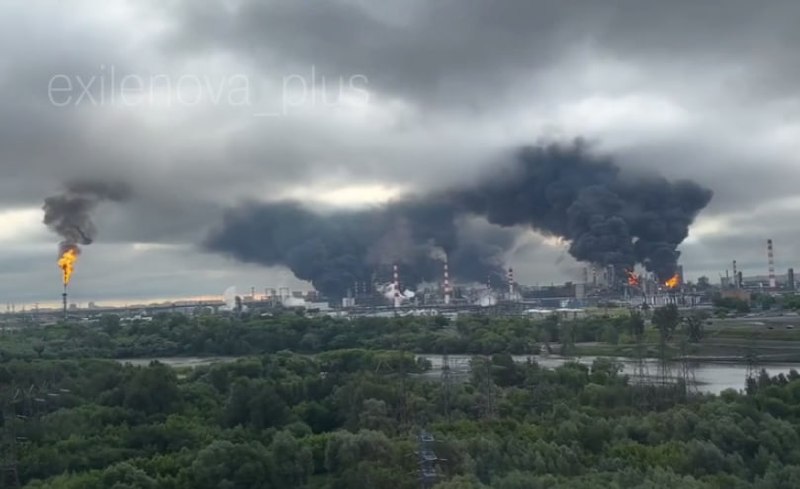
The Russian Ministry of Defence announced at 07:18 UTC on 18 June 2026 that the country's armed forces had carried out a "group strike" on fuel and energy complex facilities in Ukraine overnight, using long-range ground- and air-based precision weapons alongside drones. The Russian-language channels Readovka, Two Majors and Zvezda News all carried the ministry's statement within a two-hour window, each emphasising that the operation was framed as retaliation for Ukrainian strikes on Russian territory.
The pattern — a Russian mass strike on Ukrainian energy infrastructure, followed within days by a Ukrainian retaliatory strike on Russian oil or fuel assets — has become the routine rhythm of the war's third winter. What is new is the speed at which both sides are now cycling through it, and the narrowing of Russian targeting to a smaller set of refining and storage nodes that Ukraine has spent the past year methodically degrading.
What the Russian statement actually says
The ministry's overnight release, distributed through the Telegram channels Readovka and Two Majors, names "fuel and energy complex facilities" as the target set. The Russian framing is direct: the strike was a response, the ministry said, to "terrorist attacks by the Kiev regime," a formulation Russian state media has used consistently since 2022 to describe Ukrainian long-range strikes inside internationally recognised Russian territory. The Zvezda News feed, citing the same ministry briefing, highlighted the use of "high-precision ground- and air-based weapons" alongside drones — a signature Russian approach that combines ballistic, cruise and Shahed-type loitering munitions in a single salvo.
The ministry did not, in the version carried by the three channels, list specific cities or specific facilities. Russian operational communiqués have routinely withheld target lists since 2024, leaving the geography to be reconstructed from open-source imagery and Ukrainian emergency-service reports in the hours that follow. What the three Russian-aligned channels share is a focus on the category of target — fuel, refining, storage, distribution — rather than the asset.
Why the fuel-and-energy target set matters
Ukraine's refining sector was, before the war, sized to meet domestic demand and produce a modest export surplus. Russian strikes have systematically taken individual units offline for weeks at a time, and Ukrainian retaliatory drone strikes on Russian refineries have done the same on the other side of the border. The economic effect is asymmetric in one direction — Ukraine imports more of the refined products it can no longer produce, while Russia continues to ship crude by tanker to non-sanctioning buyers — but the political effect is convergent: fuel queues, rationing talk and acute pressure on agricultural and transport users in both countries.
For Moscow, the fuel-and-energy target set is doing what Kyiv's grid strikes did in 2022–23: forcing the opponent to spend hard currency, air defence interceptors and political capital on defending civilian-adjacent infrastructure. For Kyiv, the same logic runs in reverse. Both sides have publicly committed to continuing the exchange until the other side moves first to negotiate restrictions on long-range strikes — a position neither government currently holds.
The structural frame: a war fought on fuel tanks
What is being normalised, strike by strike, is a war in which the civilian downstream of energy infrastructure — drivers, farmers, hospital backup generators, district heating systems — bears an ever-larger share of the cost. The Russian announcement frames its overnight operation as a measured response; the Ukrainian general staff, when its overnight summary is released, is likely to characterise any Russian retaliation as a war crime against critical civilian infrastructure. Both characterisations are partial truths. The honest reading is that two governments have concluded, independently, that degrading the other's fuel base is a lower-cost path to leverage than attempting a breakthrough on the front line.
This is not a new theory of warfare, but the scale and tempo in 2026 is. Russia has launched at least one multi-wave strike against Ukrainian energy targets every month since late 2024; Ukraine's domestic refining utilisation has not returned to pre-war levels at any point in the past eighteen months. The exchange is now structural, not episodic.
Stakes and what to watch
The near-term question is whether Ukraine's air defences — supplemented by Western-supplied interceptors and, increasingly, by indigenous drone-interceptor programmes — can continue to attrit the mass of incoming Russian drones and missiles at a politically tolerable cost. If they cannot, Ukraine faces a winter in which rolling fuel and power outages compound. On the Russian side, the question is whether Ukrainian long-range strikes, now hitting refining and storage assets deep inside Russia, will force Moscow to redirect air defence away from the front line and toward rear-area infrastructure, with consequences for the ground campaign.
A second, quieter question runs underneath both: whether any external party can credibly broker a strike-restriction arrangement before one side's fuel base is degraded past the point of political sustainability. As of 18 June 2026, there is no visible diplomatic channel working that problem in public. The exchange pattern, in other words, continues.
Desk note: Monexus is reporting the Russian strike announcement as carried by three Russian-aligned Telegram channels, with the explicit caveat that Russian operational communiqués have consistently understated or omitted Ukrainian interception performance and overclaimed damage. The article does not assert specific Ukrainian casualties, specific damaged facilities or specific interception rates because the three source items do not contain those figures; those will be addressed when Ukrainian general staff and emergency-service reporting is published in the hours after this piece.
Wire provenance
This editorial synthesis draws on the following public wire/social posts:
- https://t.me/readovkanews
- https://t.me/two_majors
- https://t.me/zvezdanews