The Strait, the Memorandum, and the Price of Pretending Nothing Changed
A memorandum on the Strait of Hormuz is being sold as de-escalation. It is, more honestly, a payment on account — and the bill is the regional order that preceded it.
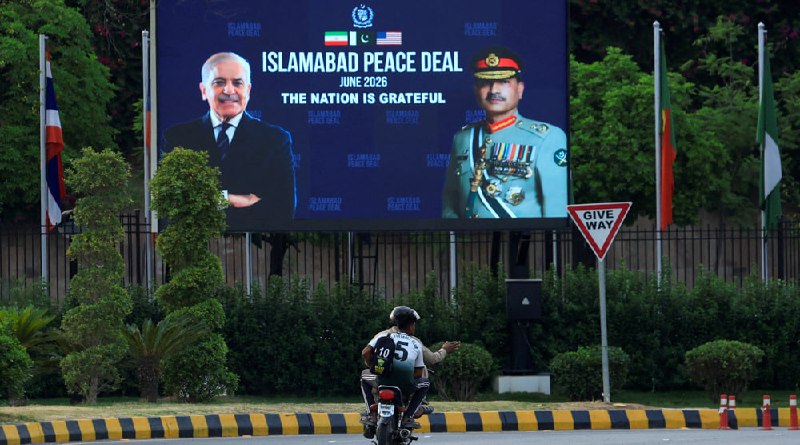
At 22:41 UTC on 17 June 2026, a Telegram channel affiliated with BRICS-branded coverage posted a two-line bulletin: Iran has announced that its "commitments regarding Strait of Hormuz have begun because the memorandum of understanding has been signed." Three hours earlier, Cointelegraph's news desk, citing Axios, had reported that the United States and Iran were "considering signing their agreement today," and that such a step "could accelerate the reopening of the Strait of Hormuz." Two wire items, the same day, pointing at the same piece of paper. What the paper actually says — and what it is being used to mean — are two different problems.
This publication's reading is straightforward. The deal, as signalled by Iranian and US-aligned sources, is being marketed as the end of a crisis. It is better understood as the formalisation of one. A chokepoint through which a substantial share of seaborne crude transits is not being "reopened" so much as re-priced, with a memorandum standing in for a settlement that no party is willing to dignify with a treaty. The language tells you as much: "commitments have begun," not "the blockade is lifted."
What is actually on the table
The framing in Western coverage emphasises de-escalation. The framing in Iranian-aligned channels emphasises reciprocity. Neither is wrong, and that is precisely the point. A memorandum of understanding is the form a deal takes when both sides want the consequences of an agreement and neither wants the responsibility of one. The Strait of Hormuz does not need to be blockaded for it to be weaponised; the credible threat of disruption, codified into a document the parties can wave at oil markets, does most of the work on its own.
Per Axios reporting channelled through Cointelegraph on 17 June 2026, the US and Iran are still negotiating the final text — meaning that what Iranian state-aligned channels describe as a signed instrument is, on the American side, at minimum a draft. The gap between "memorandum signed" (Iranian framing) and "considering signing" (US framing) is the gap the markets will live inside for as long as the agreement remains unenforced.
The market will read it first, and worst
The most important audience for the memorandum is not in Washington or Tehran. It is in the dealing rooms of Singapore, London, and Houston. Any document that changes the expected flow of crude through a chokepoint of this geography will be priced before it is implemented. The speed of the repricing is the speed of the rumour cycle. The two bulletins above — a 15:51 UTC "considering signing" followed by a 22:41 UTC "commitments have begun" — are the shape of that cycle. They are also, not coincidentally, the shape of a tradable information edge.
The structural point is older than this particular crisis. Chokepoints and the legal instruments written around them have always been a kind of derivative: the right to disrupt, contracted forward. The novelty is that the contract is now publicised, in real time, by channels that are themselves part of the signalling architecture.
The counter-read: there is no deal
The most plausible alternative reading is that there is no deal at all, in any substantive sense, and that the bulletins describe a diplomatic face-saving ritual. A government that has spent months signalling that it will close the Strait cannot announce that it has changed its mind; it needs an instrument to point at. A government that does not want to be drawn into a wider confrontation cannot announce that it has conceded; it needs an instrument to point at. The memorandum is the shared pointing-at object.
This reading is consistent with the timing. Late June is the point at which a face-saving formulation is most useful to both parties, and least useful to the third parties — Israel, the Gulf monarchies, the EU energy complex — whose interests are not represented in the document. They are downstream of it. That asymmetry is the deal's actual content.
What is being settled, in plain terms
The thing being settled is the legitimacy of a particular kind of pressure. Iran is being recognised as a party that can hold global energy flows at a price. The United States is being recognised as a party that will pay that price in writing rather than in ordnance. Both are precedential. Neither is reversible by a change of administration on either side.
The stakes, on the time horizon that matters, are not whether the Strait is open next month. Of course it is open next month. The stakes are whether the instrument used to make it open — a memorandum, signed and broadcast, with no enforcement mechanism that survives a tanker dispute — becomes the default currency of US-Iranian management. If it does, the next crisis will not be a crisis over the Strait. It will be a crisis over the meaning of the previous memorandum. That is the deal. Everything else is the communiqué.
Desk note: Monexus is treating the 17 June 2026 bulletins as primary signals only, not as confirmation of a signed bilateral instrument. Where the Iranian framing and the Axios-cited US framing diverge — and they do, on sequence and on language — the divergence is itself the news.
Wire provenance
This editorial synthesis draws on the following public wire/social posts:
- https://t.me/bricsnews
- https://t.me/cointelegraph
- https://t.me/cointelegraph