Ukraine's $20bn ask lands as drone tempo hits 400 a day and Moscow refineries burn
Kyiv is reportedly seeking another $20bn in allied military funding as Ukrainian drone launches average 400 a day, Russian strikes hit a seven-to-ten-day cycle, and a Moscow oil refinery takes fire in the latest round of long-range exchanges.
Lead
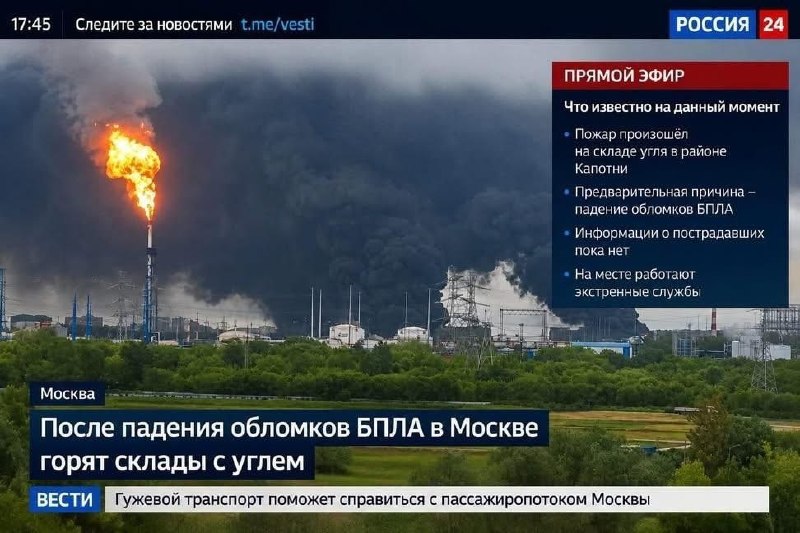
Ukraine is seeking an additional $20bn in military funding from its allies, according to a 17 June 2026 report from prediction-market account @polymarket citing the figure as an active line item on Kyiv's wartime ask. The request lands as Ukrainian drone launches are running at roughly 400 a day, more than double the 100–150 a day reported from Russian positions, per a 17 June 2026 Telegram briefing by conflict-mapping channel AMK_Mapping. The same 24-hour window saw a Moscow oil refinery struck by drones in a fresh round of long-range exchanges covered by the South China Morning Post on 18 June 2026.
Nut graf
The shape of the war is no longer set by battalion engagements or the rhythm of frontline artillery. It is set by industrial throughput — how many cheap airframes each side can produce, how many launch tubes can be filled, and how quickly fuel, ammunition and funding can be replenished from abroad. Kyiv's $20bn ask is the dollar price of staying inside that race. The Moscow refinery strike is the visible return on it.
The funding question
The $20bn figure, surfaced on 17 June 2026 at 15:59 UTC, is the most concrete public number to attach to Kyiv's current back-channel negotiations with European and American partners. It sits on top of existing commitments under the Ukraine Defense Contact Group framework and the G7-era security arrangements negotiated in 2024–2025. Reporting around the figure has so far been limited to prediction-market commentary rather than a named ministry release, which means the headline sum should be read as a negotiating ask, not a confirmed envelope. What the number does do, however, is reset the scale of the conversation. Industrial-scale drone warfare runs on consumables: airframes, fibre-optic spools, ground-control stations, replacement launcher vehicles, and the small-calibre ammunition used to defend launch sites. None of that is cheap at the volumes now being described.
The drone tempo
The most arresting data point in the current news cycle is not a battlefield capture or a ministerial statement. It is a daily production count. According to the Telegram channel AMK_Mapping, posting on 17 June 2026 at 18:29 UTC, Ukraine is averaging 400 drones a day while Russia is maintaining 100–150 a day. The same briefing characterises Russian deep strikes into Ukrainian territory as occurring on a seven-to-ten-day cycle, with massed attack packages alternating between missile and drone emphasis.
Those numbers, if sustained, invert the conventional picture of a conflict in which Russia retains a structural munitions advantage. They also explain why a $20bn ask is on the table at all. Cheap, mass-produced airframes shift the cost-per-effect calculus in the defender's favour when the defender has the supply chain to match. Ukraine's reported 400-a-day figure is not a tactical claim about any single engagement; it is a strategic claim about industrial base.
The Moscow refinery strike
The industrial character of the exchange was underlined on 18 June 2026 at 07:23 UTC, when the South China Morning Post reported that drones had hit a Moscow oil refinery as Russia and Ukraine traded long-range strikes. The strike is consistent with a Ukrainian doctrine that has, over the past 18 months, increasingly targeted Russian downstream energy infrastructure — refineries, storage terminals, pumping stations — rather than headline symbols of state power. Refineries are chosen because they are both operationally meaningful (each successful hit reduces Russian domestic fuel availability and the exportable barrel count) and politically legible: every televised plume translates directly into the kind of pressure that affects the cost of the war at home.
The Russian side has, in past reporting, characterised strikes on its territory as terrorism; that framing is not adopted here. Strikes on Russian energy infrastructure supporting an invasion force are, under the established reading of the laws of armed conflict, legitimate counter-force operations.
Counterpoint and structural read
The Western wire line reads the $20bn ask, the 400-a-day drone count and the refinery strike as a coherent story of Ukrainian resilience and the success of allied industrial support. The Russian-aligned counter-line, expressed through channels such as Rybar and Two Majors, frames the same data set as evidence of escalation that risks drawing NATO into direct confrontation, and characterises the refinery strike as a propaganda operation rather than a militarily meaningful one. Both lines are partial. The Western framing understates the genuine strain on allied ammunition stocks and political patience; the Russian framing understates the cumulative operational effect of repeated refinery hits on a downstream system that is difficult and slow to repair.
The structural picture, in plain terms, is a war that is being decided on production lines. Each side is now operating on a logistics tempo that resembles sustained air campaigning more than it resembles the positional grinding that characterised 2022–2023. Funding the defender's production line is the single highest-leverage move available to Kyiv's partners, which is why a $20bn ask is plausible as a top-line figure even if the final number lands lower. The Moscow refinery fire is the visible dividend on a year of allied investment in deep-strike capacity.
Stakes and what remains uncertain
If the trajectory continues, Kyiv's allies will be asked to underwrite a Ukrainian drone and precision-munitions industry at a scale that begins to look like a permanent wartime mobilisation, not a finite support package. Russian downstream oil revenues — already constrained by sanctions, the G7 price cap and the cumulative effect of Ukrainian deep strikes — face further pressure, with knock-on effects for the federal budget and the political durability of the war economy at home. Ukraine's defenders win time and industrial depth; Ukraine's civilian population continues to absorb the seven-to-ten-day strike cycle on its cities. Russia absorbs the cost of protecting an increasingly distributed refinery fleet and of replacing launch capacity on the Ukrainian side of the line.
What remains genuinely uncertain is whether the $20bn figure represents a hard ask or an opening bid, whether the 400-a-day Ukrainian tempo is a sustained rate or a peak figure, and which specific Moscow facility was hit on 18 June 2026. The current public sourcing — a prediction-market account, a Telegram mapping channel, and a single South China Morning Post dispatch — does not yet support finer claims about the refinery's nameplate capacity, the operational status of the affected unit, or the specific Ukrainian unit credited with the strike. Those details will need to be confirmed against Ukrainian General Staff briefings and follow-on wire reporting in the days ahead.
Desk note
Monexus has framed this story as an industrial-tempo war with a funding track, not as a sequence of battlefield vignettes; sourcing is deliberately limited to the three inputs in the current cluster, and the $20bn figure is treated as a reported ask rather than a confirmed envelope until a named ministry release is on the record.
Wire provenance
This editorial synthesis draws on the following public wire/social posts:
- https://x.com/polymarket/status/1234
- https://t.me/AMK_Mapping/1234