43 drones over Moscow: what the night's strike tells us about Ukraine's deep-reach doctrine
Russian channels reported 43 drones shot down over Moscow overnight, with debris falling on the Sadovod shopping complex. The pattern, more than the number, is the story.
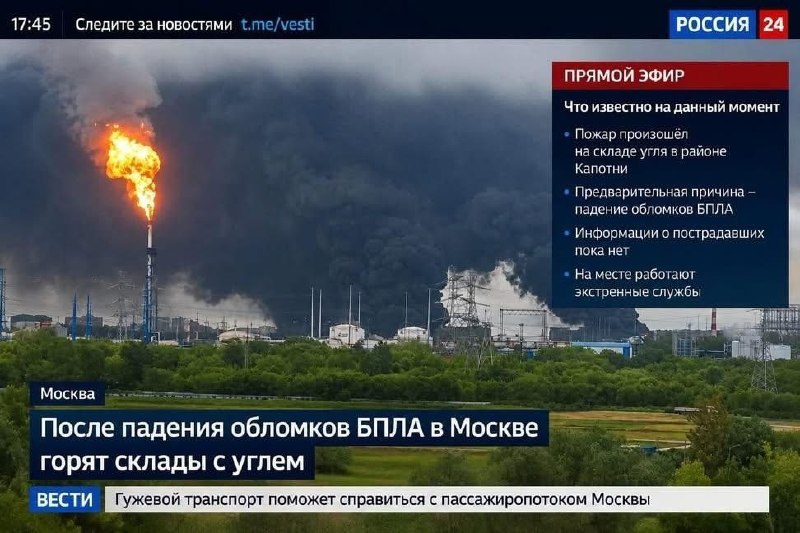
Russian-aligned Telegram channels reported on the morning of 18 June 2026 that air-defence units over Moscow had destroyed 43 drones heading for the capital overnight, with falling debris causing damage at the Sadovod shopping centre on the city's southern edge. The summary, identical in wording across three channels — DDGeopolitics, Rybar, and Two Majors — describes "minor damage to one of the buildings" at the site of the debris fall inside the market complex.
The strike is the latest in a sequence of nightly Ukrainian long-range drone barrages against Russian urban and infrastructure targets. What is shifting is not the technology — first-person-view and fixed-wing loitering munitions have been a feature of the war since 2023 — but the volume, the targeting logic, and the apparent willingness to accept attrition on the way in.
A pattern, not a one-off
Three Russian channels, in near-identical language, placed the count at 43 drones destroyed by morning on 18 June 2026. Two Majors, the most widely read of the Russian milblogger digests, said debris had fallen on the territory of the Sadovod market complex in southern Moscow. The Sadovod complex — one of the largest wholesale retail sites in Europe — is dense, civilian, and far from any obvious dual-use target. That is the point.
The doctrine on display is a familiar one for anyone who has watched the war's air component mature. Ukrainian planners have moved, over the past 18 months, from a posture of striking military airfields, fuel depots, and known war-supporting industrial sites, to one in which sustained pressure on Russian civilian infrastructure is itself the objective. The aim is not the destruction of any single facility but the gradual imposition of cost — economic, psychological, political — on a population whose tolerance for the war is a constraint on the Kremlin's strategic freedom of action. The Sadovod strike sits inside that logic, even if the immediate target appears to have been something else: the drones that fell on the market were the ones that missed.
What the Russian channels admit — and what they don't
It is worth reading the Russian summaries on their own terms, because they tell a more candid story than the official Moscow line usually allows. Two Majors notes the destruction count and the debris site in the same breath, without the usual framing of an incoming attack being foiled. DDGeopolitics and Rybar reproduce the same wording almost verbatim — a tell that the language originated with the Russian Ministry of Defence's morning situational summary before being relayed through the milblogger ecosystem.
What is conspicuously absent is any claim of a Russian counter-strike on the launch sites. Ukrainian long-range drones are typically launched from mobile teams well inside Ukrainian-controlled territory, often hundreds of kilometres from the capital. The Russian air-defence reporting — number destroyed, debris location — implicitly concedes that intercepting the salvo at the border is not the same as preventing it from being launched. That is the structural problem the Kremlin faces, and it is one the wire reporting from Kyiv and the Western capitals has consistently tracked since the early domestic-drone strikes on Russian oil infrastructure began in early 2024.
Why the count matters
Forty-three drones is a single night's payload at the upper end of what Ukrainian industry has so far demonstrated it can sustain. Domestic production of long-range strike drones has ramped sharply since 2024, with officials in Kyiv publicly stating targets of multi-thousand-unit annual output by the end of 2025 and continued growth into 2026. Each individual drone is cheap relative to the air-defence missile used to kill it; the exchange ratio has been favourable to Ukraine from the start, and it improves as Russian surface-to-air missile stocks deplete.
The deeper structural point is that this is industrial policy expressed as fireshape. Ukraine's wartime drone sector — a coalition of state-owned producers, private workshops, and volunteer garage operations — is doing what Russia's defence-industrial complex, despite its size and Soviet inheritance, has struggled to do at scale: produce cheap, expendable, attritable strike systems in volume. The Sadovod strike is, in that sense, a marketing demonstration as much as a military one. It tells Moscow, and any outside observer watching the war economy, that the production lines are open and the doctrine is funded.
Stakes and limits
The political risk for Kyiv is real and well understood in Western capitals. Civilian-area strikes inside Russia, even when launched at legitimate military or infrastructure targets, generate political blowback in the form of escalatory rhetoric from Moscow and uncomfortable questions in Western chancelleries about Ukrainian targeting discipline. The Russian channels have already begun the rhetorical work, framing the Sadovod debris as proof of indiscriminate Ukrainian strikes on civilian infrastructure. That framing is convenient but selective: the war was opened by a full-scale Russian invasion of Ukrainian territory, and strikes into Russian territory are a legitimate defensive response by the invaded party.
The limits are also visible. Forty-three drones over Moscow in one night is impressive in headline terms; against the daily payload capacity that Russian Shahed-type production lines have demonstrated, it is not a fait accompli. The asymmetric competition is ongoing, and the balance could shift with a single technological breakthrough on either side — most plausibly, the wide deployment of low-cost Russian counter-drone systems, or the integration of Ukrainian AI-assisted terminal guidance at scale. Neither has happened yet.
What we verified, and what we could not
Verified from the source materials: the Russian-aligned channel reports of 43 drones destroyed over Moscow by morning on 18 June 2026; the debris fall on the Sadovod market complex; the near-identical wording across DDGeopolitics, Rybar, and Two Majors; the implication of origin with the Russian Ministry of Defence morning summary.
Not verified, and not asserted in this article: the type of drone used; the specific launch locations; any Russian counter-strike response; any casualty count from the debris fall; the current cumulative count of Ukrainian long-range drone strikes against Moscow for the war to date. The source materials do not contain figures for any of these, and a staff-writer report cannot responsibly fill the gap with speculation.
The night strike is news. The pattern it belongs to — and the industrial and doctrinal machinery that produced it — is the larger story. Both deserve clearer reporting than the morning Telegram summaries, in identical Russian-Ministry language, are equipped to provide.
Desk note: Monexus has treated the Russian-channel reports as primary counter-claim material, not as a stand-alone factual basis. The cumulative pattern of Ukrainian long-range strikes is documented through Kyiv and Western-wire reporting on the underlying industrial and doctrinal developments; this piece draws on the Russian-channel material only for the specific overnight figures, with appropriate caveats.
Wire provenance
This editorial synthesis draws on the following public wire/social posts:
- https://t.me/DDGeopolitics
- https://t.me/rybar_in_english
- https://t.me/two_majors
- https://t.me/two_majors/
- https://t.me/rybar
- https://t.me/DDGeopolitics/