Drones Over Moscow: What Two Strikes on the Capital's Oil Refinery Reveal About Ukraine's Shifting Long-Range Calculus
A second strike on the Moscow Oil Refinery in a week, paired with a Ukrainian drone that fell on a Moscow shopping centre roof, marks a deliberate escalation in Kyiv's air campaign against Russian critical infrastructure.
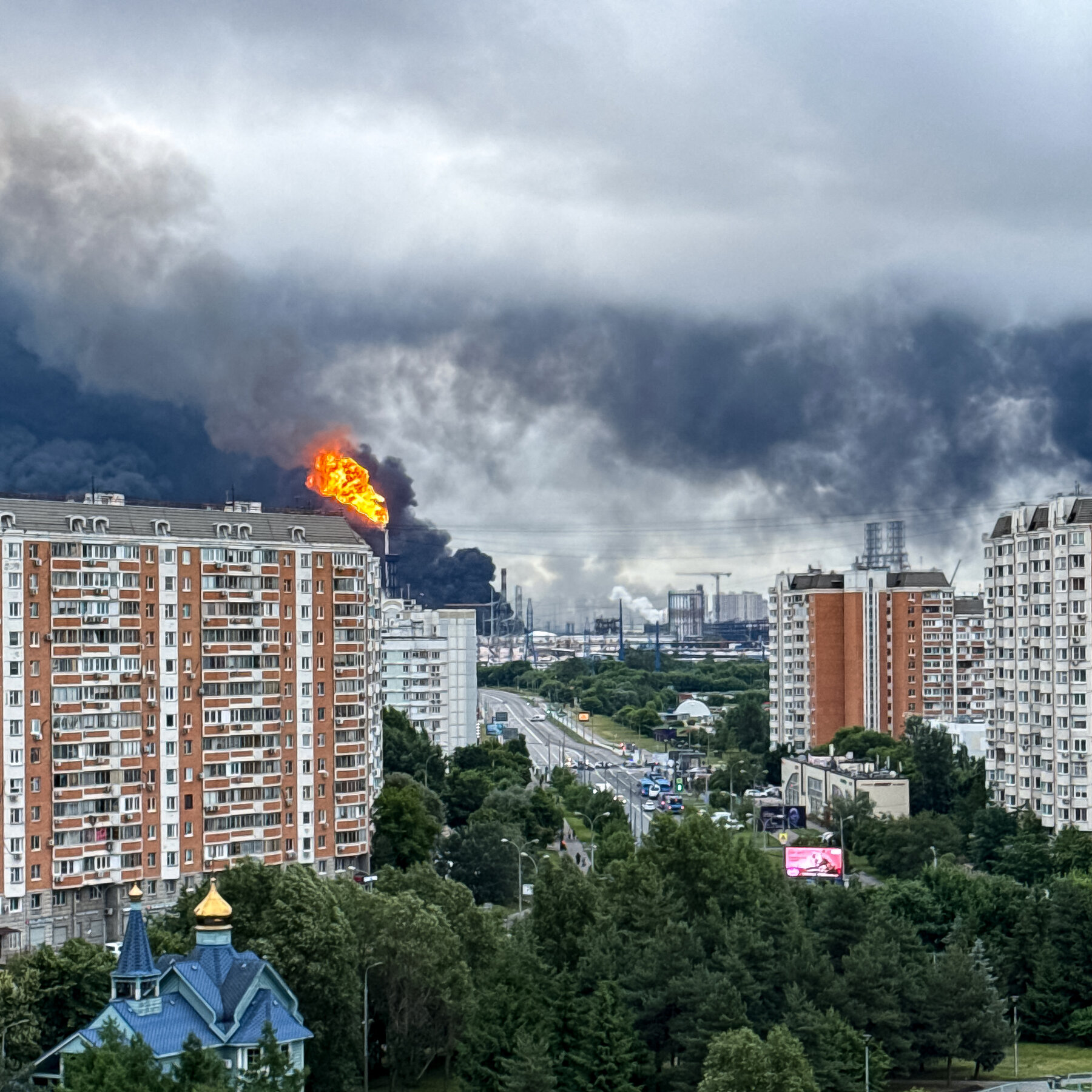
On the night of 17–18 June 2026, Ukraine's long-range unmanned air arm reached the Moscow region for the second time in seven days, striking the Moscow Oil Refinery and hitting targets in Rostov Oblast and on territory Russia has occupied since 2022. Earlier in the same reporting cycle, a downed drone came to rest on the roof of a Moscow shopping centre — a scene President Volodymyr Zelenskyy publicly framed as a "completely fair response to the Russian strikes on our cities and towns." The combined picture, drawn from three Ukrainian-side Telegram channels operating on the morning of 18 June, is a clear escalation in tempo: more sorties, more geography, more willingness to claim them.
The story behind those two events is not only about drones. It is about the slow shift in what Ukraine is willing, and able, to put at risk deep inside Russian airspace — and what that means for the energy calculus on which the Kremlin's war effort still partly rests.
What was struck, and by whom
According to posts on the official Zelenskyy channel and the Mykolaiv Oblast military administration (ODA) channel, both timestamped in the 06:59–07:01 UTC window on 18 June 2026, Ukrainian long-range capabilities — described in those posts as "sanctions" — hit the Moscow Oil Refinery for the second time in a week, and struck additional targets in Rostov Oblast and in Russian-occupied territory. The same string of ODA updates said the strikes were deliberate and serial: a pattern, not a one-off.
The Andriy Tsaplienko channel, a well-known Ukrainian frontline correspondent feed, posted at 07:11 UTC that a downed drone had come to rest on the roof of a Moscow shopping centre, and quoted Zelenskyy describing the broader campaign as a "completely fair response to the Russian strikes on our cities and communities." The shopping-centre frame is the line Kyiv chose to amplify; the refinery strike is the operation it chose to claim.
No independent Russian-language wire confirmation of either impact appears in the thread material this article draws on. The Ukrainian channels are the sole sourcing layer for the moment of impact; the structural significance, however, can be read off the tempo.
Why the tempo matters
A second refinery strike within seven days is a different category of event from a single deep penetration. It implies that the airframe availability, the targeting cycle, and the air-defence suppression required to reach the Moscow region's industrial belt are no longer episodic — they are routinised. Western analysts have spent the last eighteen months arguing over whether Ukraine's domestic long-range drone industry could sustain a campaign measured in dozens, not scores; the 18 June messaging is the second data point in a week suggesting that threshold has been crossed.
The Zelenskyy channel's choice of vocabulary is also a tempo signal. Calling refinery hits "sanctions" is not new — Kyiv has used the framing since at least 2024 — but pairing the word with "for the second time in a week" is a deliberate announcement that this is a campaign with a cadence, not a menu of one-off options. The Mykolaiv ODA post extends the same cadence to the Rostov and occupied-territory axis, implying a multi-axis, multi-target air plan rather than a single priority list.
For Russia, the operational implication is uncomfortable. Refineries around Moscow are not symbolic targets. They sit on the same distribution grid that fuels the central federal district and feeds export flows. Repeated hits do not need to put a facility permanently offline to matter; they impose inspection cycles, insurance repricing, maintenance backlogs, and a steady draw on interceptor missiles and air-defence radar time that would otherwise be covering frontline logistics hubs and railheads in Belgorod, Kursk, and the Donbas.
The Russian counter-frame
The thread material reviewed for this article does not include Russian state media or Russian milblogger response to the 18 June strikes; that absence is itself a data point. When the TASS–RIA–Telegram-Russia axis carries a strike prominently, it is usually paired with claims of full interception or a civilian-cost frame designed to harden domestic opinion. The quieter the official Russian channel is, the more weight Russian-aligned outlets tend to push onto the intercepted-everything line, often after the fact, often hedged with "according to the Russian Ministry of Defence." Absent a wire hit from those channels, the prudent read is that the impact claims have not yet been effectively rebutted.
There is also a counter-narrative that travels further than Russian officialdom: the escalation-management argument. Under this reading, every additional deep strike on Russian soil pulls NATO and the European Union closer to a threshold the West does not want to cross — direct supply of long-range strike enablers, looser rules of engagement on weapons provided by allies, or openly permissive targeting intelligence. The argument has a surface plausibility: Ukraine's air campaign is conducted under a deliberate ambiguity about how much of the targeting data, the airframe integration, and the satellite tasking is genuinely Ukrainian, and how much is enabled by allied intelligence sharing that stops short of co-belligerency.
The case against that reading, made implicitly in the 18 June Zelenskyy quote, is that Russia has not adjusted its own strike tempo against Ukrainian cities. The "fair response" framing is a direct rebuttal: as long as Russian long-range fires continue, Ukraine will answer in kind, and the burden of escalation-management is on the side that started the long-range fires, not the side answering them.
What this sits inside
The deeper pattern is not new. The history of modern air campaigns is the history of one side learning, slowly, to put weapons on the other side's economic infrastructure. The contemporary US, Israeli, and Iranian exchanges of the last three years have all lived inside this logic; the Houthi campaign against Saudi and Emirati oil assets in 2019 sits inside it too. The Ukrainian variant has three features that distinguish it from those predecessors.
First, the strike package is overwhelmingly unmanned and domestically produced, which compresses the political cost of attrition. A lost cruise missile is a diplomatic incident; a lost long-range drone is, increasingly, an inventory item. Second, the target set is being publicly described in economic rather than purely military terms ("sanctions"), which reframes the campaign as an extension of economic statecraft rather than a tactical air operation. Third, the cadence is being announced in advance through official channels — the 18 June posts are not scoops; they are bulletins — which makes the campaign legible to financial markets, energy traders, and Moscow's own risk-pricing in real time.
Read together, the three features describe a country that has decided to compete with Russia in a domain — sustained economic attrition through deep strike — that until 2024 was the sole province of state actors with large air forces, large inventories, and large political risk tolerance. The Monexus finding is that the gap between Ukraine's demonstrated capability and its announced intent narrowed further in the first half of June 2026, and that the 17–18 June strikes are the most visible data point in that narrowing.
What we verified, and what we could not
Verified against the thread material:
- A Ukrainian-channel claim of a second strike on the Moscow Oil Refinery within one week, posted on the official Zelenskyy channel at 06:59 UTC on 18 June 2026 and on the Mykolaiv ODA channel at 07:01 UTC the same morning.
- A Ukrainian-channel claim of additional targets hit in Rostov Oblast and Russian-occupied territory, posted in the same 06:59–07:01 UTC window.
- A Zelenskyy quote framing the broader campaign as a "fair response to the Russian strikes on our cities and communities," relayed by the Tsaplienko channel at 07:11 UTC on 18 June 2026.
- A Tsaplienko report, sourced to video, of a downed drone on the roof of a Moscow shopping centre.
Not verified in this round:
- Independent Russian-language wire confirmation of either impact site, the refinery's operating status, or any casualties. The thread material does not include a TASS, RIA, Reuters, AFP, or BBC confirmation of the 18 June strikes.
- The specific airframe type, the unit responsible, and the launch azimuth. None of the three posts name the platform.
- The Russian Ministry of Defence's interception count, or any Russian statement at all. The thread material does not contain one.
- Any financial-market reaction (Urals price, ESPO differential, Moscow Exchange moves). The source layer reviewed does not include market data.
Stakes and what to watch next.
If the cadence described in the 18 June posts holds, the second-half-of-June question is no longer whether Ukraine can reach the Moscow Oil Refinery — it is whether it can reach it on a tempo that meaningfully degrades Russian domestic fuel supply before the autumn refining-maintenance window closes. Russian refining runs are typically dialled down for scheduled maintenance in late August and September; any sustained disruption imposed before then translates into tighter distillate markets, regional fuel-price spikes, and pressure on subsidy budgets for agricultural and military users.
The second-order stake is the political one. A routinised deep-strike campaign narrows the gap between "Ukraine strikes inside Russia" and "allied intelligence, training, and targeting enable Ukraine to strike inside Russia." The current ambiguity has held because both Kyiv and its partners prefer it that way. A successful, sustained, multi-target-per-week deep strike campaign makes the ambiguity harder to maintain, and forces a reckoning that the West has so far deferred about what kind of air force Ukraine is becoming.
The third stake, often missed, is informational. The fact that the 18 June claims were published, in close succession, on three Ukrainian channels within a twelve-minute window is itself a signal that Kyiv wants the campaign to be legible to multiple audiences at once: Russian domestic, Western policymaker, global energy trader. The Monexus read is that this legibility is the point. A campaign that nobody outside the target country can price in is half a campaign; a campaign that the global market wakes up to every Monday morning is, over months, a form of economic pressure that does not need a single additional weapon to do its work.
Desk note: The wire reporting on this strike cycle has so far lagged the Ukrainian-side Telegram bulletins reviewed for this piece. Monexus has therefore foregrounded the Ukrainian sources, named them, and flagged the absence of independent confirmation in the verification ledger above. The structural argument — that the campaign's tempo, not its individual impact, is the news — does not depend on the unverified details.
Wire provenance
This editorial synthesis draws on the following public wire/social posts:
- https://t.me/V_Zelenskiy_official
- https://t.me/mykolaivskaODA
- https://t.me/Tsaplienko