Ukraine's deep-strike night: drones hit Moscow refinery, Rostov depot, and a flagship shopping centre
In a single pre-dawn window on 18 June 2026, Ukrainian long-range drones hit Russia's largest fuel refinery, an oil depot near the Ukrainian border, and a major Moscow shopping centre — a coordinated deep-strike campaign aimed at the machinery of the war economy.
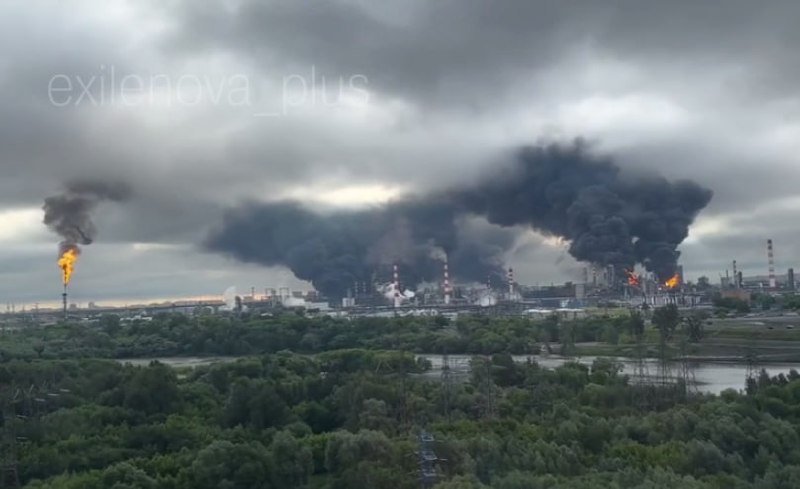
The night of 17–18 June 2026 did not end quietly inside Russia. Between roughly 02:00 and 05:00 UTC, Ukrainian long-range strike drones hit three targets hundreds of kilometres from the front line: a Moscow oil refinery that supplies a substantial share of the capital's fuel, an oil depot in Gukovo in Rostov region close to the Ukrainian border, and a major shopping centre in Moscow that was left ablaze by a drone filmed punching through smoke from earlier hits. The timing was deliberate — spread across one pre-dawn window — and the geography was deliberate too. The campaign is the clearest signal yet that Kyiv's deep-strike posture has moved from episodic into industrial tempo, aimed squarely at the machinery that keeps Russia's war economy running.
The economic logic behind these strikes is no longer hidden. Russia's domestic refining system has become one of the most attractive targets a budget-constrained defender can hit: concentrated, soft-skinned, difficult to fully air-defend, and tied directly to fuel availability for the front. Each successful drone set on a refinery or depot tightens the supply loop that Moscow's logistics planners rely on.
What was struck, and where
The most strategically significant target was the Moscow oil refinery. At 06:45 UTC on 18 June 2026, Kyiv Post reported that the facility — the largest in the Russian capital and one of the biggest in the country — had been hit "for the second time in a week," with Ukrainian drones sparking fires and triggering disruption to fuel flows into the Moscow metropolitan area. Kyiv Post's reporting said the refinery supplies up to 40% of the capital's fuel, a figure that, if accurate, makes any sustained outage a direct political problem inside Russia, not just a military one.
Separately, Noel Reports, a Telegram channel tracking Ukrainian strike activity, reported at 06:48 UTC that Ukrainian strike drones had attacked an oil depot in Gukovo in Rostov region, with a fire visible at the facility and video appearing to show the moment of impact. Gukovo sits roughly twenty kilometres from the Ukrainian border and has been a recurring trans-shipment node for Russian rail and road fuel logistics moving toward the southern front.
The third strike, reported at 06:32 UTC by the Telegram channel Tsaplienko, hit what the channel described as one of the largest shopping centres in the Russian capital. Tsaplienko's footage showed a drone making its way into Moscow through smoke from previous hits, with the building subsequently engulfed. Civilian-targeting language is a non-trivial charge in this kind of reporting, and it is worth saying plainly: the channel's framing was unverified, and Russian and Ukrainian outlets may disagree on whether the mall was being used for dual-purpose logistics, whether air-defence debris was the proximate cause, or whether the strike was solely military in intent. The Russian-language information space has a strong incentive to read any deep-strike incident as terrorism; the Ukrainian information space has an incentive to read every strike as precision military action. Neither incentive is dispositive.
Independent visual corroboration of the Moscow refinery fire came from the OSINT feed Osinttechnical, which at 05:11 UTC posted additional footage of the Moscow oil refinery ablaze, linked from its verified X account. The visuals are consistent with a sustained fire at an industrial fuel-processing site, not a brief grass or transformer burn.
The tempo has changed
The single most important thing about this night is not any one fire. It is the tempo. Two strikes on the same Moscow refinery inside a week, paired with a Rostov depot hit and a third deep-strike inside the capital in the same window, is not a campaign of symbolic报复 — it is a campaign of industrial pressure. Ukraine's domestic drone production, much of it now operating at the brigade level with Western-supplied long-range strike components layered on top, has reached a throughput that lets Kyiv sustain these attacks across multiple high-value targets simultaneously.
That capability did not appear from nowhere. Throughout 2024 and 2025, Ukrainian strikes on Russian refining assets were episodic and often claimed by the SBU or GUR only after the fact. By the first half of 2026, the pattern looks different: raids on a scale where a single night can knock a major refinery offline and tag a logistics depot near the border in the same operational cycle. The Russian air-defence response — interception rates, glide-bomb attrition, EW displacement — is an obvious next question, but the visible fact is that drones are reaching the target set.
This is also why the shopping-centre strike matters analytically, even setting aside the verification question on the ground. Russia has spent four years building layered air defence around Moscow: Pantsir systems around the refinery ring, long-range SAMs guarding the Kremlin corridor, EW units trying to spoof or spoof-fail incoming drones. If a multi-storey civilian building in the capital is repeatedly reachable by loitering munitions in a single night, that is a political fact about the defence of Moscow, regardless of what the building's wartime function was.
The counter-narrative, and what it does not change
The Russian framing of these strikes is well-rehearsed and worth taking seriously on its own terms. State-aligned messaging will frame the shopping-centre strike, in particular, as terrorism against civilians, will amplify any casualty count that emerges from Russian emergency services, and will use it to argue that Western-supplied long-range strike capability to Kyiv is escalation, not defence. There is a real debate to be had inside Western policy circles about the calibration of deep-strike authorisation — what range, what payload, what target set, what civilian-collision risk — and that debate should be reported on honestly.
What that counter-narrative does not change is the basic territorial and legal fact of the war. Ukraine is the invaded party. Strikes launched from Ukrainian territory into the territory of the state that invaded it, against infrastructure being used to sustain that invasion, are not analogous to a first strike. They are defensive operations at strategic depth. The relevant policy question is not whether such strikes should happen — Ukraine's leadership has decided they will — but how the Western supplier coalition chooses to enable or constrain them.
It is also worth being honest about what the source picture here does and does not establish. The Telegram channels cited above — Noel Reports, Kyiv Post's official channel, Tsaplienko, RN Intel, and Osinttechnical — are operationally credible within the open-source community but are not equivalent to a Reuters dispatch or a BBC verified report. Visual footage exists for the Moscow refinery fire and the Gukovo depot hit. The shopping-centre strike is so far supported mainly by Tsaplienko's framing and footage, which is a thinner evidentiary base than the other two, and the casualty picture is not established in any of the materials available at the time of writing.
Stakes, looking forward
The economic stakes for Russia are real but not catastrophic — at least not yet. A single refinery outage affects regional fuel supply and price; a sustained campaign of refinery and depot strikes, layered with attacks on rail fuel hubs and trans-shipment nodes, begins to threaten Russia's ability to fuel its forward formations in southern Ukraine at the rate the campaign requires. The marginal pass-rate of Ukrainian drones into the Russian heartland is the operational variable to watch over the coming weeks. If the rate holds or rises, Russian domestic political pressure on the war's economic cost rises with it.
The political stakes for the supplier coalition are sharper. Each successful deep strike inside Russia raises the volume of the domestic Russian conversation about the war's cost. It also raises the volume of the European conversation about the risk that a sustained Ukrainian deep-strike campaign drags NATO into direct confrontation. The honest reading of the night of 17–18 June is that the campaign is now industrialised, the political economy of the war on the Russian side is being deliberately stressed, and the next round of decisions about long-range strike authorisation will be made against the backdrop of a Ukraine that is visibly capable of operating inside Moscow's air-defence envelope on a routine basis, not as a one-off.
Desk note: Monexus treats deep-strike coverage with explicit attribution to the open-source channels doing the heaviest reporting on these raids — Kyiv Post's Telegram channel, Noel Reports, Tsaplienko, RN Intel, and Osinttechnical — while flagging the verification limits that come with single-source visual claims. Where Western wires have not yet verified a specific strike, we say so rather than asserting confirmation we do not have.
Wire provenance
This editorial synthesis draws on the following public wire/social posts:
- https://t.me/Kyivpost_official
- https://t.me/noel_reports
- https://t.me/Tsaplienko
- https://t.me/rnintel
- https://twitter.com/Osinttechnical/status/2067471443374280918