Ukraine's largest Moscow drone strike in two years signals a step-change in deep-strike economics
Kyiv's SSO and SBU acknowledged an overnight barrage that Russian officials say involved 194 drones over the capital and 555 across the country, hitting a Moscow oil refinery in the Kapotnya district.
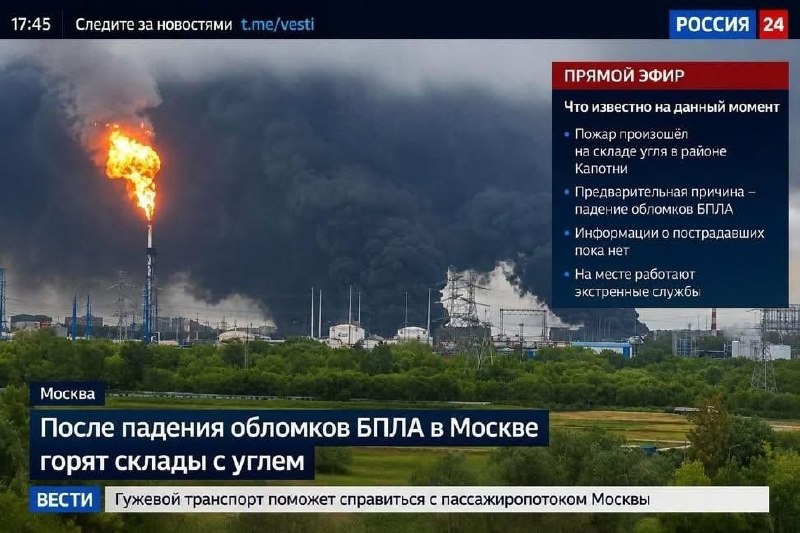
In the early hours of 18 June 2026, Ukraine's Special Operations Forces (SSO) and the Security Service of Ukraine (SBU) publicly confirmed that they were the authors of the largest drone attack on the Russian capital in two years. According to the Russian Defence Ministry, as relayed by Telegram channel Clash Report at 07:37 UTC, air-defence units intercepted 194 drones over Moscow and 555 across Russia in a single overnight wave. Strike video distributed by Telegram channel myLordBebo at 07:16 UTC shows a direct hit on the Kapotnya oil refinery in south-east Moscow, with a heavy lid blown clear of a storage vessel and lifted visibly into the sky. The attack is a defensive action by the invaded party; that framing is the only one consistent with the established record of the war, and it is the framing this publication operates from.
The pattern matters as much as the payload. The 194-drone count over Moscow, if confirmed, is not a one-off escalation — it is the visible output of an industrial tempo that has been building for at least a year. Telegram analyst AMK Mapping, writing at 07:29 UTC, put the current Ukrainian deep-strike rate at roughly 400 fixed-wing drones per day on average, with Russia holding to 100–150 per day and concentrating massed attacks every seven to ten days. The Moscow raid is therefore less a peak than a demonstration: a single salvo pulled from a stockpile that is now, by AMK's reading, two-to-four times the size of Russia's own. The strategic implication is that Kyiv can choose to spend density against a single high-value Russian target — a refinery, a depot, an airfield — and still keep daily pressure on the front line.
What actually got hit
The visible target was the Kapotnya refinery, a downstream asset inside the Moscow city boundary, not a peripheral oblast. Telegram channel myLordBebo published on-scene video of the strike, with strike cam showing a tank-roof or pressure-lid assembly shearing off and ascending on the detonation plume. The Russian Defence Ministry, as quoted by Clash Report, framed the night's work as a defence success: 194 of the Moscow-bound drones intercepted, 555 intercepted nationwide. The SSO and SBU confirmation, carried by Telegram correspondent Andriy Tsaplienko at 07:38 UTC, is the operative attribution. There is no dispute, on either side, that the wave was Ukrainian.
Three things follow from that confirmation. First, the strike was not a harassment raid; it was a deliberate, named-organ operation against an energy target inside the capital. Second, Russian official framing — emphasising the intercept count — implicitly concedes the density of the attack, because no Ministry of Defence spokesperson volunteers a 555-drone nightly total when the night has been quiet. Third, the location inside the Moscow ring road resets assumptions about air-defence coverage that have underpinned Russian domestic political messaging for two years.
The counter-narrative from the Russian side
The Russian line, in the Telegram channels that aggregate it, is straightforward: air defence worked, the intercept rate was high, and the damage is limited. The Kapotnya footage complicates that line. It is hard to square a successful intercept narrative with a refinery storage vessel visibly destroyed, and the two framings will not comfortably sit together in the morning-after commentary cycle on Russian state-aligned channels. The Kyiv line, by contrast, is also restrictive: Tsaplienko's confirmation lists the actors but stops short of claiming the refinery's functional destruction, and AMK's tempo numbers are explicitly framed as a stocktake, not a forecast.
The most defensible reading is the boring one. Russian air defence did engage at scale, did down a high proportion of the salvo, and the attack still reached a hardened fuel asset in the capital. Intercept percentages and physical outcomes are not the same metric. A 90% intercept rate on a 194-drone wave is a story about nineteen hits, not a story about defence.
What the tempo numbers actually mean
The 400-per-day Ukrainian figure is a Telegram analyst's number, not a Ministry of Defence release, and it should be read as an order-of-magnitude estimate rather than a tabulated inventory. Within that caveat, it lines up with the visible shape of 2026: a year in which fixed-wing one-way-attack drones have become the workhorse of deep strike because they are cheap, they are attritable, and they impose a cost-per-intercept on the defender that the defender cannot sustain. If Ukraine is producing and launching in the range of 12,000 such drones per month, and Russia is launching in the range of 3,000–4,500, the unit-economics gap is roughly three-to-one in Kyiv's favour on the deep-strike axis, even before Russian Shahed-type imports are netted out.
This is the structural frame that makes the Moscow raid legible. Deep-strike warfare has crossed a cost threshold: the price of a successful penetration of Moscow's air-defence envelope is now, by visible evidence, lower than the political cost of admitting that penetration has happened. The Kremlin's dilemma is not technical — Russian Pantsir and Tor batteries are clearly engaging — but informational. Every overnight salvo that ends with a refinery on fire forces Moscow to choose between understating the attack and acknowledging that the cheapest weapon in the Ukrainian inventory has reached the capital.
Stakes and forward view
If the tempo holds, the next six to twelve months are a refinery story. Kapotnya joins a growing list of Russian downstream assets that have been hit, and the cumulative drag on Russian fuel output — rather than any single strike — is the variable that matters for the war economy. The Ukrainian bet is that a steady drumbeat of low-cost penetrations forces Russia to spend interceptors, redirect fighter coverage, and eventually concede either domestic fuel prices or export volumes. The Russian bet is that the intercept rate can be sustained politically even as the physical outcomes degrade. Both bets are now in play on the same night.
The honest uncertainty sits on a narrow band. Telegram-channel sourcing is by nature partial; the Russian intercept count is a Ministry claim, not a third-party measurement; the AMK tempo numbers are analytic estimates rather than audited figures. What is not uncertain is the directional change. The Moscow strike of 18 June 2026 is, on the available evidence, the largest single-night Ukrainian drone attack on the Russian capital in two years, and it was carried out under acknowledged SSO and SBU authority. That combination — the density, the targeting, the named attribution — is the news. The oil refinery on fire inside the Moscow ring road is its proof.
This publication reads the overnight wave as a step-change in deep-strike economics, not as a turning point. The wire framing, which leads with the Russian intercept count, treats the night as a defensive success; the underlying industrial tempo, as documented by Telegram-based open-source trackers, treats it as a normal night's output from a stockpile that has crossed a scale threshold. Both can be true. The question is which framing ages better.
Wire provenance
This editorial synthesis draws on the following public wire/social posts:
- https://t.me/ClashReport
- https://t.me/Tsaplienko
- https://t.me/myLordBebo
- https://t.me/AMK_Mapping
- https://t.me/ClashReport/