Ukraine hits Moscow Oil Refinery for second time in a week; Russia retaliates against fuel sites
Kyiv's long-range drones struck the Moscow Oil Refinery for the second time in a week, with additional targets reported in Rostov and Russian-occupied territory, prompting a Russian group strike on Ukrainian fuel facilities overnight.
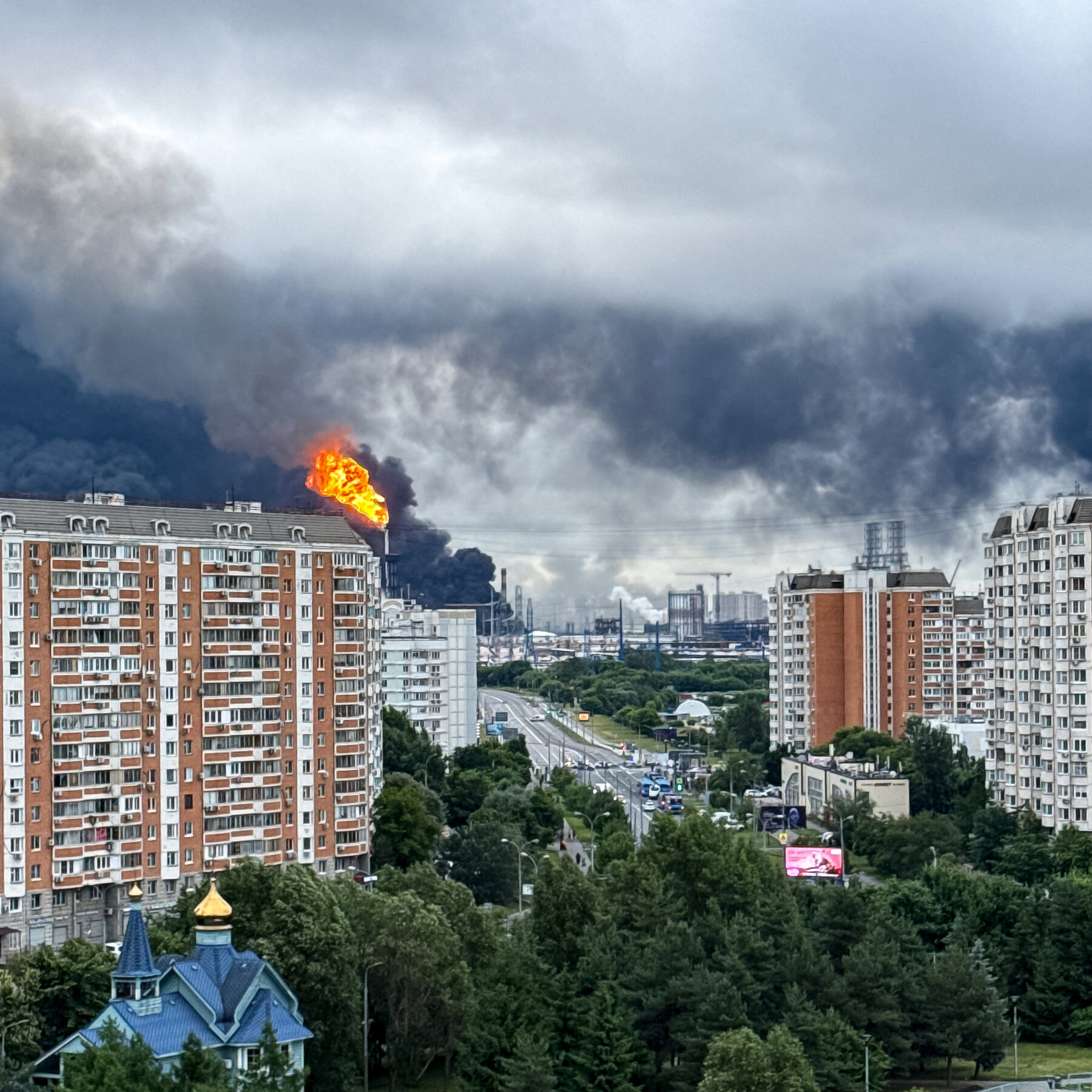
In the early hours of 18 June 2026, Ukrainian long-range drones struck the Moscow Oil Refinery for the second time in seven days, with additional targets reported across the Rostov region and in Russian-occupied territory, according to official Ukrainian channels posting overnight [2026-06-18T07:01]. President Volodymyr Zelenskyy's account carried the same operational summary almost simultaneously [2026-06-18T06:59]. Within an hour, Russia's Ministry of Defence announced a retaliatory group strike with high-precision ground- and air-based weapons, framed as a response to "terrorist attacks by the Kiev regime" [2026-06-18T06:55], and state outlet Zvezda News specified that Ukrainian fuel-and-energy facilities were the targets of the Russian response [2026-06-18T06:01].
The exchange marks the second direct hit on the Moscow refinery in roughly a week — a tempo that, if sustained, will draw close attention from European fuel traders, Russian federal budget planners, and the small set of insurers who still cover Russian downstream assets. It also illustrates a tactical convergence: as Ukrainian deep-strike capability has matured, Moscow's chosen retaliation has migrated toward Ukrainian refineries, storage, and grid nodes that are easier to reach and politically easier to justify inside Russia.
What Kyiv says it hit, and what Moscow says it hit back
The Ukrainian framing, published first by the Mykolaiv regional administration and repeated from the president's official account within minutes, lists three categories of impact: the Moscow Oil Refinery, struck for the second time in a week; targets in the Rostov region, which Ukrainian official channels have repeatedly named in recent months; and targets inside what Kyiv describes as "temporarily occupied territ[ories]" — the standard Ukrainian diplomatic formulation for Russian-held areas. The phrasing — "our long-range sanctions reached the Moscow region" — is itself a deliberate signal. Ukrainian official channels now use "sanctions" as a metonym for drone strikes against Russian economic and military infrastructure, placing them inside the language of economic warfare rather than battlefield attrition.
Russia's response, carried by the Ministry of Defence channel and amplified by state outlet Zvezda News, claims a "group strike with high-precision ground- and air-based" weapons and, more specifically, drones against "facilities of the fuel and energy complex of Ukraine." The Russian wording explicitly frames the operation as retaliation for "terrorist attacks in Kyiv" — a reference, in the Russian state's lexicon, to Ukrainian strikes on Russian soil. The symmetry of the two communiqués is notable: each side names fuel infrastructure on the other's territory, and each side frames its own action as a measured reply to the other's escalation.
A tempo that is changing the economics of the war
Strikes on Russian refineries are no longer one-off events. By the count implicit in Kyiv's overnight post — a second Moscow refinery hit inside a week — Ukrainian long-range drones are now operating on a sustained cadence against downstream oil assets in European Russia. The immediate financial effect falls on Russian refining margins and on the federal budget, which depends on petroleum-product taxation; the secondary effect falls on global product markets, where Russian diesel and fuel-oil exports have been a structural price-setter for years. The two prior Moscow refinery strikes referenced in the overnight post are not, on the available evidence, claimed by Russian channels as having caused sustained outages, and the sources do not specify throughput loss, unit downtime, or casualty figures from the latest strike.
Russia's chosen counter-targets — Ukrainian fuel and energy infrastructure — are the more strategically legible choice. Ukrainian storage and refining capacity is geographically concentrated, easier to reach with air- and sea-based standoff weapons than Ukrainian military formations, and politically presentable inside Russia as a reply to attacks on Russian civilians. The Russian framing in the overnight posts — "in response to terrorist attacks by the Kiev regime" — is the standard formulation Russian state communications have used to describe strikes on Ukrainian power and fuel infrastructure throughout the war, and it performs the same function now: it locates Moscow as the responding party and Kyiv as the initiator.
How the two narratives diverge
The most important read-through is not the strike count but the narrative split. Ukrainian official channels lead with the term "sanctions," folding deep-strike operations into the language of economic pressure on Russia. Russian official channels lead with the term "terrorist attacks," folding the same events into the language of regime illegitimacy. The underlying physical events — drones launched at fuel infrastructure on both sides of the front — are largely agreed; the political reading is not. Independent verification of damage assessments on either side remains thin in the overnight posts. Russian channels do not acknowledge loss at the Moscow refinery; Ukrainian channels do not quantify the impact of the Russian counter-strike on Ukrainian fuel sites. Both communiqués are official-source statements operating in their own framing lane.
What remains uncertain, and what is worth watching
Several things are not specified in the available posts. The sources do not name the specific unit or sub-region of the Moscow Oil Refinery that was hit, nor do they state whether the strike triggered a temporary shutdown. Russian channels do not give the location, scale, or timing of the Ukrainian fuel-and-energy targets within Ukraine itself. There is no independent third-party confirmation of either side's claimed impacts in the overnight material. What is established, and what the overnight posts agree on in their own ways, is the operational pattern: a Kyiv-initiated long-range strike on a Russian downstream asset of strategic significance, followed within the hour by a Moscow-initiated long-range strike on Ukrainian fuel infrastructure, with each side's framing of causation pointing firmly at the other.
Wire provenance
This editorial synthesis draws on the following public wire/social posts:
- https://t.me/mykolaivskaODA
- https://t.me/V_Zelenskiy_official
- https://t.me/two_majors
- https://t.me/zvezdanews