Moscow on fire: Ukraine's strikes on Russian oil are rewriting the war's economic logic
For the second time in a week, Ukrainian drones have hit a Moscow oil refinery. The pattern — not the single strike — is what changes the math for Moscow.
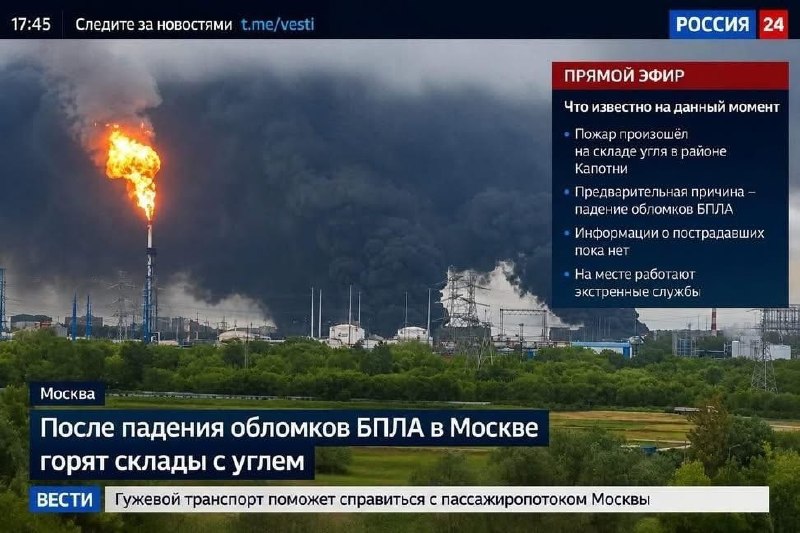
For the second time in a week, Ukrainian long-range drones have hit the Moscow Oil Refinery, with additional targets reported in the Rostov region and in Russian-occupied territory. The strike pattern, reported on 18 June 2026 by Ukraine's Defence Intelligence (DI Ukraine), regional military administrations, and President Volodymyr Zelenskyy's official channel, points to a deliberate shift: Kyiv is no longer treating Russian refining capacity as a peripheral pressure point. It is treating it as infrastructure.
The question that follows is not whether these drones can reach Moscow — that has been answered — but whether a sustained campaign against Russian oil processing can bend the war's economic logic faster than sanctions, embargoes, or the G7 price cap have managed on their own. Early evidence suggests it can. The question is how much, and how fast.
What was hit, and by whom
According to posts from DI Ukraine, the Mykolaiv regional military administration, and Zelenskyy's official Telegram channel on the morning of 18 June 2026 (UTC), the Moscow Oil Refinery in the Moscow region was struck for the second time in seven days, with further targets recorded in Rostov and in the temporarily occupied territories. Zelenskyy framed the strikes as a "fair response" to Russian attacks on Ukrainian cities and towns, language that signals a deliberate political framing as much as a military one — Kyiv is publicly claiming the operation, the opposite of the ambiguity that characterised earlier cross-border strikes.
The accompanying reporting from journalist Andriy Tsaplienko, who published footage of a downed drone falling on the roof of a shopping centre, shows that the air-defence environment inside Russia is now visibly active over civilian infrastructure. That is a fact with its own signalling weight: it tells Russian audiences that the war has reached the capital's commuter belt, not just its remote oblasts.
The counter-narrative Moscow will push
Moscow's likely counter-frame, consistent with prior Russian messaging on Ukrainian strikes inside the federation, is that these are terrorist attacks on civilian infrastructure, designed to frighten Russian families and to provoke escalatory responses. Russian state media will also point to the fact that falling Ukrainian drones have hit Russian shopping centres, a line of argument that conflates interception failures with deliberate targeting.
That framing is not baseless — the Tsaplienko footage does show a drone coming down on a commercial roof — but it elides the asymmetry. Ukraine is striking refineries and military-industrial sites on the territory of a state that launched a full-scale invasion in February 2022 and has, throughout the war, deliberately hit Ukrainian energy infrastructure, port facilities, and residential buildings. Strikes against the aggressor's fuel supply are a legitimate defensive response. That distinction should not be smoothed over for balance's sake.
Why refineries, and why now
Russian crude exports have proven remarkably resilient to Western pressure. The G7 price cap, the EU oil embargo on seaborne imports, and a parallel shadow-fleet logistics architecture have together kept Russian Urals flowing, mostly to Asian buyers, at discount prices that are still profitable at scale. What the embargo has not solved is refining. Russia exports crude, but its domestic fuel price is a function of how much of that crude its own refineries can process. Knock out refining capacity, and the discount on the crude goes up while the price at the Russian pump goes the other way — a fiscal and political problem for the Kremlin at the same time.
Ukraine appears to have concluded that a steady cadence of long-range strikes on refineries, combined with sustained attacks on Russian fuel storage and rail logistics, is a more effective pressure tool than waiting for the next round of sanctions. The twice-in-a-week cadence is the key data point. Single strikes are absorbable. A pattern is a policy.
The structural read
This is what a strategic bombing campaign looks like at the early-industrial stage: small payload, high precision, repeated, deniable enough to stay below the threshold that triggers direct Western intervention. Ukraine is using the same logic the United States and Israel have used in other theatres — degrade the adversary's economic sinews rather than its army in the field — but with a domestic drone-industrial base that has scaled faster than most Western analysts forecast.
For Moscow, the math is uncomfortable. A refinery hit twice in a week is, in the absence of rapid repairs, a refinery that runs at reduced throughput for a month. Multiply that across four or five sites over a season, and the Russian fuel market starts to show visible stress — not in the export ledger, where the shadow fleet absorbs the crude, but at home, where the regime's social contract rests on stable prices and a functioning war economy.
Stakes, and what remains uncertain
The Kremlin's incentive to escalate — against Ukrainian cities, against the energy grid, possibly against Kyiv's Western backers — rises with each successful strike. That is the obvious risk: the more pressure this campaign puts on the Russian fuel balance, the more willing Moscow may be to retaliate against Ukrainian civilians and infrastructure at a tempo that Kyiv's air defence cannot fully absorb. There is also a counter-question: how quickly can Russian refining capacity be repaired, and at what cost? The available source material does not specify repair timelines or output losses, and that is the part of the story that will determine whether the pattern matters more than the incident.
What is not in dispute is that the geography of this war has, in the last seven days, decisively shifted. A Moscow oil refinery is not a battlefield in eastern Ukraine. It is the seat of a power that is now being told, in diesel particulates and refinery alarms, that the cost of its invasion is no longer someone else's problem.
Desk note: Monexus leads this story on Ukrainian and Western-allied sources, as the editorial compass requires for a conflict in which Ukraine is the invaded party. Russian state and milblogger channels have not been used as a stand-alone factual basis; their expected counter-frame is reconstructed here from established Russian messaging patterns rather than cited as a fresh claim.
Wire provenance
This editorial synthesis draws on the following public wire/social posts:
- https://t.me/DIUkraine/
- https://t.me/Tsaplienko/
- https://t.me/mykolaivskaODA/
- https://t.me/V_Zelenskiy_official/