Ukrainian drones hit Moscow oil refinery, darken the Russian capital's morning
A Ukrainian drone strike set the Moscow Oil Refinery ablaze on 18 June 2026, sending oily fallout across residential districts and marking another escalation in Kyiv's long-range campaign against Russian fuel supply.
Lead
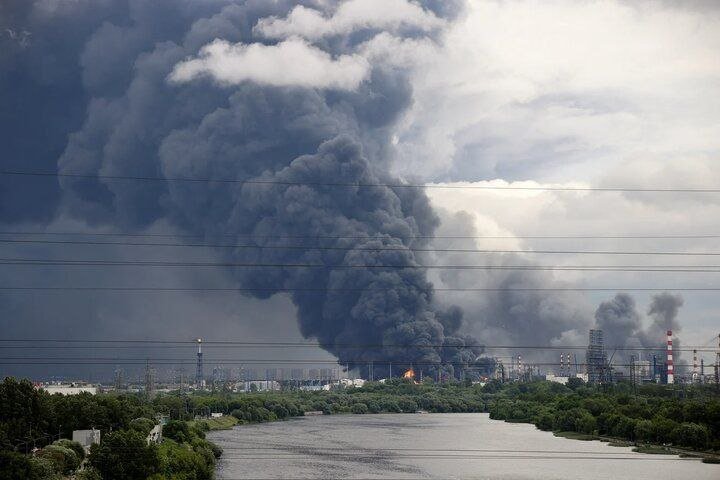
Residents across several parts of Moscow reported an unusual "oil rain" on the morning of 18 June 2026 after Ukrainian drone strikes hit the Moscow Oil Refinery overnight, with dark oily residue falling across districts of the Russian capital alongside a thick column of black smoke over the plant. Photos and videos shared online showed the residue streaking windshields and balconies, while Russian firefighting helicopters were filmed dumping water on the burning facility. The strike, the latest in a months-long Ukrainian campaign against Russian fuel infrastructure, came as Kyiv widens its long-range targeting of sites deep inside Russian territory.
Nut graf
Kyiv's overnight raid on the Moscow Oil Refinery is the sort of operation that, a year ago, would have drawn a sharp Russian retaliatory statement and a short wire paragraph; in mid-2026, it is a near-routine entry in a strike ledger that has already cost the Russian energy sector billions of dollars in damage and the Russian public a quiet sense of domestic safety. The political signal — that the war's strike envelope now extends to a refinery inside the Moscow ring road — matters more than the immediate operational damage, and it is the signal Moscow is most likely to read.
What was hit, and how Moscow saw it
The Moscow Oil Refinery, a sprawling plant in the southeastern part of the capital, was visibly burning through the morning of 18 June, with the OSINTtechnical account posting footage of a resident watching the fire from a high-rise balcony. The Telegram channel Kyivpost_official reported that the strike triggered an "oil rain" — droplets of unburned petroleum products dispersed by the fire and prevailing winds — that fell across residential neighbourhoods, leaving dark stains on parked cars and windows. Helicopters were filmed circling the refinery and dropping water on the flames, an image that several Russian and Russian-aligned channels circulated as evidence of the scale of the response.
Kyiv has not formally claimed the strike at the time of writing, a pattern consistent with its handling of previous long-range operations: tactical silence in the first hours, followed by confirmation from the SBU or the General Staff, often days later. Ukrainian outlets have framed the refinery campaign as a deliberate effort to degrade the revenue base that funds Russia's invasion, with domestic fuel shortages and export disruptions the explicit goal.
The Russian framing, and what it reveals
Russian state media was quick to depict the strike as a provocation against a civilian target, with Iranian-aligned channel PressTV posting footage of firefighting helicopters and thick black smoke over the Russian capital. Russian emergency services reported no casualties in the initial hours, and Moscow Mayor Sergei Sobyanin's office, in line with its standing practice, treated the incident as a routine air-defence event rather than a strategic failure. The framing matters because it concedes the operational fact — the drone reached the refinery, the refinery is burning, oil products are falling on residential districts — while stripping it of the political implication: that the airspace above the Moscow metropolitan area is contested.
The Twitter-based account OSINTtechnical, a frequent monitor of strikes inside Russia, posted the balcony footage within hours of the impact, with the post circulating widely through the open-source community. Telegram channel Clash Report amplified the helicopter footage, framing the response as a desperate scramble. Russian milbloggers, by mid-morning, were beginning to circulate claims about the type of drone used and the route it took, an information contest in which every side has an incentive to claim a tactical victory.
A pattern, not an anomaly
The Moscow strike is the latest data point in a campaign that has run for more than a year and that has, by independent tracking, hit dozens of Russian refineries, depots and pumping stations from Belgorod to the Caspian. The structural read is plain: Ukraine has built a long-range strike capacity — a mix of domestically produced drones, adapted Soviet airframes, and Western-supplied missiles — that allows it to impose a steady, low-grade cost on Russia's most politically sensitive economic sector. The cost is not catastrophic; Russian oil exports continue, and the Kremlin has leaned on the rouble's resilience and on Asian buyers to absorb redirected flows. But the cost is persistent, distributed, and increasingly visible to Russian voters in the form of regional fuel price spikes and, now, oily residue on parked cars in the capital.
The dominant Western wire framing treats the campaign as a Ukrainian success story — evidence that sanctions plus long-range strikes are degrading Russia's war-making capacity. The counter-narrative, voiced by Russian state media and some Western energy analysts, is that the damage is largely cosmetic, that Russian refining capacity is being restored faster than it is destroyed, and that the human cost on the Russian side is being exaggerated for propaganda effect. Both reads have evidence behind them. What neither disputant can deny is the political optics of a Moscow refinery visibly burning on a weekday morning, with helicopter rotors audible in residential districts and oily rain falling on the cars of Muscovites who, until now, have experienced the war mainly through state television.
Stakes, and what remains uncertain
If the current trajectory holds, two things follow. First, the Kremlin faces a slow-bleed political problem: a war that was sold as a quick operation now produces regular, visible reminders that Russian territory — including the capital — is not invulnerable. Second, the strike envelope widens in both directions; Russia has already hit Ukrainian refining and storage capacity, and the two campaigns are now mutually reinforcing, with each side treating the other's energy infrastructure as a legitimate target.
What remains uncertain is the immediate operational picture. The sources cited here do not specify the type of drone used, the number of impacts, or the volume of refinery throughput affected. Russian emergency services reported no casualties in the first hours, but independent verification of that figure is not yet available. The longer-term effect on Russian fuel prices and export volumes will only become clear in the days and weeks ahead, and the pattern of previous strikes suggests the more interesting numbers — repair timelines, capacity offline, regional shortages — tend to emerge from Russian industry sources and independent trackers, not from the initial wire reports. For now, the morning image is the story: a refinery in flames, helicopters in the sky, and a Russian capital learning what the war sounds like from the inside.
Wire provenance
This editorial synthesis draws on the following public wire/social posts:
- https://t.me/Kyivpost_official
- https://twitter.com/Osinttechnical/status/2067608995985068239
- https://t.me/presstv
- https://t.me/ClashReport