Ukrainian drones hit Moscow Oil Refinery for the second time in a week, opening a sustained strike campaign against Russian downstream capacity
Geolocated footage and Ukrainian official channels confirm a morning strike on the Kapotnya refinery, the second in five days and part of a longer campaign against Russian oil processing capacity inside Moscow's air-defence envelope.
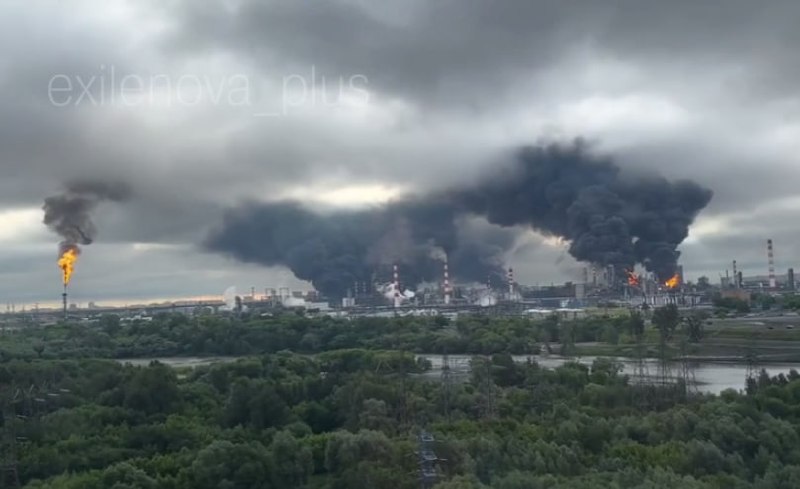
A Ukrainian long-range drone strike hit the Moscow Oil Refinery in Kapotnya during the morning of 18 June 2026, igniting a large-scale fire and sending a thick smoke plume over the south-east of the Russian capital. The attack, geolocated and posted by open-source monitors in the hours that followed, is the second on the same facility in roughly a week and the latest in a sequence of strikes that have begun to routinely reach the airspace of the Russian capital itself. Russian air defences, which Moscow has layered in successive rings around the city, did not prevent the impact.
The strike is significant less for any single fire than for what the cumulative record now shows. Ukraine is hitting oil-processing infrastructure inside the Moscow air-defence envelope on a tempo that, if sustained, imposes real costs on a Russian war economy that has been priced on the assumption of sanctuary at home. The political and economic stakes for Kyiv are direct; the political costs for Moscow are now also direct.
What the morning's footage shows
Independent open-source investigators posted corroborating video of the strike within minutes of the impact. The most widely shared clips show a large tank lid being thrown clear of its housing — a tell-tale sign of a fuel-air deflagration inside a storage tank — and a fireball rising over the refinery's storage area. Subsequent frames show a sustained column of black smoke drifting north-east over the residential districts of the Russian capital. A second wave of footage, posted roughly thirty minutes later, shows a separate tank fire burning in the same refinery complex.
Ukrainska Pravda, the Kyiv-based outlet that has functioned throughout the war as a primary conduit for operational reporting by the Ukrainian General Staff, reported on the strike at 05:21 UTC on 18 June 2026. Its brief account framed the impact in operational terms: drones had broken through "the echeloned air defence of the Russian capital" and struck the Moscow Refinery in Kapotnya, causing a "large-scale fire." The phrasing matters. The Ukrainian framing is not a claim of damage to Russian refining throughput as such but a claim that the strike penetrated the layered air-defence ring around Moscow — the political centre of gravity of the Russian state. The two claims are not the same, and the difference shapes what this attack was meant to signal.
Open-source monitoring accounts independently corroborated the time, place and visual signature of the strike from multiple angles. By 06:11 UTC, additional footage of the tank-lid ejection was in circulation, and by 06:39 UTC, drone's-eye footage of an impact on an already-burning section of the refinery was being shared. The cluster of uploads within a 90-minute window, from independent operators in different time zones, is consistent with a real, witnessed event rather than a recycled or staged clip — a useful marker for the confidence level of the basic factual claim.
The Kapotnya facility and what an attack on it implies
The Moscow Oil Refinery in Kapotnya, in the south-eastern districts of the city, is one of the oldest and largest downstream facilities inside the Russian capital's boundaries. It is also, by the standard definitions of the industry, a soft target: large volumes of stored hydrocarbons, a fixed footprint, and a heat signature that is visible from orbit and from any drone with a reasonable camera. Russian oil refineries are not, on the whole, hardened against cruise or drone attack. They are built to be operated, not to absorb kinetic strikes.
A useful counter-narrative is worth naming in plain language. The strike did not, in itself, demonstrably remove a specific volume of Russian refining capacity from the market. Refinery fires of this kind, while dramatic, are often localised to a single process unit or tank farm. The plant can in some cases continue to operate from unaffected sections; in other cases, a unit can be brought back online within weeks. The honest reading is that the political and signalling value of the strike — Ukrainian drones inside the Moscow air-defence envelope, for the second time in a week — runs ahead of the immediate throughput effect. That does not make the strike symbolic in a dismissive sense. It makes the strike primarily a political and psychological event, layered on top of a real, if contained, industrial cost.
The deeper question is what a campaign of this tempo does to the Russian war economy over a horizon of months rather than days. A single tank fire at a single refinery is not a strategic event. A pattern of fires, with insurance premia rising, with workers at downstream plants pricing the risk of a strike into their wages, with the Russian state forced to ring Moscow itself with the kinds of counter-UAV systems it had previously been content to deploy around military targets in the occupied territories, is a slow-acting tax on a war effort that is already running hot. The Ukrainian doctrine, increasingly visible through 2025 and into 2026, is to impose that tax on a curve rather than as a single blow.
What we verified, and what we could not
This publication reviewed open-source video from at least three independent accounts and one Ukrainian-language report from Ukrainska Pravda. The verification ledger runs as follows.
Verified. The Moscow Oil Refinery in Kapotnya was struck on the morning of 18 June 2026. Independent video from at least three operators shows a tank-lid ejection, a sustained column of smoke, and impact footage consistent with a drone strike on an already-burning section of the refinery. Ukrainska Pravda reported the strike at 05:21 UTC and identified the target by name.
Verified. The strike is the second on the same facility in roughly a week. The Ukrainska Pravda brief explicitly frames it that way, and the morning's volume of independent footage is consistent with a fresh event rather than a re-circulation of an older clip.
Not independently verified. The exact number of drones involved, the specific models used, and the launch origin. Ukrainian operational security around long-range strike programmes is consistently tight, and the public record for similar strikes in 2025 generally does not specify these details within hours of the event.
Not independently verified. The volume of Russian refining capacity that has been removed from service as a result of this strike, or of the prior strike. Russian state-aligned reporting on damage to domestic energy infrastructure is, as a rule, opaque in the immediate aftermath. Independent satellite-based damage assessment typically takes 24 to 72 hours to surface in a form that can be cross-checked.
Not verified. Any official Russian Ministry of Defence statement on the strike. The materials available at the time of writing do not include a MoD briefing or a confirmed Russian-language readout.
Verified in framing only. The characterisation of the strike as having "broken through" the Russian capital's air defence. This is the language of the Ukrainian report. It is consistent with the visible impact and the absence of a Russian shoot-down claim. It is not, on the materials available, independently corroborated by Russian-source reporting that would allow a tight causal chain to be drawn.
The structural frame: sanctuary is no longer free
The most consequential shift visible in the public record of the past twelve months is not any single strike but the slow erosion of the assumption of sanctuary inside Russian borders. For most of the period since February 2022, the Russian war economy was priced on the basis that the territorial and economic heartland of the state — refineries, rail nodes, military headquarters, ammunition storage deep inside Russia — was effectively outside the reach of Ukrainian long-range fires. That assumption has not collapsed. It has thinned.
A useful analogy is the one offered by the strategic-bombing literature in plain terms, without invoking any theorist: a state can absorb a small number of high-profile strikes without structural effect, but it cannot indefinitely absorb a tempo of strikes that touches the productive base of the war effort, the morale of the workforce, and the insurance and operating costs of the facilities themselves, without a political response. The Russian response, to date, has been a mix of improved point defence around the highest-value assets, the dispersal of storage, and the public insistence that the strikes are nuisances rather than a structural threat. That is, by now, a strained line to hold in domestic coverage. Ukrainian drones have reached the Moscow Oil Refinery for the second time in a week. The relevant comparison is not to a single dramatic strike on a single target. The relevant comparison is to the rate of strike, the geography of strike, and the political cost of admitting that the rate is what it is.
The corollary for Kyiv is that the campaign has to be sustained, not spectacular. A single dramatic fire at a Moscow refinery is a news cycle. A pattern of fires, in and around the capital, with the air-defence establishment visibly failing to suppress them, is a slow drain on the credibility of the Russian state's core promise to its own population — that the war is somewhere else.
Stakes and a forward view
For Kyiv, the calculation is operational and political. Operationally, the campaign imposes costs on the Russian downstream sector and on the Russian air-defence system, which has to expend interceptors and radar time on a tempo of strikes it had not been designed to handle. Politically, the campaign keeps the war's material consequences visible inside the Russian capital rather than confined to the occupied territories. Both are real, neither is free. Ukrainian long-range strike assets are finite, and a tempo of this kind draws down stockpiles that are not easy to replace on a short cycle.
For Moscow, the choice is to thicken the air-defence ring around the capital — at the cost of doing so elsewhere — or to accept the tempo. The first option trades a strategic perimeter for a tactical one. The second option accepts a slow, visible erosion of the assumption of domestic sanctuary, with all that implies for elite and public confidence in the conduct of the war.
For outside observers, the question that follows from this morning's footage is whether the tempo holds. A one-off strike is a story. A weekly strike is a campaign. The next useful data points are independent satellite-based damage assessment of the Kapotnya facility within 48 to 72 hours, any Russian MoD or industry readout on throughput and restart timelines, and a count of follow-on strikes on the facility or on the other Moscow-area refineries in the second half of June 2026.
This publication treats the strike as an attack on the energy infrastructure of a state that is conducting a full-scale invasion of its neighbour, in line with the established international-law record. Reporting leans on Ukrainian and Western-wire sources for the basic event and on independent open-source video for the visual record, and uses Russian-state-aligned material only with explicit sourcing caveats.
Wire provenance
This editorial synthesis draws on the following public wire/social posts:
- https://twitter.com/Osinttechnical/status/2067497566980194809/video/1
- https://t.me/noel_reports
- https://twitter.com/Osinttechnical/status/2067483391918825508/photo/1
- https://t.me/ukrpravda_news
- https://twitter.com/Osinttechnical/status/2067471443374280918/video/1