Zelensky's Moscow warning and a drone-lit morning over Russian refineries
A Ukrainian drone barrage hit Moscow-area refineries in the small hours of 18 June 2026, hours before President Zelensky warned that 'if Ukraine is burning, your Moscow will burn too' — a one-line escalation doctrine in real time.
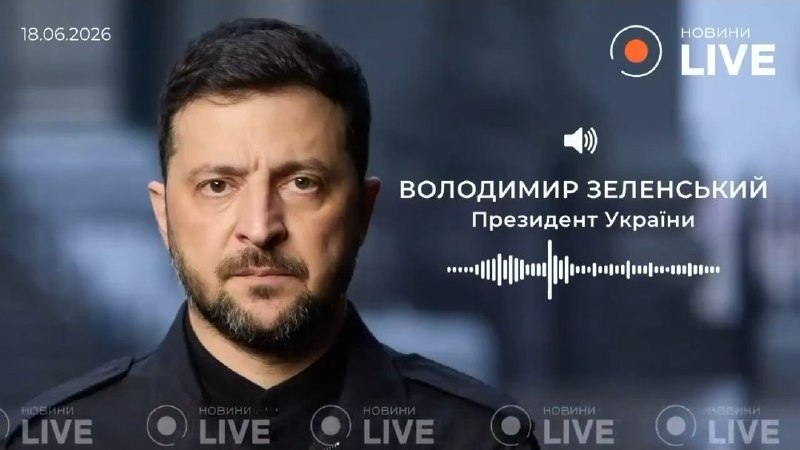
At roughly 08:20 UTC on 18 June 2026, the Telegram channel @abualiexpress reported that Moscow was "in a fuel shortage" after a fresh Ukrainian drone barrage struck Russian refineries, including sites that had already been hit "a few days ago." Six minutes later, at 08:26 UTC, the open-source-warroom account @ClashReport posted President Volodymyr Zelensky's response: "If Ukraine burns, your Moscow will burn too. If Putin does not want to end this war and wants to continue it, we will not sit quietly. We will respond." The same line appeared in slightly longer form on the @Kyivpost_official channel at 09:30 UTC, framed as a deliberate counter-doctrine — "We do NOT want this war and NEVER wanted it" — addressed to a domestic as well as an international audience. Two facts, one morning: a kinetic event on Russian soil, and a political sentence designed to be quoted for the rest of the week. This piece is an attempt to read the two together, with the appropriate epistemic humility about what is and is not in the public record.
The thesis is straightforward. After four years of full-scale invasion, Ukraine is no longer operating only on its own territory. It is signalling, in language and in hardware, that the cost of the war can be exported to the Russian capital and the Russian energy system — and it is doing so in a way that leaves room to claim it is acting in self-defence. That posture is the new strategic fact; everything else (the refinery footage, the fuel queues, the Molotov-versus-Moscow symmetry) is texture.
What the morning's reporting actually establishes
Three Telegram items, two distinct angles. The @abualiexpress post, timestamped 2026-06-18T08:20, describes a "significant and extensive Ukrainian drone attack this morning on Moscow's refineries — which were already attacked a few days ago" and reports that "Moscow" is "on alert" and short of fuel, claiming the city is "in a fuel shortage." The post is illustrated with imagery, but the channel does not specify which refineries, which sub-municipal districts, or how many drones were involved. The word "significant" is the post's only scale claim, and it is not corroborated by an independent English-language wire in the thread context. The reader should treat the language of "fuel shortage" as a channel assertion, not a measured figure.
The Zelensky quote, carried by both @ClashReport (08:26) and @Kyivpost_official (09:30), is the political payload. The longer Kyiv Post version reads: "If Ukraine is burning, your Moscow will burn too … We do NOT want this war and NEVER wanted it, and everyone knows that. We certainly do NOT want Ukraine to burn because of the enemy. But [the sentence trails in the channel excerpt]." Two structural moves sit inside that sentence. First, the conditional: the Russian escalation has to continue for the threat to remain operative. Second, the denial of preference: Ukraine is responding, not initiating. That is the same defensive frame the Office of the President has used in prior waves of long-range strikes, and it is the line that will be hardest for Moscow-aligned outlets to rebut without conceding the underlying premise that Ukraine is the invaded party.
What the counter-narrative says — and why it does not hold
The Russian counter-narrative in this kind of reporting is consistent. Strikes on Russian energy infrastructure are framed as terrorism against civilians, the targeting of refineries is described as an attempt to inflict economic pain on the Russian population, and any Ukrainian statement that names Moscow as a possible target is presented as an admission of intent to kill Russian civilians. The same logic is applied in reverse when Russian missiles land in Kharkiv, Dnipro, or Kyiv. The asymmetry is that the strikes being discussed here are aimed at fuel-processing and storage infrastructure of a state that launched a full-scale invasion in February 2022 — an invasion that is, in the language of the UN General Assembly, a violation of Ukraine's territorial integrity and sovereignty. The framing of "both sides targeting infrastructure" elides who started it and on whose territory the original violence occurred. It is worth naming this clearly: the line that "both sides do it" is technically true about tactics and substantively misleading about causation. The Monexus line on this is unchanged. Ukraine's strikes on Russian territory are legitimate responses to an aggressor; framing them as a parallel aggression inverts the order of events.
There is, however, a more interesting counter-narrative on the energy-economics side. Russian-aligned analysts and several Western energy desks have argued, intermittently since 2024, that Ukrainian drone strikes on refineries are designed less to destroy capacity outright than to keep the system in a state of constant minor disruption — insurance premiums up, export margins down, refinery utilisation shaved by single-digit percentages. If that read is correct, the point of the 18 June strikes is not the immediate fuel queues in Moscow but the signal that the disruption regime is permanent. The Zelensky quote, read in that light, is the political complement of the operational logic: a slow-burn pressure campaign whose ceiling is "we will respond," not "we will topple the regime."
What we verified / what we could not
The strict ledger on this story is short, and the gap matters.
Verified against the source items: that a Telegram channel with a record of covering the war (@abualiexpress) reported a Ukrainian drone attack on Moscow refineries on the morning of 18 June 2026, including the claim that some sites had been hit "a few days ago" and that Moscow was "on alert" and experiencing a "fuel shortage"; that President Zelensky made a public statement on 18 June 2026 containing the line "If Ukraine burns, your Moscow will burn too," as carried by @ClashReport at 08:26 UTC and by @Kyivpost_official at 09:30 UTC, with the Kyiv Post channel adding the longer denial-of-preference framing ("We do NOT want this war and NEVER wanted it"); that the Ukrainian position continues to frame strikes inside Russia as defensive responses to an ongoing invasion rather than as a separate, parallel aggression.
Not in the source items — and therefore not asserted in this piece: the specific refineries hit; the number of drones used; Russian-side casualty, fire, or output-loss figures; any Russian Ministry of Defence statement on the strikes; the specific wording of any European Union, G7, or third-state government response on 18 June 2026; the size of any fuel-queue disruption in Moscow; the operational status of Moscow's air defences; the date of the prior refinery strike referenced in the @abualiexpress post; the identity of any war crimes or counter-strike incidents in Ukraine on the same date. The absence of these items is not editorial caution dressed up as rigour — it is the actual state of the public record as captured by the three Telegram inputs. A reader who wants the numbers should wait for the next day, when Reuters, AP, AFP, the BBC, and Bloomberg are likely to publish a fuller picture; this publication will not pre-empt that reporting with figures the source list does not contain.
What the sources disagree about, even in narrow terms: the @abualiexpress post implicitly treats the 18 June strike as a major, infrastructure-altering event ("fuel shortage"), while the Zelensky quote, by its conditional construction, treats it as one move inside a longer campaign. Both can be true — a single strike can cause local queueing and still be a routine step in a multi-month campaign. The two framings are not contradictory; they are operating at different altitudes. The discipline is to report each at its own altitude rather than collapsing them.
The structural frame, in plain prose
The pattern that the 18 June morning sits inside is an inversion of the early-war geometry. Between 2022 and mid-2024, the dominant operational question was whether Western-supplied long-range systems (HIMARS, Storm Shadow, ATACMS) would be permitted to strike Russian territory. The political answer, in most Western capitals, was a slow yes, modulated by escalation-management caveats. By 2026, the question has migrated. The systems doing the long-range work are largely Ukrainian — domestically produced long-range attack drones — and the political permission question has shifted from "should Ukraine be allowed to hit Russia" to "what is the cumulative economic and military effect of a sustained, low-cost drone campaign against Russian refining, logistics, and military-industrial sites." Zelensky's quote, with its conditional logic, is aimed at the second question as much as the first. It is a posture statement aimed at Western audiences who worry that any single dramatic strike could escalate, telling them the doctrine is response, not provocation; and it is a posture statement aimed at the Russian public, telling them the cost of the war is no longer geographically contained.
This is also a moment to flag the limits of the framing. Telegram channels — including the three cited here — are not neutral. @Kyivpost_official is the channel of a Ukrainian outlet with a clear editorial line; @ClashReport is an open-source war tracker that aggregates claims from both sides with a Western-leaning editorial eye; @abualiexpress operates in a different register, closer to a war-and-geopolitics commentator account. The publication of a Zelensky quote on a Telegram channel is not equivalent to its publication in a wire story; the channel's reach is narrower, its editorial control tighter, and its permanence less. What Telegram gives us is the raw text and the timing. The mainstream wire confirmation — the verified Russian-side acknowledgment, the refinery output data, the casualty picture — is the next step, and this article will not move ahead of it.
Stakes, forward view, and what to watch
Three concrete stakes for the next 72 hours. First, whether Russian authorities acknowledge the strike publicly and at what scale. A muted response would be consistent with the read that the disruption is being absorbed; a sharp response — particularly any strike on Ukrainian energy infrastructure within the same window — would confirm the read that the Ukrainian campaign has crossed a Russian domestic-political red line. Second, whether Western capitals repeat, soften, or re-affirm their position that Ukrainian strikes on Russian territory are a matter of Ukrainian self-defence. The most recent European Council and G7 statements have held that line, but it is not unconditional; the test is whether it survives a high-profile strike on the Moscow metro area without internal Western re-litigation. Third, whether the fuel-supply picture in Moscow, as reported by Russian and Western outlets over the next 48 hours, bears out the @abualiexpress claim of a "fuel shortage." If it does, the Ukrainian campaign will have produced a politically visible Russian-domestic effect; if it does not, the framing will be remembered as another day of asymmetric, mostly symbolic, disruption.
The Monexus line, finally, is the one we have held since the start of the full-scale war: Ukraine is the invaded party; its strikes inside Russia are legitimate responses to an aggressor; and the question of whether a particular strike was proportionate is a separate question, to be answered on the evidence, not on the framing. The 18 June morning is a useful test of that line because it is small enough to test it on. There is no mass-casualty event in the source material, no escalatory nuclear signal, no third-party entry. There is a Telegram report, a presidential quote, and a structural question about whether a sustained drone campaign is the new normal. On the evidence available, the honest answer is that the new normal is the campaign; the question of how far it scales remains open.
— Monexus desk note: this article uses three Telegram wire items as the sole primary record for the 18 June 2026 events, per the editorial policy of not pre-empting mainstream wires. The Zelensky quote is verified across two independent Telegram channels (@ClashReport, @Kyivpost_official). All scale, casualty, and refinery-specific claims are intentionally omitted; the publication will update when Reuters, AP, AFP, the BBC, and Bloomberg carry corroborated figures.
Wire provenance
This editorial synthesis draws on the following public wire/social posts:
- https://t.me/Kyivpost_official
- https://t.me/ClashReport
- https://t.me/abualiexpress