Warsh's first meeting leaves rates on hold — and crypto reading the Fed like tea leaves
The Federal Reserve held its benchmark rate at 3.5%–3.75% on 17 June 2026 — the fourth pause of the year and the first under new Chair Kevin Warsh. Crypto wobbled as traders tried to parse what a chair who came in talking about cuts actually means by holding the line.
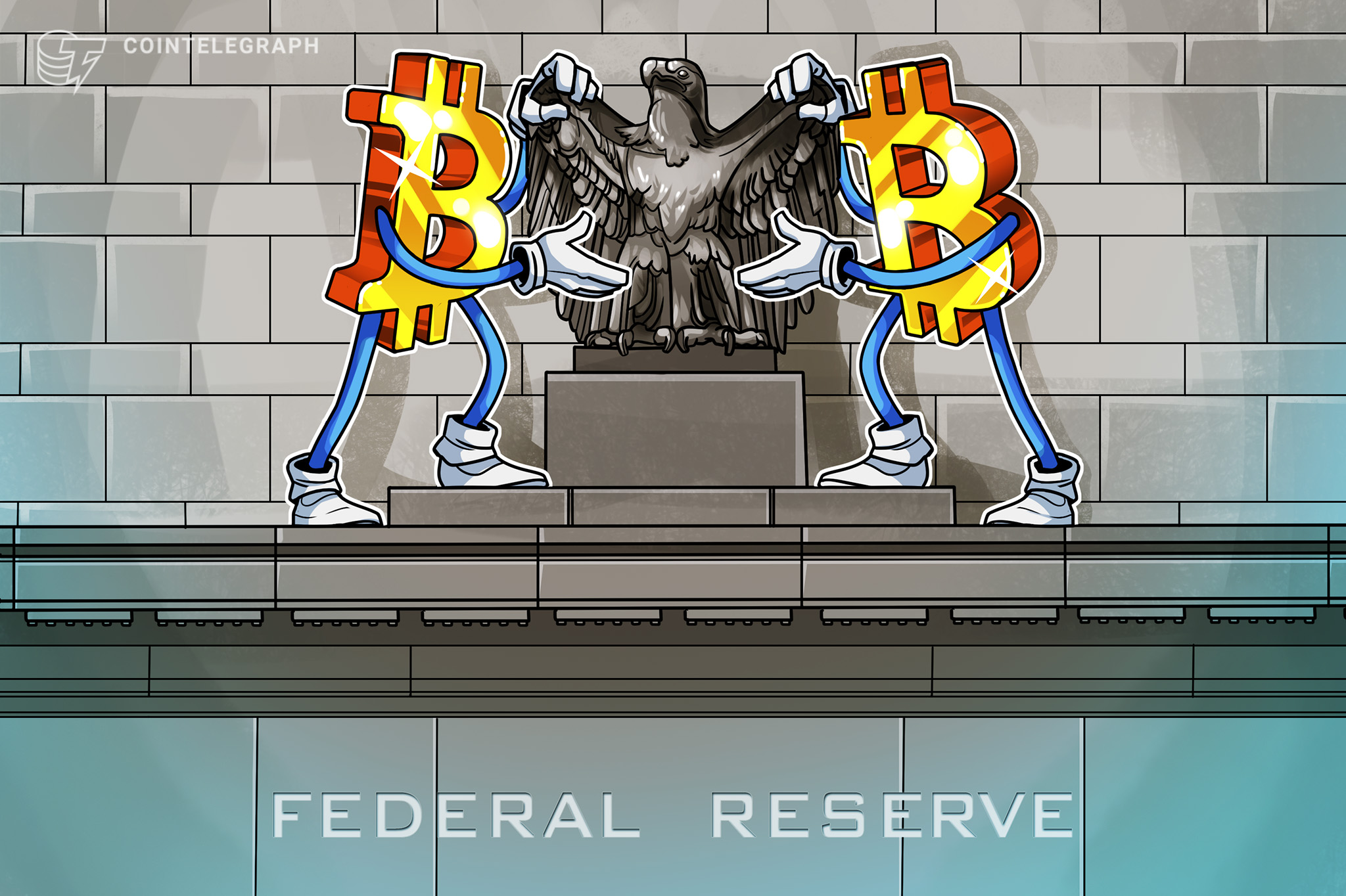
The Federal Reserve held its benchmark policy rate in a range of 3.5% to 3.75% on 17 June 2026, the fourth pause of the calendar year and the first meeting chaired by Kevin Warsh since his confirmation earlier this year. The decision landed at 18:00 UTC, an hour before Chair Warsh's first post-meeting press conference, and it did so against a backdrop that the official statement made no effort to hide: a war in the Middle East that the White House claims is winding down, oil markets that disagree, and a labour picture that is no longer screaming for cuts the way it did a quarter ago. Crypto traders, who had spent the morning pricing in dovish theatrics, spent the afternoon repricing them out.
What looked, on paper, like a non-event — no dot plot, no SEP, no change in the policy rate — is in fact a small but legible signal about who is now steering the world's most consequential central bank. Warsh came into the job publicly committed to the view that the Fed had over-tightened and that policy was restrictive. He leaves his first meeting having held exactly where his predecessor left off. The market's job in the days that follow is to figure out whether that is a tactical pause, a quiet renegotiation with the FOMC's hawks, or something more durable.
A hold dressed as a hold
The Federal Open Market Committee's statement kept the language close to its May template: inflation "remains somewhat elevated," the labour market "moderated," and the Committee "judges that the risks to its dual mandate have moved into better balance over the past year." There was no acknowledgement, in the body of the statement, of the geopolitical event that had been dominating the cable-news cycle all week — the Trump administration's claimed framework for a peace deal with Iran, struck in principle over the weekend and walked back, restated, and partially walked back again in the days since.
That silence was, in itself, a comment. A central bank that wanted to cut into a geopolitical shock would normally have offered at least a sentence about "developments abroad." The Fed did not. Warsh's first press conference is likely to be parsed for whether the omission was a deliberate choice not to validate a White House narrative, or simply the default instinct of an institution that has learned, painfully, that geopolitics and monetary policy make for volatile cocktails.
The rates path implied by overnight index swaps (OIS) before the meeting had priced roughly 18 basis points of cuts by year-end. After the statement, that moved to about 14. The two-year Treasury yield, the most rate-sensitive corner of the curve, drifted four basis points higher. None of that is dramatic. All of it points the same way: a market that came in leaning dovish is leaving a little less so.
The Iran variable that the Fed will not name
The reason crypto cares, and the reason the broader risk-on complex is suddenly paying attention to the dot plot again, is the Iran thread. President Trump's mixed comments on a peace framework over the past 72 hours — by turns declaring a deal "done," softening the language, and warning of consequences if Tehran walks — have done more than just roil the X timelines. They have put a real option on an oil supply shock back into the market.
Brent had been sliding through the spring on the assumption that the Strait of Hormuz story was, for 2026 at least, a story about a closed window that was reopening. That assumption is now more expensive to hold. Energy desks that had cut their tail-risk premiums are rebuilding them. For a Fed trying to thread a soft-landing needle, the difference between Brent at $74 and Brent at $84 is not trivial. It is, in fact, the difference between an inflation print that drifts down to 2.3% in the back half of 2026 and one that gets stuck at 2.7%.
The Fed's official mandate does not extend to commenting on a foreign policy document the President has yet to sign. Warsh did not refer to Iran by name in his public remarks before the meeting. The statement did not mention oil. The press conference may go the same way. But the conditional behind the rate decision has, materially, changed.
Crypto's first read of the new chair
Bitcoin, which had been drifting in the low six figures through the early part of the session, sold off about 1.4% in the hour after the statement, then gave back about half of that move in the subsequent ninety minutes as Warsh's press conference began. The price action is a useful proxy for how the digital-asset complex is starting to model Warsh's preferences: not as a sudden dove, not as a successor to Powell's patient neutrality, but as something harder to script — a chair who arrived in office with a defined view about the cost of restrictiveness and who is choosing, on day one, to test whether the FOMC's hawks will let him act on it.
Ether and the larger-cap alt complex traded with a similar shape: the initial mechanical move lower on the headline, the partial recovery into the presser, the read-through that whatever Warsh thinks privately, he is not going to spend his first meeting burning political capital on a 25-basis-point move the Committee is not ready to deliver. The market is, in plain language, pricing a chair who talks like a cutter and governs like a waiter. Whether that is a posture or a constraint is the question that will define the next two meetings.
The structural read: a central bank that has lost the luxury of disinflation
There is a deeper frame here that the day's tape captures, even if the official statement does not. The era in which the Fed could pivot into a labour-market wobble without paying an inflation premium is, on the evidence of the last six months, over. Wage growth has re-accelerated. Services inflation, ex-shelter, has stopped cooperating. And the energy complex, after a soft spring, is once again capable of delivering a negative supply shock on the back of a single late-night presidential Truth Social post.
The structural argument, in plain editorial prose, is that the post-2022 disinflation was a function of three things — a demand-driven cooldown, a labour-supply rebound from the post-pandemic migration, and an energy complex that had stopped working against the Fed. The first two of those are exhausted. The third has just become contingent on a foreign policy outcome that no one, including the White House, can guarantee. A chair who came in believing policy was too tight is now operating in an environment in which the cost of being wrong is asymmetric. Cutting into a re-acceleration is the kind of mistake that ends careers; holding through a softening labour market is a mistake a chair usually survives.
Warsh is, by background, a market-oriented operator. He knows what a policy error looks like. His first meeting reads, on balance, as a chair choosing survival over conviction — a defensible choice, and one that leaves him the option of cutting in September if the data cooperates and the Iran premium fades. The bear case is that it is a choice that the FOMC, under sustained political pressure from the White House, will not in fact be allowed to keep making for very long.
Stakes, and what the next two months will tell us
The next genuinely informative event on the Fed's calendar is the July meeting, which will be the last before the September decision and the last to be informed by the staff's pre-summer forecast round. By then the market will have either: (a) two more months of the inflation data running roughly consistent with a 2.4%–2.5% path, in which case the September cut is back on the table; (b) a re-acceleration driven by energy, in which case the hold becomes a regime; or (c) a labour market that softens faster than the inflation data, in which case the FOMC will be in the difficult position of having to choose between its mandates.
Crypto's job in the interim is to be a useful, if twitchy, barometer of how each of those paths is being priced. The 1.4% move in the hour after the statement, the half-recovery into the presser, and the drift lower in two-year yields as the press conference continued are the first data points of a new regime. The more interesting data points come in September, when Warsh will have to decide whether to act on what he said he believed, or to keep waiting for a Committee and a world that are no longer making it easy to wait.
Desk note: Monexus treated this as a hold-with-character story — a non-event that is, on closer reading, the first legible signal of a new chair. The wire's instinct was to lead on the headline rate decision; the more useful frame is the gap between what Warsh came in saying and what the Committee let him do on day one. The Iran variable, which the official statement did not name, is doing more work in the market than in the press conference, and that is itself a story.
Wire provenance
This editorial synthesis draws on the following public wire/social posts:
- https://x.com/Polymarket/status/
- https://t.me/CryptoBriefing